Commentary - (2025) Volume 11, Issue 2
Received: 01-Mar-2025, Manuscript No. ldt-25-178406;
Editor assigned: 03-Mar-2025, Pre QC No. P-178406;
Reviewed: 17-Mar-2025, QC No. Q-178406;
Revised: 24-Mar-2025, Manuscript No. R-178406;
Published:
31-Mar-2025
, DOI: 10.37421/2472-1018.2025.11.293
Citation: Rossi, Elena. ”Novel Biomarkers for Early Lung Disease Detection.” J Lung Dis Treat 11 (2025):293.
Copyright: © 2025 Rossi E. This is an open-access article distributed under the terms of the Creative Commons Attribution License, which permits unrestricted use, distribution and reproduction in any medium, provided the original author and source are credited.
The ongoing pursuit of enhanced diagnostic tools for lung diseases has led to significant advancements in the identification of novel biomarkers. These biomarkers are crucial for enabling early detection, which is paramount for improving patient outcomes through timely intervention and treatment [1].
The landscape of lung disease diagnostics is rapidly evolving, moving towards more sensitive and specific methods that can differentiate between benign conditions and early-stage malignancies or other progressive respiratory disorders. The advent of liquid biopsy has revolutionized the approach to early cancer detection, offering minimally invasive methods to identify biomarkers in bodily fluids. This technique holds particular promise for lung cancer, allowing for screening and diagnosis at its earliest, most treatable stages [2].
Beyond cancer, other debilitating lung conditions such as Idiopathic Pulmonary Fibrosis (IPF) are also benefiting from biomarker research. Non-invasive biomarkers, like microRNAs found in serum, are showing potential for early diagnosis and prognosis, aiding in the differentiation of IPF from other interstitial lung diseases [3].
The exploration of breath analysis represents another promising non-invasive avenue for early lung cancer detection. By analyzing volatile organic compounds (VOCs) in exhaled breath, researchers are identifying unique patterns that may serve as early indicators of malignancy, potentially transforming lung cancer screening paradigms [4].
For chronic conditions like Chronic Obstructive Pulmonary Disease (COPD), proteomic analysis is emerging as a powerful tool. Identifying specific protein signatures in sputum and serum can facilitate early diagnosis and help stratify disease severity, leading to more personalized management strategies [5].
Circulating tumor cells (CTCs) are gaining recognition as valuable biomarkers in the context of lung cancer. Their isolation and analysis, though challenging, offer insights into minimal residual disease and can aid in predicting treatment responses, contributing to early detection and monitoring [6].
Genetic and epigenetic alterations in cell-free DNA (cfDNA) present a sophisticated approach to early lung adenocarcinoma detection. Analyzing somatic mutations and DNA methylation patterns in cfDNA can identify disease at its earliest stages with remarkable accuracy [7].
Autoimmune-related lung diseases, often presenting with complex and varied symptoms, can also be targeted by biomarker research. Specific autoantibody profiles are being identified as early warning signs, enabling earlier initiation of treatment for conditions like autoimmune-induced interstitial lung disease [8].
Extracellular vesicles (EVs), which carry a diverse cargo of proteins and nucleic acids, are emerging as a significant class of biomarkers for a range of lung diseases. Their utility spans early detection, disease monitoring, and prediction of therapeutic efficacy [9].
Finally, the integration of artificial intelligence (AI) with traditional biomarker discovery methods is accelerating progress. AI algorithms can process vast and complex datasets, uncovering novel predictive and diagnostic signatures for early lung disease detection and patient stratification, ushering in a new era of precision medicine [10].
The scientific community is actively engaged in developing and validating novel biomarkers for the early identification of a spectrum of lung diseases. This includes a strong focus on molecular, genetic, and imaging markers that can distinguish between benign conditions and early signs of malignancy or other progressive lung disorders, ultimately aiming to improve patient prognosis through timely intervention [1].
A significant area of advancement involves liquid biopsy techniques. These methods leverage circulating tumor DNA (ctDNA) and other biomarkers found in blood or other bodily fluids to detect lung cancer with high sensitivity and specificity at its nascent stages. The synergistic integration of these less invasive techniques with established diagnostic protocols represents a substantial leap forward in personalized lung cancer screening and early detection strategies [2].
Research into non-invasive diagnostic markers extends to chronic and complex lung conditions such as Idiopathic Pulmonary Fibrosis (IPF). Studies are investigating microRNAs (miRNAs) in patient serum as potential biomarkers that can not only aid in the early diagnosis of IPF but also predict its prognosis. Identifying specific miRNA profiles is critical for distinguishing IPF from other interstitial lung diseases and understanding its progression trajectory [3].
Volatile organic compounds (VOCs) present in exhaled breath are being explored for their diagnostic utility in the early detection of lung cancer. This non-invasive breath analysis method offers a unique opportunity to identify specific VOC patterns associated with early-stage lung malignancy, potentially establishing a novel and patient-friendly screening approach [4].
For the early detection and prognostic assessment of Chronic Obstructive Pulmonary Disease (COPD), proteomic analysis is proving to be an invaluable tool. Researchers are examining protein biomarkers found in sputum and serum, aiming to establish specific protein signatures that can facilitate early diagnosis and enable better stratification of disease severity for tailored patient management [5].
Circulating tumor cells (CTCs) are recognized for their potential as biomarkers in the early diagnosis and ongoing monitoring of lung cancer. Despite the technical challenges in isolating and analyzing CTCs, advancements in these areas highlight their role in detecting even minimal residual disease and predicting how patients will respond to therapy, contributing to earlier intervention and better outcomes [6].
The analysis of cell-free DNA (cfDNA) is another sophisticated biomarker strategy for the early detection of lung adenocarcinoma. By examining somatic mutations and DNA methylation patterns within cfDNA, researchers are developing highly accurate methods to identify early-stage lung cancer, offering a promising non-invasive diagnostic pathway [7].
In the realm of autoimmune-related lung diseases, the identification of specific autoantibody profiles is critical for early diagnosis. These autoantibodies can serve as early indicators for conditions like autoimmune-induced interstitial lung disease, paving the way for earlier therapeutic interventions and potentially altering disease progression [8].
Extracellular vesicles (EVs), along with their molecular cargo such as proteins and nucleic acids, are emerging as a significant source of novel biomarkers for a variety of lung diseases. Their application is being explored for early detection, continuous disease monitoring, and the prediction of responses to various treatments [9].
The synergy between artificial intelligence (AI) and biomarker discovery is rapidly transforming the field of lung disease diagnostics. AI algorithms are adept at analyzing complex, multi-modal datasets from genomics, proteomics, and imaging to identify previously undiscovered predictive and diagnostic signatures, thereby enhancing early disease detection and refining patient stratification for more effective treatment strategies [10].
Recent research highlights significant advancements in the early detection of lung diseases through novel biomarker discovery. Innovations include the application of liquid biopsies utilizing circulating tumor DNA, non-invasive breath analysis of volatile organic compounds, and the examination of microRNAs and autoantibodies for conditions like Idiopathic Pulmonary Fibrosis and autoimmune lung diseases. Proteomic analysis is aiding in the early diagnosis and prognosis of COPD, while circulating tumor cells and cell-free DNA analysis are showing promise for early lung cancer detection. Extracellular vesicles and their cargo are also emerging as valuable biomarkers. Furthermore, artificial intelligence is being integrated to analyze complex datasets, accelerating the identification of predictive signatures for early diagnosis and patient stratification across various lung pathologies.
None
None
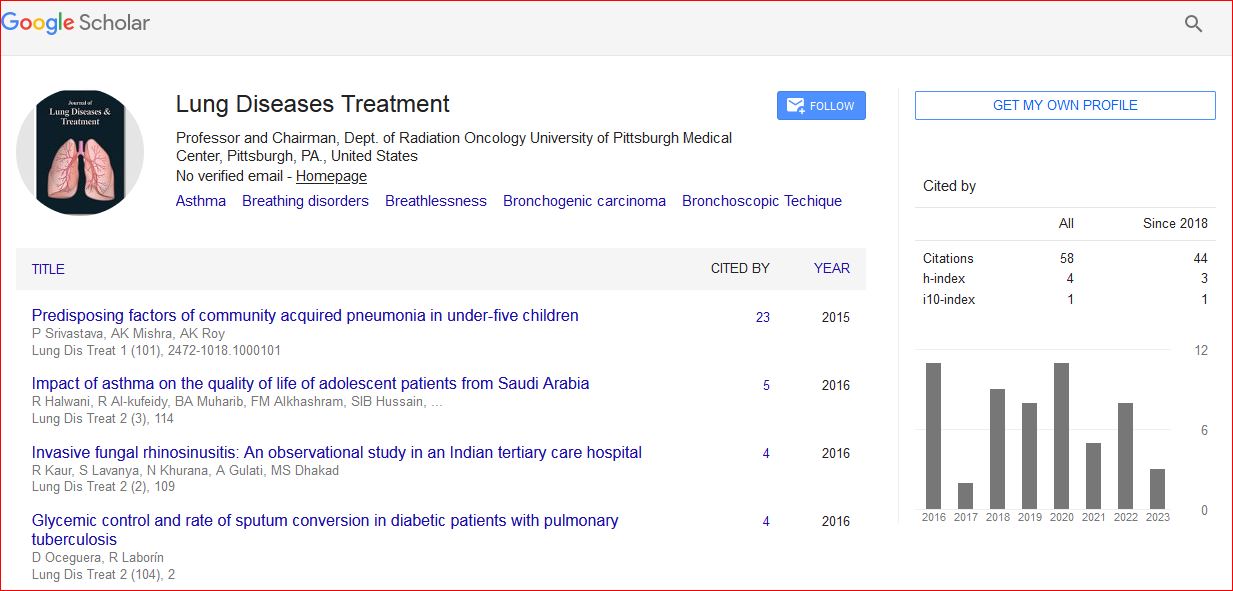
Journal of Lung Diseases & Treatment received 247 citations as per Google Scholar report