Commentary - (2025) Volume 10, Issue 6
Received: 01-Dec-2025, Manuscript No. jomp-26-185133;
Editor assigned: 03-Dec-2025, Pre QC No. P-185133;
Reviewed: 17-Dec-2025, QC No. Q-185133;
Revised: 22-Dec-2025, Manuscript No. R-185133;
Published:
29-Dec-2025
, DOI: 10.37421/2576-3857.2025.10.335
Citation: Williams, Ken. ”Novel Biomarker Panels for Early HCC Detection.” J Oncol Med and Pract 10 (2025):335.
Copyright: © 2025 Williams K. This is an open-access article distributed under the terms of the Creative Commons Attribution License, which permits unrestricted use, distribution and reproduction in any medium, provided the original author and source are credited.
Hepatocellular carcinoma (HCC) remains a significant global health challenge, necessitating advancements in early detection strategies to improve patient outcomes and therapeutic efficacy [1].
The development of novel biomarker panels represents a critical frontier in this endeavor, offering enhanced sensitivity and specificity beyond traditional single-marker approaches [1].
These integrated panels leverage the power of multiple analytes, such as microRNAs, circulating tumor DNA, and specific proteins, to capture the complex molecular signatures of early-stage HCC [1].
Among these promising avenues, circulating microRNAs (miRNAs) have emerged as particularly valuable biomarkers. Found in the bloodstream, specific miRNA signatures can reflect the subtle molecular changes occurring in nascent tumors, making them ideal candidates for non-invasive early diagnosis and prognosis through liquid biopsy technologies [2].
Similarly, cell-free DNA (cfDNA) and circulating tumor DNA (ctDNA) mutations are being investigated for their utility in early HCC diagnosis. The presence and specific mutational profiles within these circulating nucleic acids can serve as sensitive indicators of nascent tumors, complementing existing screening methods and aiding in risk stratification [3].
Protein biomarkers, while historically significant, are also undergoing refinement. While alpha-fetoprotein (AFP) remains a standard, its limitations in early-stage detection are being addressed by developing panels that combine AFP with novel protein candidates to improve diagnostic accuracy and enable earlier intervention [4].
The integration of multi-omics data, encompassing genomics, transcriptomics, and proteomics, offers a more comprehensive approach to biomarker panel development. Analyzing these diverse molecular layers aims to provide a complete picture of early tumorigenesis, leading to more robust and accurate diagnostic tools, often with the aid of artificial intelligence and machine learning [5].
The successful translation of these novel biomarker panels from research findings to routine clinical practice is a crucial step. This involves overcoming hurdles such as regulatory approval, cost-effectiveness, and physician adoption, with prospective validation studies playing a key role [6].
Investigating the synergistic performance of combined biomarkers, such as ctDNA and protein panels, can further enhance early HCC detection, particularly in at-risk populations. The combined insights from these different modalities offer a more sensitive and specific diagnostic approach [7].
Extracellular vesicles (EVs) and their molecular cargo, including miRNAs and proteins, represent another exciting frontier. These vesicles, released by cells, can carry disease-specific information, positioning EV-based diagnostics as a promising non-invasive method for early HCC identification [8].
Current research in circulating tumor DNA (ctDNA) focuses on its application in early diagnosis and monitoring of HCC. Technological advancements have made ctDNA analysis more feasible and accurate, holding the potential to revolutionize HCC screening and management [9].
Finally, the development of multi-analyte panels integrating epigenetic markers with ctDNA is being explored for enhanced early detection. These panels aim to improve sensitivity and specificity, facilitating timely intervention and potentially improving patient survival rates by combining distinct molecular signatures [10].
The critical need for and recent advancements in novel biomarker panels for the early detection of Hepatocellular Carcinoma (HCC) are explored, highlighting how integrating multiple biomarkers like microRNAs, circulating tumor DNA, and specific proteins offers improved sensitivity and specificity compared to single-marker approaches. Early detection is paramount for better patient outcomes and treatment efficacy, and these evolving panels represent a significant step forward in achieving this goal, aiming to move beyond current screening limitations [1].
Circulating microRNAs (miRNAs) are identified as a promising avenue for early HCC detection. This research details the identification and validation of specific miRNA signatures found in the bloodstream, which can reflect the molecular changes occurring in early-stage tumors. The discussion covers the challenges and potential of liquid biopsy technologies for non-invasive diagnosis and prognosis, paving the way for routine clinical application [2].
The utility of cell-free DNA (cfDNA) and circulating tumor DNA (ctDNA) mutations in the early diagnosis of HCC is investigated. The presence and specific mutational profiles within cfDNA/ctDNA can serve as sensitive indicators of nascent tumors. The article reviews current methodologies for ctDNA analysis and their potential to complement existing screening methods, offering a non-invasive tool for risk stratification and early diagnosis [3].
The role of specific protein biomarkers, such as alpha-fetoprotein (AFP) and its isoforms, alongside novel protein candidates, is examined for early HCC detection. While AFP remains a standard, its limitations in sensitivity and specificity for early-stage disease are acknowledged. This research highlights the development of panels combining AFP with emerging proteins to improve diagnostic accuracy and enable earlier intervention [4].
Multi-omics data integration, including genomics, transcriptomics, and proteomics, is discussed for the development of comprehensive biomarker panels for HCC. By analyzing these diverse molecular layers, researchers aim to capture a more complete picture of early tumorigenesis, leading to more robust and accurate diagnostic tools. The article emphasizes the potential of artificial intelligence and machine learning in analyzing such complex datasets [5].
The clinical translation of novel biomarker panels for early HCC detection is examined. This section explores the hurdles in moving from promising research findings to routine clinical practice, including regulatory approval, cost-effectiveness, and physician adoption. Strategies for successful implementation and the importance of prospective validation studies in diverse patient populations are discussed [6].
The performance of combined circulating tumor DNA (ctDNA) and protein biomarker panels is evaluated for enhancing early HCC detection, particularly in at-risk populations. The synergy between ctDNA mutations and specific protein levels offers a more sensitive and specific diagnostic approach than either modality alone, highlighting the potential for a comprehensive liquid biopsy strategy [7].
Extracellular vesicles (EVs) and their cargo, including miRNAs and proteins, are explored as novel biomarkers for early HCC detection. EVs are released by cells and can carry disease-specific molecular information. This research delves into the potential of EV-based diagnostics as a non-invasive method for identifying HCC at its earliest stages, representing a new frontier in early cancer diagnosis [8].
Current trends in circulating tumor DNA (ctDNA) based detection strategies for HCC are reviewed, emphasizing their application in early diagnosis and monitoring. The discussion covers technological advancements that have improved the feasibility and accuracy of ctDNA analysis, highlighting its potential to revolutionize HCC screening and management by detecting minimal residual disease and early recurrence [9].
Finally, the development and validation of a multi-analyte biomarker panel, integrating epigenetic markers with circulating tumor DNA, for enhanced early detection of HCC are presented. This panel aims to improve sensitivity and specificity in identifying individuals with early-stage HCC, thereby facilitating timely intervention and potentially improving patient survival rates, underscoring the advantage of combining different molecular signatures [10].
This collection of research focuses on advancing the early detection of Hepatocellular Carcinoma (HCC) through novel biomarker panels. Studies explore the integration of multiple biomarkers, including microRNAs, circulating tumor DNA (ctDNA), and proteins, to enhance diagnostic sensitivity and specificity beyond single-marker approaches. Promising strategies involve analyzing circulating miRNAs and ctDNA mutations, as well as refining protein panels by combining traditional markers like AFP with new candidates. Multi-omics data integration and the role of extracellular vesicles (EVs) are also highlighted as key areas for developing comprehensive diagnostic tools. The challenges and strategies for clinical translation of these biomarker panels are addressed, emphasizing the need for prospective validation and overcoming regulatory and adoption hurdles. Ultimately, these efforts aim to facilitate earlier intervention, improve patient outcomes, and revolutionize HCC screening and management.
None
None
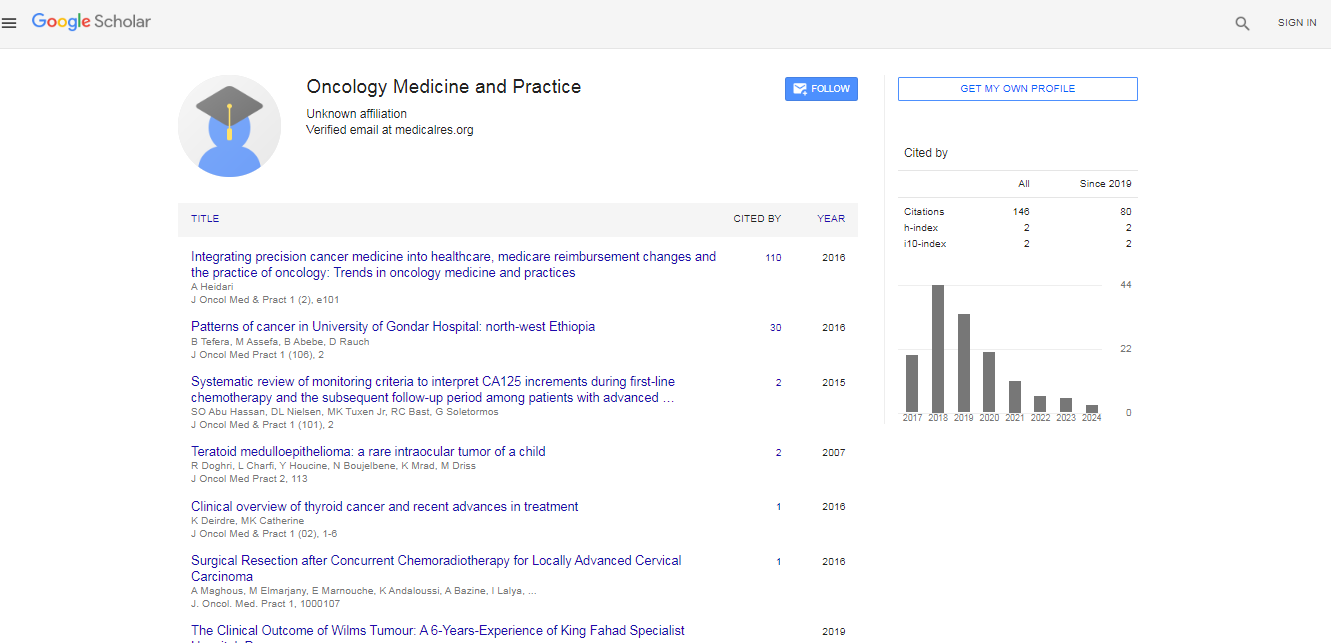
Journal of Oncology Medicine & Practice received 142 citations as per Google Scholar report