Opinion - (2025) Volume 15, Issue 5
Received: 01-Sep-2025, Manuscript No. jnt-26-178962;
Editor assigned: 03-Sep-2025, Pre QC No. P-178962;
Reviewed: 17-Sep-2025, QC No. Q-178962;
Revised: 22-Sep-2025, Manuscript No. R-178962;
Published:
29-Sep-2025
, DOI: 10.37421/2161-0959.2025.15.584
Citation: Fujimura, Naoko. ”Novel Anti-Fibrotic Therapies For Chronic Kidney Disease.” J Nephrol Ther 15 (2025):584.
Copyright: © 2025 Fujimura N. This is an open-access article distributed under the terms of the Creative Commons Attribution License, which permits unrestricted use, distribution and reproduction in any medium, provided the original author and source are credited.
Chronic kidney disease (CKD) is increasingly understood as a condition driven by progressive fibrosis, a pathological process that significantly contributes to organ damage. Current therapeutic approaches for CKD primarily focus on managing the underlying conditions and slowing the progression of the disease, highlighting a substantial unmet need for treatments that can directly target and potentially reverse established fibrotic changes. The scientific community is witnessing exciting advancements in this domain, with novel therapeutic agents being developed to target various molecular pathways that inhibit myofibroblast activation, reduce the excessive deposition of extracellular matrix (ECM), and promote its degradation. Promising strategies are exploring interventions in the transforming growth factor-beta (TGF-β) pathway, the inhibition of specific enzymes critical for collagen synthesis and remodeling, and the modulation of inflammatory responses that are known contributors to fibrogenesis. The successful development of these novel anti-fibrotic therapies holds the profound potential to fundamentally alter the management of CKD, offering the prospect of not merely slowing but possibly reversing the kidney damage associated with this condition [1].
The profibrotic cytokine transforming growth factor-beta (TGF-β) stands out as a central mediator in the complex pathogenesis of CKD. For a considerable period, the inhibition of TGF-β signaling has been a primary therapeutic target in research. However, significant challenges persist in effectively and safely modulating this critical pathway. Contemporary research efforts are increasingly concentrating on achieving more precise interventions within this pathway, for instance, by targeting specific downstream effectors or by developing agents that can counteract the effects of TGF-β without inducing broad immunosuppression. A comprehensive understanding of the intricate interactions between TGF-β and other fibrogenic factors is considered paramount for the successful development of effective and safe TGF-β-targeted therapies for CKD [2].
Fibroblast activation and their subsequent differentiation into myofibroblasts represent critical cellular events in the cascade of kidney fibrosis. Therefore, targeting this specific cellular process is emerging as a highly promising therapeutic strategy. Current research is actively investigating agents designed to inhibit myofibroblast proliferation, induce their apoptosis, or facilitate their reversion to a less active cellular state. This investigative landscape includes the exploration of novel small molecules and biological agents that can interfere with well-established signaling pathways known to drive myofibroblast differentiation, such as platelet-derived growth factor (PDGF) and integrin signaling pathways [3].
The accumulation of extracellular matrix (ECM) is universally recognized as the hallmark characteristic of fibrosis across various organs, including the kidney. Consequently, therapies specifically aimed at reducing ECM deposition or enhancing its degradation are undergoing rigorous investigation. This research encompasses the exploration of inhibitors for collagen synthesis enzymes, such as lysyl oxidases (LOX), and the development of agents that can promote the activity of matrix metalloproteinases (MMPs), which are essential for ECM breakdown. Achieving a delicate balance between ECM production and degradation is deemed crucial for effectively preventing and potentially reversing the fibrotic scarring that impairs kidney function [4].
Inflammation is recognized as a significant contributor, playing a substantial role in both the initiation and propagation of kidney fibrosis. Consequently, targeting inflammatory pathways that actively promote fibrogenesis presents a viable and attractive therapeutic approach. Current research is actively examining the efficacy of various anti-inflammatory agents with the goal of suppressing the activation of immune cells and reducing the release of pro-fibrotic cytokines from these cells. This indirect modulation of the fibrotic process in CKD holds considerable therapeutic promise [5].
The repurposing of existing drugs for anti-fibrotic effects in CKD represents an exceptionally attractive strategy, primarily due to the well-established safety profiles of these already approved medications. A diverse array of drugs approved for other medical conditions are currently being investigated for their potential to mitigate kidney fibrosis. This includes certain statins, angiotensin-converting enzyme (ACE) inhibitors, and mineralocorticoid receptor antagonists, all of which have demonstrated pleiotropic effects extending beyond their primary therapeutic indications. While early findings suggest potential benefits, further extensive clinical validation remains imperative [6].
The role of cellular senescence in driving the fibrotic process is increasingly capturing the attention of the scientific community. Senescent cells, characterized by their irreversible cell cycle arrest, tend to accumulate within fibrotic tissues. These cells secrete a characteristic senescence-associated secretory phenotype (SASP), which actively promotes inflammation and ECM remodeling, thereby exacerbating fibrosis. The development of senolytic drugs, designed to selectively eliminate senescent cells, or senomorphic drugs, aimed at inhibiting the SASP, could offer a novel and promising therapeutic avenue for treating kidney fibrosis [7].
Emerging therapeutic targets also include various factors involved in cellular metabolism that are frequently found to be dysregulated in the context of fibrosis. For instance, alterations in lipid metabolism and mitochondrial dysfunction are implicated in promoting myofibroblast activation and enhancing ECM production. Consequently, investigating therapeutic agents that can effectively restore metabolic homeostasis within kidney cells is a promising avenue that may yield beneficial outcomes for patients with kidney fibrosis [8].
The extracellular matrix (ECM) itself is no longer viewed as a passive structural scaffold but rather as an active participant in the fibrotic process. Consequently, a significant focus of current research is dedicated to understanding how to modulate ECM composition and stiffness. This includes exploring strategies designed to enhance matrix remodeling and potentially target specific ECM components that are believed to contribute to the overall fibrotic phenotype within the kidney [9].
The intricate influence of the gut microbiome on kidney disease, including the development of fibrosis, is an area of intense and burgeoning investigation. It is now understood that gut dysbiosis can lead to heightened inflammation and an increased production of uremic toxins, both of which are known promoters of fibrogenesis. Therefore, therapeutic interventions aimed at modulating the gut microbiota, such as the administration of probiotics or the application of fecal microbiota transplantation, are being actively explored as novel anti-fibrotic strategies for managing CKD [10].
Chronic kidney disease (CKD) is characterized by progressive fibrosis, a key pathological process driving organ damage. Current treatments focus on managing underlying causes and slowing progression, leaving a significant unmet need for therapies that directly reverse established fibrosis. Exciting advancements are underway, with novel agents targeting various pathways to inhibit myofibroblast activation, reduce extracellular matrix (ECM) deposition, and promote matrix degradation. Strategies include targeting the TGF-β pathway, inhibiting specific enzymes in collagen synthesis and remodeling, and modulating inflammatory responses contributing to fibrogenesis. The development of these novel anti-fibrotic therapies could revolutionize CKD management by offering a way to potentially reverse kidney damage [1].
The profibrotic cytokine transforming growth factor-beta (TGF-β) is a central mediator in CKD pathogenesis. Inhibiting TGF-β signaling has long been a therapeutic target, but challenges remain. Recent research focuses on more precise modulation of this pathway, such as targeting specific downstream effectors or developing agents that counteract TGF-β effects without broad immunosuppression. Understanding the complex interactions between TGF-β and other fibrogenic factors is crucial for developing effective and safe TGF-β-targeted therapies for CKD [2].
Fibroblast activation and differentiation into myofibroblasts are critical steps in kidney fibrosis, making this cellular process a promising therapeutic target. Research is exploring agents to inhibit myofibroblast proliferation, promote apoptosis, or revert them to a less active state. This includes investigating novel small molecules and biologics that interfere with signaling pathways known to drive myofibroblast differentiation, such as PDGF and integrin signaling [3].
Extracellular matrix (ECM) accumulation is the hallmark of fibrosis. Therapies aimed at reducing ECM deposition or enhancing its degradation are under investigation. This includes exploring inhibitors of collagen synthesis enzymes, like lysyl oxidases (LOX), and agents that promote matrix metalloproteinase (MMP) activity involved in ECM breakdown. Balancing ECM production and degradation is crucial for preventing and potentially reversing fibrotic scarring in the kidney [4].
Inflammation plays a significant role in initiating and propagating kidney fibrosis. Targeting inflammatory pathways that promote fibrogenesis is a viable therapeutic approach. Research is examining the efficacy of anti-inflammatory agents that can suppress immune cell activation and reduce the release of pro-fibrotic cytokines, thereby indirectly hindering the fibrotic process in CKD [5].
Repurposing existing drugs for anti-fibrotic effects in CKD is an attractive strategy due to their established safety profiles. Several drugs approved for other conditions are being investigated for their ability to mitigate kidney fibrosis, including certain statins, ACE inhibitors, and mineralocorticoid receptor antagonists, which have shown pleiotropic effects. Early findings suggest potential benefits, but further clinical validation is needed [6].
Cellular senescence's role in driving fibrosis is gaining attention. Senescent cells accumulate in fibrotic tissues and secrete a senescence-associated secretory phenotype (SASP) that promotes inflammation and ECM remodeling. Developing senolytic drugs that selectively eliminate senescent cells or senomorphic drugs that inhibit the SASP could offer a novel approach to treating kidney fibrosis [7].
Emerging therapeutic targets include factors involved in cellular metabolism that are dysregulated in fibrosis. For instance, altered lipid metabolism and mitochondrial dysfunction can contribute to myofibroblast activation and ECM production. Investigating agents that can restore metabolic homeostasis within kidney cells may prove beneficial [8].
The extracellular matrix itself is not just a passive scaffold but an active participant in fibrosis. Understanding how to modulate matrix composition and stiffness is a focus of research. This includes exploring strategies to enhance matrix remodeling and potentially target specific ECM components that contribute to the fibrotic phenotype [9].
The gut microbiome's influence on kidney disease, including fibrosis, is an area of intense investigation. Dysbiosis can lead to increased inflammation and production of uremic toxins that promote fibrogenesis. Therapeutic interventions aimed at modulating the gut microbiota, such as probiotics or fecal microbiota transplantation, are being explored as novel anti-fibrotic strategies in CKD [10].
Chronic kidney disease (CKD) is characterized by progressive fibrosis, and current treatments have limitations in reversing this damage. Significant research is focused on developing novel anti-fibrotic therapies. These therapies aim to target key pathways involved in fibrosis, including inhibiting myofibroblast activation, reducing extracellular matrix deposition, and modulating inflammatory responses. Specific strategies involve targeting the TGF-β pathway, enzymes critical for collagen synthesis, and cellular senescence. Additionally, researchers are exploring the potential of repurposing existing drugs, modulating cellular metabolism, and targeting the extracellular matrix itself. The influence of the gut microbiome on kidney fibrosis is also a growing area of investigation, with interventions like probiotics and fecal microbiota transplantation being explored. The ultimate goal is to develop treatments that can not only slow but potentially reverse kidney damage caused by fibrosis.
None
None
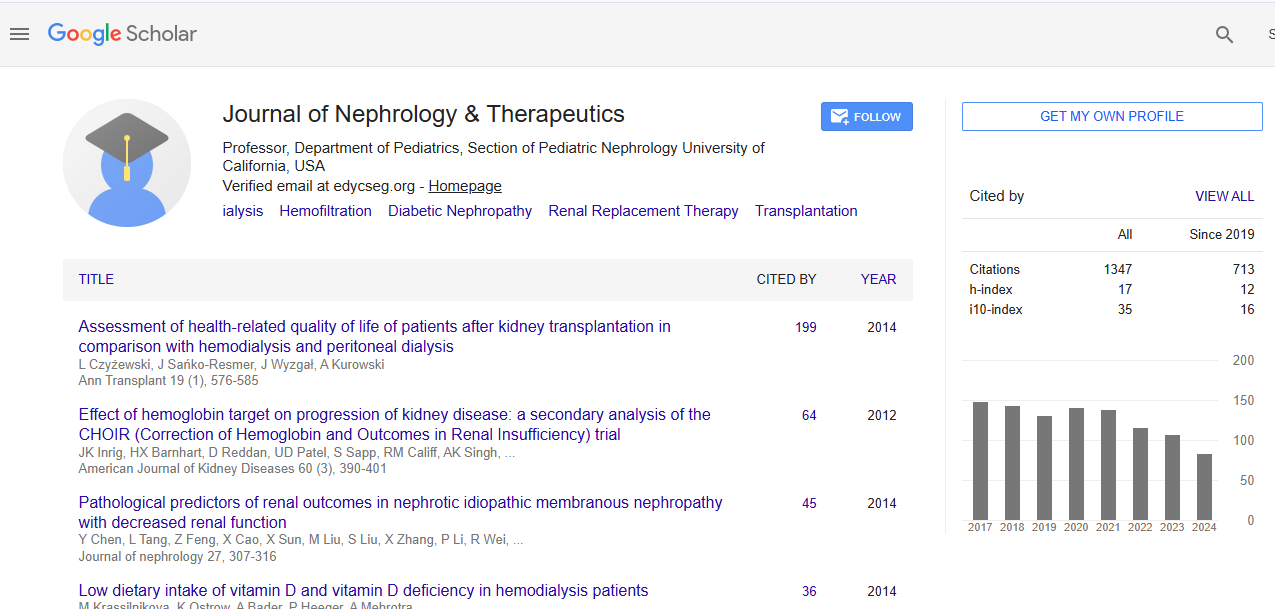
Journal of Nephrology & Therapeutics received 784 citations as per Google Scholar report