Commentary - (2025) Volume 9, Issue 3
Received: 01-Jun-2025, Manuscript No. jcre-26-187189;
Editor assigned: 03-Jun-2025, Pre QC No. P-187189;
Reviewed: 17-Jun-2025, QC No. Q-187189;
Revised: 22-Jun-2025, Manuscript No. R-187189;
Published:
29-Jun-2025
, DOI: 10.37421/2795-6172.2025.9.300
Citation: Hassan, Zainab. ”Novel Anticoagulant for Atrial Fibrillation: A Comprehensive Review.” J Clin Res 09 (2025):300.
Copyright: © 2025 Hassan Z. This is an open-access article distributed under the terms of the Creative Commons Attribution License, which permits unrestricted use, distribution and reproduction in any medium, provided the original author and source are credited.
This collection of research articles addresses the multifaceted evaluation of a novel oral anticoagulant designed for patients diagnosed with atrial fibrillation. The primary objective across these studies is to thoroughly assess the efficacy and safety profile of this new therapeutic agent, critically comparing its performance against established treatments and standards of care. Understanding the nuances of its mechanism of action, its impact on preventing thromboembolic events, and crucially, its adverse event profile, particularly concerning bleeding risks, forms the bedrock of this research. The meticulous design of these clinical trials, including detailed patient population characteristics and robust statistical analyses, is central to deriving meaningful implications for current clinical practice and future therapeutic strategies. The research delves into Phase 3 clinical trials that are specifically investigating the effectiveness of this novel anticoagulant in mitigating the incidence of stroke and systemic embolism among individuals with non-valvular atrial fibrillation. These pivotal studies likely involve direct comparisons with existing treatments, such as warfarin or other direct oral anticoagulants (DOACs), to establish superiority or non-inferiority. The outcomes measured are paramount, encompassing primary efficacy endpoints like stroke incidence and vital secondary endpoints such as the frequency and severity of major bleeding events. Furthermore, the detailed patient demographics and the precise inclusion and exclusion criteria employed are indispensable for discerning the generalizability and applicability of the study findings to broader patient populations. A significant area of investigation within this body of work pertains to the pharmacokinetic and pharmacodynamic properties of the novel anticoagulant. These studies meticulously examine how the drug is absorbed, distributed, metabolized, and excreted within the body, correlating drug concentrations in the bloodstream with its anticoagulant effect. Such insights are fundamental for optimizing dosing regimens, ensuring therapeutic efficacy, and proactively managing potential drug-drug interactions. This understanding is particularly critical in patient cohorts exhibiting varying degrees of renal or hepatic impairment, where drug clearance and metabolism may be significantly altered, necessitating tailored therapeutic approaches. Further research explores the potential benefits and risks of the novel anticoagulant through detailed subgroup analyses of clinical trial data. These investigations are designed to scrutinize the drug's performance within specific patient demographics, such as elderly individuals, those with compromised renal function, or patients with a prior history of stroke. Such granular analyses are essential for understanding whether the observed treatment benefits and associated risks are consistent across diverse patient profiles. This information directly informs personalized treatment decisions, allowing clinicians to tailor anticoagulant therapy to the unique characteristics and vulnerabilities of individual patients. The critical aspect of bleeding events associated with anticoagulant therapy is a central theme, with dedicated research focusing on the bleeding risk profile of this novel agent. These studies meticulously document the incidence of various bleeding complications, ranging from major hemorrhages to clinically relevant non-major bleeding episodes. By comparing these rates against those observed with existing anticoagulants, a clear picture of the new drug's safety emerges. Identifying predictive factors for bleeding risk and outlining effective strategies for managing such complications are key objectives, contributing significantly to the safe implementation of this therapy. Beyond purely clinical endpoints, a growing emphasis is placed on patient-reported outcomes and the impact of the novel anticoagulant on patients' quality of life. Research in this domain employs validated instruments to assess symptom burden, functional status, and overall well-being, thereby providing a patient-centered perspective on the treatment's value. The potential for improved convenience, such as less frequent monitoring requirements compared to older anticoagulants like warfarin, may also be highlighted, contributing to enhanced patient adherence and satisfaction. This holistic approach complements traditional efficacy and safety measures. The economic implications of adopting this novel anticoagulant are also explored through rigorous cost-effectiveness analyses. These studies evaluate the financial impact of using the new drug in the management of atrial fibrillation, meticulously considering direct treatment costs, patterns of healthcare resource utilization, and the downstream economic benefits derived from successful stroke prevention. Such analyses are vital for informing healthcare policy, guiding formulary decisions, and ensuring that new therapies offer value within the broader healthcare system. Furthermore, the management of major bleeding events, a significant concern with any anticoagulant, is specifically addressed. Research in this area likely outlines recommended reversal strategies and supportive care measures tailored to this particular novel agent. The aim is to provide clear guidance for clinicians to effectively mitigate the morbidity and mortality associated with bleeding complications, thereby enhancing patient safety and confidence in the treatment. Long-term data on both the efficacy and safety of the novel anticoagulant are crucial for understanding its sustained utility. Publications focusing on extended follow-up periods from clinical trials assess the durability of therapeutic benefits and identify any late-emerging safety concerns. This longitudinal data is indispensable for real-world clinical decision-making, allowing healthcare providers to make informed choices about long-term anticoagulant management and to appreciate the drug's profile over prolonged periods of use. Finally, direct comparative studies, often referred to as head-to-head trials, are presented, pitting the novel anticoagulant against other existing direct oral anticoagulants. These trials provide invaluable comparative data on efficacy, safety, and potentially patient preferences, offering clinicians critical insights to differentiate between various DOAC options. This allows for more precise and individualized selection of anticoagulant therapy based on specific patient needs, comorbidities, and risk profiles.
The efficacy and safety of a novel oral anticoagulant for patients with atrial fibrillation are rigorously examined in a randomized controlled trial, focusing on its performance relative to existing treatments. Key insights are derived from its effectiveness in preventing thromboembolic events and its safety profile, particularly regarding bleeding risks. The study's design, patient characteristics, and statistical methodologies are fundamental to understanding its clinical implications. A Phase 3 trial detailed herein investigates the novel anticoagulant's capacity to reduce stroke and systemic embolism in individuals with non-valvular atrial fibrillation. This research likely contrasts the new drug with standard-of-care options, measuring primary endpoints such as stroke incidence and secondary endpoints including major bleeding events. The patient demographics and inclusion/exclusion criteria are crucial for assessing the generalizability of the findings. Pharmacokinetic and pharmacodynamic properties of the novel anticoagulant are explored in patients with atrial fibrillation, examining absorption, distribution, metabolism, and excretion, and relating blood concentration to anticoagulant effect. Understanding these parameters is vital for establishing optimal dosing regimens and managing potential drug interactions, especially in patients with compromised renal or hepatic function. Subgroup analyses of a clinical trial for the novel anticoagulant in atrial fibrillation patients are reported, likely focusing on specific patient groups such as the elderly or those with renal impairment. These analyses are important for determining if treatment benefits and risks are consistent across diverse patient profiles, thereby informing personalized treatment decisions. This publication addresses the bleeding risk profile of the novel oral anticoagulant in patients with atrial fibrillation, detailing the incidence of various bleeding types and comparing these rates to existing anticoagulants. Identification of factors predicting bleeding risk and strategies for bleeding management are critical components of this research. The research explores patient-reported outcomes and quality of life associated with treatment using the novel anticoagulant for atrial fibrillation. This includes assessments of symptoms, functional status, and overall well-being, providing a patient-centered perspective on the drug's benefits beyond clinical endpoints. Convenience of administration and reduced monitoring may be highlighted. A cost-effectiveness analysis of the novel anticoagulant for stroke prevention in atrial fibrillation is presented. This study analyzes the economic impact, considering treatment costs, healthcare resource utilization, and outcomes such as stroke prevention, which is crucial for informing healthcare policy and formulary decisions. This research investigates the management of major bleeding events in patients taking the novel anticoagulant for atrial fibrillation. It outlines specific reversal strategies or supportive care measures for this agent, aiming to minimize morbidity and mortality from bleeding complications. Long-term efficacy and safety data from the clinical trial of the novel anticoagulant in atrial fibrillation are updated, extending follow-up to assess sustained benefits and potential late-emerging safety concerns. This information is vital for real-world clinical decision-making and understanding the drug's profile over extended use. A head-to-head comparison of the novel oral anticoagulant versus another DOAC in patients with atrial fibrillation is likely presented. This study provides direct comparative data on efficacy, safety, and potentially patient preference, aiding clinicians in choosing between different DOAC options based on specific patient needs.
This comprehensive review examines a novel oral anticoagulant for atrial fibrillation patients, covering its efficacy in preventing thromboembolic events and its safety profile, particularly bleeding risks. The research includes detailed pharmacokinetic and pharmacodynamic studies, subgroup analyses for personalized treatment, and assessments of patient-reported outcomes and quality of life. Cost-effectiveness and strategies for managing bleeding complications are also addressed, alongside long-term data and direct comparisons with existing direct oral anticoagulants. The overall aim is to provide a thorough understanding of this new therapeutic option for clinical practice.
None
None
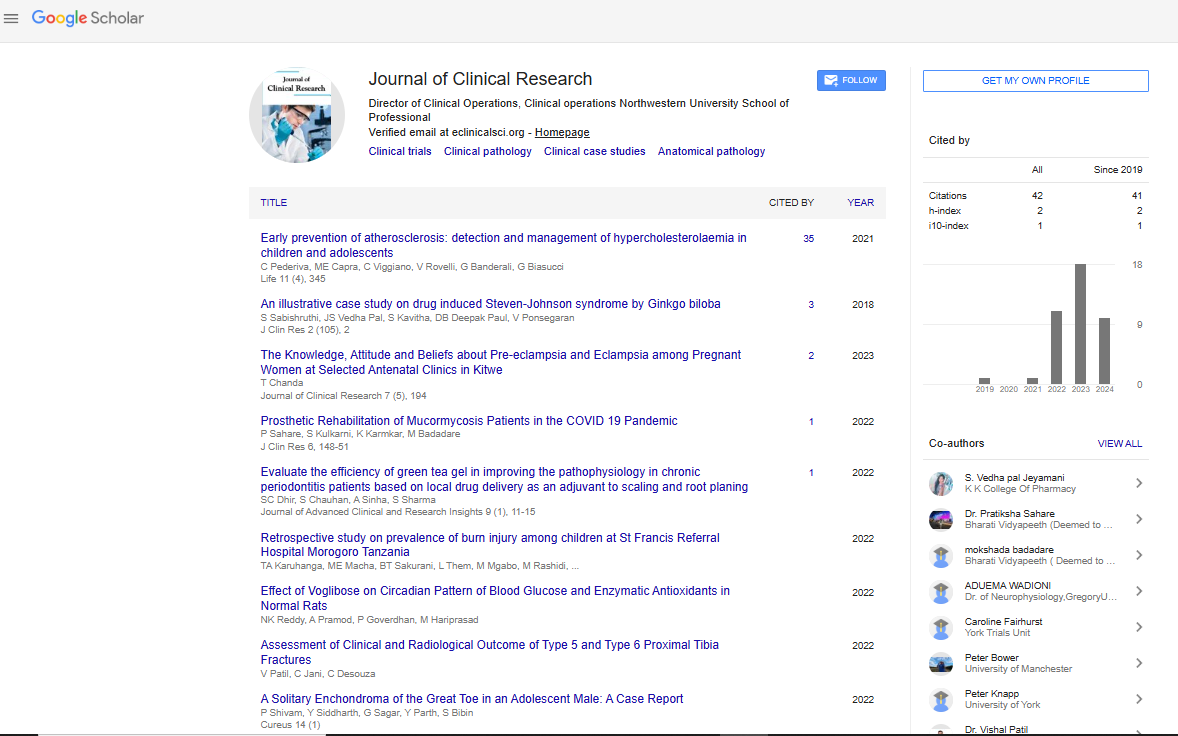
Journal of Clinical Research received 11 citations as per Google Scholar report