Short Communication - (2025) Volume 16, Issue 3
Received: 01-May-2025, Manuscript No. jpm-26-179419;
Editor assigned: 05-May-2025, Pre QC No. P-179419;
Reviewed: 19-May-2025, QC No. Q-179419;
Revised: 22-May-2025, Manuscript No. R-179419;
Published:
29-May-2025
, DOI: 10.37421/2090-0902.2025.16.539
Citation: Haddad, Yara. ”Nonlinear Dynamics: Optical Systems, Lasers and Applications.” J Phys Math 16 (2025):539.
Copyright: © 2025 Haddad Y. This is an open-access article distributed under the terms of the Creative Commons Attribution License, which permits unrestricted use, distribution and reproduction in any medium, provided the original author and source are credited.
The field of nonlinear dynamics in optical and laser systems is a vibrant area of research, offering profound insights into the complex behaviors that emerge from simple underlying principles. These nonlinearities are not merely academic curiosities but play a critical role in shaping the performance and capabilities of modern optical devices. This article delves into these intricate dynamics, exploring how phenomena such as chaos, bifurcations, and pattern formation arise, significantly impacting laser performance and optical signal processing. Understanding these nonlinear behaviors is paramount for designing more stable and efficient optical devices, with researchers employing sophisticated experimental techniques to probe and control these dynamics across various systems. Optical cavities represent a fundamental component where nonlinear interactions can lead to remarkably complex temporal and spectral dynamics. Theoretical models and numerical simulations have been instrumental in revealing how processes like gain saturation and nonlinear dispersion contribute to a rich variety of states. These states, including pulsing and the generation of frequency combs, are crucial for advancements in high-precision spectroscopy and optical communications. The study of these dynamics within optical cavities underscores the importance of nonlinear interactions for unlocking new functionalities. Extreme events, such as optical rogue waves, represent a significant challenge and an active research area within laser systems. This research outlines the mechanisms responsible for their generation, often linked to modulational instability and nonlinear interactions within the gain medium. The implications of these extreme events for the reliability and performance of optical systems are substantial. Consequently, methods for their prediction and mitigation are actively being developed, aiming to enhance system robustness. The interaction of light with nonlinear optical materials gives rise to a fascinating array of complex dynamics. Phenomena like Kerr nonlinearity and self-focusing are capable of inducing intricate spatial patterns and sophisticated temporal pulse shaping. The role of these nonlinear effects is pivotal in enabling advanced optical functionalities, including optical switching and pulse compression, pushing the boundaries of what is possible in optical processing. Quantum effects introduce another layer of complexity to the nonlinear dynamics of lasers. Quantum noise and nonlinear interactions work in tandem to influence spontaneous emission and mode competition, thereby affecting the overall laser output. At low light levels, a quantum description becomes indispensable for a comprehensive understanding of certain nonlinear phenomena, highlighting the interplay between quantum mechanics and nonlinear optics. Synchronization phenomena in coupled nonlinear optical systems, such as arrays of lasers or nonlinear waveguides, offer unique avenues for collective behavior. The interplay between coupling strength and individual system nonlinearities dictates the emergence of synchronized oscillations or complex spatio-temporal patterns. These findings hold significant promise for the development of advanced optical communication networks and sophisticated information processing architectures. Solitons in nonlinear optical fibers are a cornerstone of modern optical communication, representing stable, self-reinforcing wave packets. Their dynamics are governed by a delicate balance between nonlinearities, such as the Kerr effect, and chromatic dispersion. Understanding these dynamics is essential for enabling high-speed data transmission and exploring phenomena like soliton fission and fusion. Chaotic dynamics can arise in lasers when subjected to external feedback, a scenario frequently encountered in practical applications. This can lead to complex and often unpredictable output behavior. Identifying key parameters that drive the system into chaotic regimes and developing methods for characterizing and controlling this chaos are crucial for applications ranging from secure communication to random number generation. Plasmonic nanostructures exhibit a remarkable nonlinear optical response, largely due to their ability to strongly enhance light-matter interactions. Nonlinear effects, including harmonic generation and nonlinear absorption, are significantly modulated by localized surface plasmon resonances. This opens up exciting possibilities for applications in sensing and nonlinear optics at the nanoscale, leveraging the unique properties of plasmonic materials. The exploration of squeezed states of light within nonlinear optical systems delves into the quantum nature of light. Nonlinear interactions play a crucial role in modifying these quantum properties, leading to the generation of non-classical states with intrinsically reduced noise. These nonlinear quantum effects are fundamental to advancements in precision measurements and the development of robust quantum information processing protocols.
The intricate nonlinear dynamics observed in optical and laser systems are thoroughly examined, with a particular focus on phenomena like chaos, bifurcations, and pattern formation. These emergent behaviors, stemming from simple underlying equations, have a profound impact on laser performance and optical signal processing. The research underscores the critical importance of comprehending these nonlinear behaviors for the development of more stable and efficient optical devices, and it also touches upon the experimental methodologies employed to investigate and manage these dynamics. [1] Investigations into optical cavities reveal the emergence of complex temporal and spectral dynamics driven by nonlinear interactions. Through the utilization of theoretical models and numerical simulations, the study elucidates how factors such as gain saturation and nonlinear dispersion give rise to a diverse array of states, including pulsing and frequency combs. The authors emphasize that a deep understanding of these nonlinear effects is indispensable for applications in high-precision spectroscopy and optical communications. [2] The research delves into the nonlinear behavior of optical rogue waves within various laser systems, outlining the underlying mechanisms responsible for their generation. These mechanisms are frequently linked to modulational instability and nonlinear interactions within the gain medium. The paper critically discusses the ramifications of these extreme events on the reliability and performance of optical systems, and it proposes methods for their anticipation and mitigation. [3] This paper scrutinizes the complex dynamics that arise from the interplay between light and nonlinear optical materials. It provides a detailed account of how phenomena such as Kerr nonlinearity and self-focusing can precipitate intricate spatial patterns and sophisticated temporal pulse shaping. The authors highlight the pivotal role of these nonlinear effects in facilitating advanced optical functionalities, such as optical switching and pulse compression. [4] The study investigates the influence of quantum effects on the nonlinear dynamics of lasers. It elaborates on how quantum noise and nonlinear interactions contribute to spontaneous emission and mode competition, consequently affecting the laser output. The research emphasizes the necessity of quantum descriptions for a thorough understanding of certain nonlinear phenomena, particularly in scenarios involving low light levels. [5] The research concentrates on the synchronization phenomena observed in coupled nonlinear optical systems, including arrays of lasers and nonlinear waveguides. It explores how the collective behavior is governed by the coupling strength and the nonlinearities present in individual systems, leading to synchronized oscillations or intricate spatio-temporal patterns. These findings have significant implications for the advancement of optical communication networks and information processing technologies. [6] This paper examines the dynamics of solitons in nonlinear optical fibers, a fundamental aspect of modern optical communication systems. It investigates how nonlinearities, notably the Kerr effect and chromatic dispersion, contribute to the shaping and preservation of these solitary waves, which is crucial for enabling high-speed data transmission. The study also addresses the emergence of complex phenomena like soliton fission and fusion. [7] The article provides an analysis of chaotic dynamics in lasers that are equipped with external feedback, a scenario commonly encountered and capable of producing complex and unpredictable output. It identifies the key parameters that drive the system into chaotic regimes and discusses methodologies for both characterizing and controlling this chaos. Potential applications in secure communication and random number generation are also explored. [8] This research investigates the nonlinear optical response of plasmonic nanostructures, with a specific emphasis on their capacity to amplify light-matter interactions. It scrutinizes how nonlinear effects, such as harmonic generation and nonlinear absorption, are influenced by the phenomenon of localized surface plasmon resonance. The study suggests potential applications in the fields of sensing and nonlinear optics at the nanoscale. [9] The paper explores the dynamics of squeezed states of light when subjected to nonlinear optical systems. It analyzes the manner in which nonlinear interactions modify the quantum properties of light, resulting in the generation of non-classical states characterized by reduced noise levels. This research highlights the importance of these nonlinear quantum effects for achieving high-precision measurements and advancing quantum information processing. [10]
This collection of research papers explores the multifaceted world of nonlinear dynamics in optical and laser systems. Various studies investigate phenomena such as chaos, bifurcations, rogue waves, and soliton dynamics, highlighting their impact on laser performance and optical signal processing. The role of nonlinear interactions in optical cavities, coupled systems, and with nonlinear materials is examined, along with the influence of quantum effects and plasmonic nanostructures. Key applications in spectroscopy, communication, sensing, and quantum information processing are discussed, emphasizing the necessity of understanding these complex behaviors for technological advancement. The research also touches upon methods for predicting and controlling nonlinear phenomena to enhance system stability and efficiency.
None
None
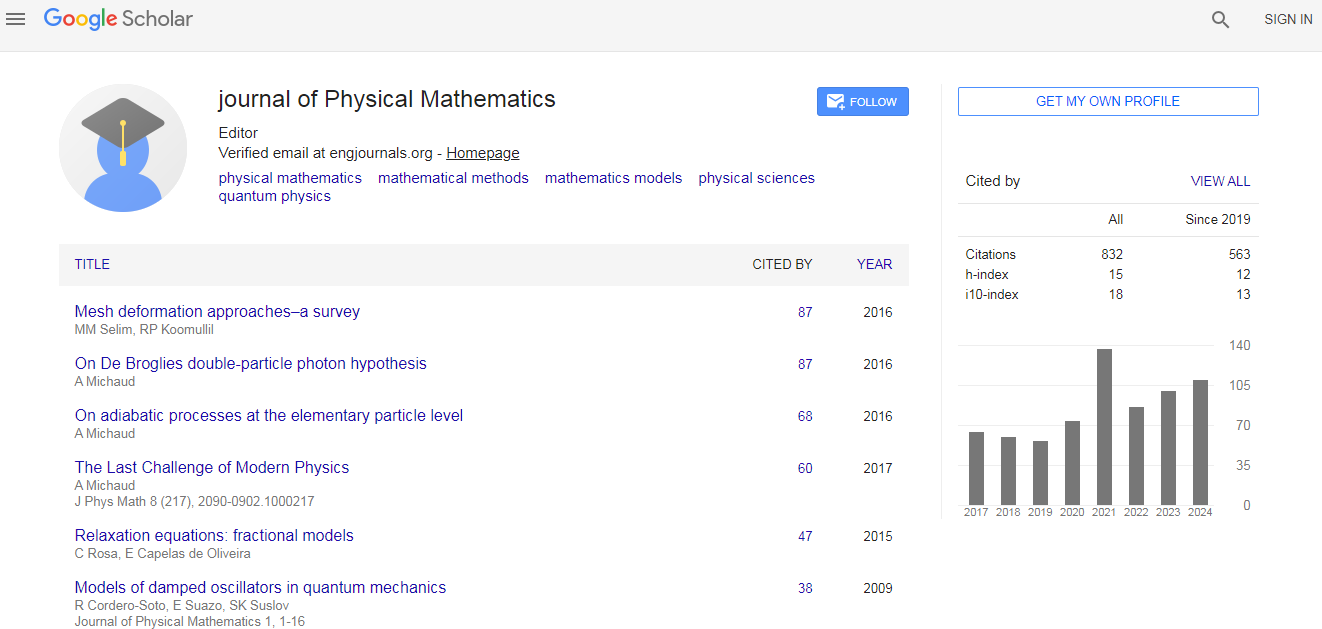
Physical Mathematics received 686 citations as per Google Scholar report