Opinion - (2025) Volume 9, Issue 2
Received: 02-Mar-2025, Manuscript No. jgdr-26-179126;
Editor assigned: 04-Mar-2025, Pre QC No. P-179126;
Reviewed: 18-Mar-2025, QC No. Q-179126;
Revised: 24-Mar-2025, Manuscript No. R-179126;
Published:
31-Mar-2025
, DOI: 10.37421/2684-6039.2025.09.254
Citation: Chen, Mei-Ling. ”Next-Generation Sequencing: Revolutionizing Genomics and Medicine.” J Genet DNA Res 09 (2025):254.
Copyright: © 2025 Chen M. This is an open-access article distributed under the terms of the Creative Commons Attribution License, which permits unrestricted use, distribution and reproduction in any medium, provided the original author and source are credited.
Next-generation sequencing (NGS) technologies have ushered in a new era of genetic research, fundamentally transforming our ability to explore the complexities of life at the molecular level. These advancements have led to rapid, cost-effective, and high-throughput sequencing of entire genomes, exomes, and transcriptomes, significantly accelerating the identification of genetic variations linked to various diseases. The continuous evolution of NGS platforms, encompassing improvements in read length, accuracy, and the development of sophisticated bioinformatics tools, further enhances their utility across a broad spectrum of research domains, from fundamental biological inquiries to critical clinical applications [1].
Parallel to the advancements in short-read sequencing, long-read sequencing technologies, exemplified by platforms such as PacBio and Oxford Nanopore, are gaining increasing prominence in genetic research. These technologies provide longer contiguous DNA sequences, which are indispensable for resolving intricate genomic regions, characterizing structural variants, and elucidating repetitive elements that often pose challenges for short-read sequencing approaches. This enhanced resolution is crucial for achieving more comprehensive genome assemblies, enabling the accurate detection of large-scale genetic alterations, and fostering a deeper understanding of overall genome architecture [2].
Furthermore, single-cell sequencing (sc-seq) has emerged as a powerful tool, allowing for the detailed analysis of genetic material at the individual cell level. This capability is particularly invaluable for uncovering cellular heterogeneity and identifying rare cell populations, proving essential in fields such as developmental biology, cancer research, and immunology, where understanding cell-to-cell variation is paramount. sc-seq has facilitated the creation of detailed cell atlases and the identification of cell-type-specific gene expression patterns and mutations [3].
Metagenomic sequencing represents another significant leap forward, enabling the direct study of genetic material from environmental samples without the need for laborious culturing of microorganisms. This approach has dramatically reshaped our understanding of microbial communities inhabiting diverse ecosystems, including the human microbiome, soil, and oceans. Metagenomics facilitates the discovery of novel genes, metabolic pathways, and intricate interactions within these complex biological communities [4].
In tandem with these technological strides, the development of portable and rapid sequencing devices, such as the MinION from Oxford Nanopore, has democratized genetic sequencing. These innovations enable fieldwork and real-time analysis, proving invaluable for outbreak surveillance, conservation genetics, and diagnostics, particularly in resource-limited settings, thereby significantly expanding the reach and applicability of genomic research [5].
The exponential growth in data generated by NGS necessitates robust and sophisticated bioinformatics and computational tools. Advanced algorithms for read alignment, variant calling, genome assembly, and data visualization are critical for extracting meaningful biological insights from the vast datasets produced by NGS. These computational advancements are indispensable for researchers attempting to interpret complex genomic information [6].
The clinical utility of NGS is rapidly expanding, with significant applications emerging in genetic diagnostics. This includes the diagnosis of rare genetic diseases, comprehensive cancer profiling, and prenatal testing. The improvements in diagnostic accuracy, reduced turnaround times, and the capacity to identify actionable mutations are collectively transforming patient care and management, paving the way for truly personalized medicine [7].
Concurrent with the evolution of sequencing technologies, the development of novel library preparation methods and chemistries continues to enhance the efficiency and broaden the scope of NGS applications. Techniques such as targeted sequencing, capture-based enrichment, and amplification-free methods empower researchers to focus on specific regions of interest or to sequence challenging samples with improved accuracy and reduced bias [8].
Moreover, epigenetic modifications, including DNA methylation and histone modifications, can now be studied comprehensively using NGS-based techniques such as bisulfite sequencing and ChIP-seq. These methodologies provide profound insights into gene regulation and cellular differentiation, illuminating how environmental factors and developmental processes influence genome function without altering the underlying DNA sequence [9].
Finally, the decreasing cost and increasing accessibility of NGS platforms are fueling large-scale population genomics projects, including genome-wide association studies (GWAS) and the sequencing of diverse human populations. These ambitious initiatives are paramount for identifying both common and rare genetic variants that influence human health and disease, and for unraveling the intricacies of human evolution and diversity [10].
Next-generation sequencing (NGS) technologies have revolutionized genetic research by enabling rapid, cost-effective, and high-throughput sequencing of entire genomes, exomes, and transcriptomes. These advancements have accelerated the identification of genetic variations associated with diseases, improved our understanding of complex biological systems, and paved the way for personalized medicine. The continuous evolution of NGS platforms, including improvements in read length, accuracy, and bioinformatics tools, further enhances their utility in diverse research areas from basic biology to clinical applications [1].
Long-read sequencing technologies, such as PacBio and Oxford Nanopore, are increasingly important in genetic research. They provide longer contiguous DNA sequences (contigs), which are crucial for resolving complex genomic regions, structural variants, and repetitive elements that are challenging for short-read technologies. This improved resolution aids in more comprehensive genome assembly, accurate detection of large-scale genetic alterations, and a deeper understanding of genome architecture [2].
Single-cell sequencing (sc-seq) allows for the analysis of genetic material at the individual cell level, uncovering cellular heterogeneity and rare cell populations. This is particularly valuable in fields like developmental biology, cancer research, and immunology, where understanding cell-to-cell variation is critical. sc-seq has enabled the construction of detailed cell atlases and the identification of cell-type-specific gene expression patterns and mutations [3].
Metagenomic sequencing enables the study of genetic material directly from environmental samples, bypassing the need for culturing microorganisms. This approach has revolutionized our understanding of microbial communities in various ecosystems, including the human microbiome, soil, and oceans. Metagenomics allows for the identification of novel genes, metabolic pathways, and interactions within these complex communities [4].
The development of portable and rapid sequencing devices, like the MinION from Oxford Nanopore, has democratized genetic sequencing, enabling fieldwork and real-time analysis. These technologies are invaluable for outbreak surveillance, conservation genetics, and diagnostics in resource-limited settings, significantly expanding the reach and application of genomic research [5].
Advances in bioinformatics and computational tools are essential for handling the massive datasets generated by NGS. Sophisticated algorithms for read alignment, variant calling, genome assembly, and data visualization are critical for extracting meaningful biological insights from NGS data, enabling researchers to make sense of complex genomic information [6].
The application of NGS in clinical diagnostics is rapidly expanding, particularly for rare genetic diseases, cancer profiling, and prenatal testing. Improved diagnostic accuracy, faster turnaround times, and the potential for identifying actionable mutations are transforming patient care and management, ushering in an era of precision medicine [7].
The development of novel library preparation methods and chemistries continues to improve the efficiency and scope of NGS. Techniques such as targeted sequencing, capture-based enrichment, and amplification-free methods enable researchers to focus on specific regions of interest or to sequence challenging samples with greater accuracy and reduced bias [8].
Epigenetic modifications, such as DNA methylation and histone modifications, can now be comprehensively studied using NGS-based techniques like bisulfite sequencing and ChIP-seq. These methods provide insights into gene regulation and cellular differentiation, revealing how environmental factors and developmental processes influence genome function without altering the DNA sequence itself [9].
The increasing affordability and accessibility of NGS platforms are driving large-scale population genomics projects, such as genome-wide association studies (GWAS) and the sequencing of diverse human populations. These initiatives are crucial for identifying common and rare genetic variants that contribute to human health and disease, and for understanding human evolution and diversity [10].
Next-generation sequencing (NGS) technologies have dramatically advanced genetic research, enabling high-throughput analysis of genomes, exomes, and transcriptomes. This has accelerated disease gene identification and paved the way for personalized medicine. Long-read sequencing provides crucial resolution for complex genomic regions and structural variants. Single-cell sequencing allows for detailed analysis of cellular heterogeneity, vital for developmental biology and cancer research. Metagenomics enables the study of microbial communities in various environments. Portable sequencing devices democratize access for fieldwork and diagnostics. Advances in bioinformatics are essential for interpreting vast NGS datasets. Clinical applications of NGS are expanding for diagnosing genetic diseases and cancer. Novel library preparation methods enhance NGS efficiency and scope. Epigenetic modifications can be studied using NGS-based techniques. Large-scale population genomics projects leverage affordable NGS to understand human health, disease, evolution, and diversity.
None
None
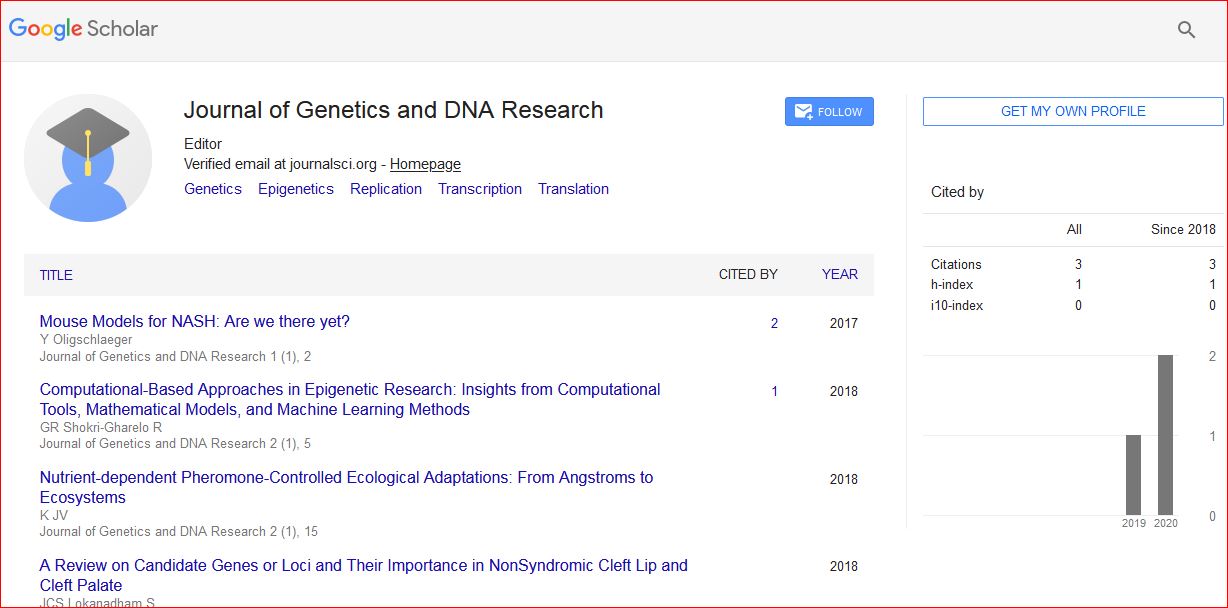
Journal of Genetics and DNA Research received 3 citations as per Google Scholar report