Opinion - (2025) Volume 13, Issue 3
Received: 01-Jun-2025, Manuscript No. JCMG-26-185540;
Editor assigned: 03-Jun-2025, Pre QC No. P-185540;
Reviewed: 17-Jun-2025, QC No. Q-185540;
Revised: 23-Jun-2025, Manuscript No. R-185540;
Published:
30-Jun-2026
, DOI: 10.37421/2472-128X.2025.13.343
Citation: Almeida, Lucas. ”Next-generation Sequencing: Revolutionizing Clinical Genomics and Personalized Medicine.” J Clin Med Genomics 13 (2025):343.
Copyright: © 2025 Almeida L. This is an open-access article distributed under the terms of the Creative Commons Attribution License, which permits unrestricted use, distribution and reproduction in any medium, provided the original author and source are credited.
Next-generation sequencing (NGS) is fundamentally transforming the field of clinical genomics, offering unprecedented capabilities for high-throughput DNA and RNA analysis. This advanced technology facilitates comprehensive profiling of the genome, transcriptome, and epigenome, significantly enhancing diagnostic accuracy and paving the way for personalized treatment strategies. It also deepens our understanding of complex disease mechanisms. Key applications span the identification of germline and somatic mutations, crucial for diagnosing hereditary cancer syndromes and characterizing tumor profiles, respectively, thereby guiding the selection of targeted therapies and enabling carrier screening [1].
Despite these advancements, challenges persist in the interpretation of generated data, precise variant classification, and seamless integration into routine clinical workflows. Addressing these requires the development and implementation of robust bioinformatics pipelines and standardized reporting protocols. Continuous innovation in NGS technologies, including the emergence of long-read sequencing and the expanding utility of liquid biopsies, promises to further broaden its impact on precision medicine [1].
Somatic mutation profiling, powered by NGS, has emerged as a critical component in oncology. It enables the precise identification of actionable mutations that are pivotal for selecting appropriate targeted therapies for cancer patients. This approach allows for a more refined classification of tumors and improves the prediction of treatment response, optimizing patient care. The development of comprehensive genomic profiling assays, predominantly utilizing NGS, provides an extensive overview of a patient's tumor mutational landscape. This broad perspective can uncover genetic alterations that might be overlooked by traditional single-gene testing methods. However, ongoing challenges include the interpretation of variants of unknown significance and understanding the mechanisms by which tumors develop resistance to therapies [2].
Germline variant analysis, another key application of NGS, is indispensable for diagnosing hereditary cancer predisposition syndromes and a wide spectrum of rare genetic disorders. Technologies such as whole exome sequencing (WES) and whole genome sequencing (WGS) provide a high-resolution view of an individual's germline genome, significantly improving the identification of causative mutations. This detailed genetic information is vital for effective genetic counseling, accurate risk assessment for individuals and families, and the implementation of cascade testing. The accurate interpretation of germline variants necessitates the use of extensive databases and sophisticated bioinformatic tools to reliably distinguish between benign polymorphisms and pathogenic mutations [3].
Liquid biopsies, a rapidly advancing area in oncology, leverage cell-free DNA (cfDNA) extracted from blood samples. This minimally invasive approach offers significant potential for cancer detection, monitoring disease progression, and assessing treatment response. When coupled with NGS, cfDNA analysis allows for the identification of tumor-derived mutations circulating in the bloodstream, providing crucial insights into tumor heterogeneity and its evolutionary trajectory. This technology holds considerable promise for early cancer detection, monitoring for minimal residual disease, and detecting acquired resistance mutations, thereby potentially revolutionizing clinical management without the frequent need for invasive tissue biopsies [4].
The interpretation of data generated by NGS remains a significant bottleneck in the broader implementation of clinical genomics. Accurately annotating variants, predicting their pathogenicity, and correlating them with clinical phenotypes require sophisticated bioinformatic pipelines and substantial expert knowledge. The establishment of standardized guidelines and comprehensive databases is paramount for ensuring consistent and reliable variant classification, which in turn enables clinicians to make well-informed decisions regarding patient care. The continuous discovery of novel variants and their association with diverse disease phenotypes underscores the need for ongoing updates and refinement of these interpretation frameworks [5].
Long-read sequencing technologies, exemplified by platforms like PacBio and Oxford Nanopore, are gaining increasing traction within clinical genomics. These advanced technologies possess the unique ability to sequence considerably longer DNA fragments compared to their short-read counterparts. This extended read length is particularly advantageous for spanning repetitive regions, resolving complex structural variants, and characterizing intricate genomic rearrangements more effectively. The enhanced capability of long-read sequencing to accurately depict complex genomic structures has profound implications for the diagnosis of various genetic disorders and for a deeper understanding of tumor evolution [6].
The successful integration of NGS into routine clinical practice hinges on several critical factors, including the establishment of robust bioinformatics infrastructure, the standardization of analytical workflows, and the availability of proficient personnel. Key challenges encompass managing large data storage requirements, ensuring adequate processing power, and providing continuous training opportunities for laboratory staff and clinicians. Implementing clear and comprehensive guidelines for sample handling, data analysis, and result reporting is essential to guarantee the consistent and accurate application of NGS in patient care. Effective collaboration between bioinformaticians, geneticists, and clinicians is therefore paramount [7].
Pharmacogenomics, a discipline that utilizes NGS to elucidate how individual genetic variations influence drug response, stands as a cornerstone of personalized medicine. By identifying specific genetic markers that are associated with drug metabolism, efficacy, and potential toxicity, clinicians can precisely tailor medication choices and dosages to the unique genetic profile of each patient. This individualized approach optimizes treatment outcomes and significantly minimizes the risk of adverse drug reactions. NGS facilitates the simultaneous assessment of multiple pharmacogenomic variants, offering a more holistic view of drug response potential [8].
The ethical, legal, and social implications (ELSI) associated with genomic testing, including those performed using NGS, are of utmost importance and demand careful consideration. Critical issues such as ensuring data privacy, preventing genetic discrimination, obtaining truly informed consent from patients, and guaranteeing equitable access to advanced genomic technologies require ongoing dialogue and the development of robust regulatory frameworks. Establishing strong mechanisms for responsible data stewardship and ensuring that the transformative benefits of genomic medicine are accessible to all populations, irrespective of socioeconomic status or background, are crucial for its ethical advancement [9].
Exome and genome sequencing, powered by NGS, are increasingly becoming indispensable tools for the diagnosis of rare and undiagnosed diseases. These comprehensive sequencing approaches provide a powerful means to identify the underlying genetic basis of conditions that often present with complex and heterogeneous etiologies. Consequently, there has been a notable increase in diagnostic yield for many patients who have previously undergone extensive investigations without receiving a definitive diagnosis, offering hope and clarity to previously perplexed clinical situations [10].
Next-generation sequencing (NGS) is revolutionizing clinical genomics by enabling high-throughput DNA and RNA analysis. This technology allows for comprehensive profiling of the genome, transcriptome, and epigenome, leading to improved diagnostic accuracy, personalized treatment strategies, and a deeper understanding of disease mechanisms. Key applications include identifying germline and somatic mutations for hereditary cancer syndromes and tumor profiling, respectively, guiding targeted therapies, and facilitating carrier screening. Challenges remain in data interpretation, variant classification, and integration into routine clinical workflows, necessitating robust bioinformatics pipelines and standardized reporting. The ongoing advancements in NGS technologies, such as long-read sequencing and liquid biopsies, promise further expansion of its role in precision medicine [1].
Somatic mutation profiling using NGS has become a cornerstone in oncology, enabling the identification of actionable mutations that guide targeted therapy selection. This approach allows for a more precise classification of tumors and prediction of treatment response. The development of comprehensive genomic profiling assays, often utilizing NGS, provides a broad view of a patient's tumor mutational landscape, uncovering alterations that might be missed by single-gene testing. Emerging challenges include the interpretation of variants of unknown significance and the evolution of resistance mechanisms [2].
Germline variant analysis through NGS is crucial for diagnosing hereditary cancer predisposition syndromes and rare genetic disorders. Whole exome sequencing (WES) and whole genome sequencing (WGS) offer a high-resolution view of the germline genome, facilitating the identification of causative mutations. This information is vital for genetic counseling, risk assessment, and cascade testing within families. The accurate interpretation of germline variants requires extensive databases and sophisticated bioinformatic tools to distinguish benign polymorphisms from pathogenic mutations [3].
Liquid biopsies, utilizing cell-free DNA (cfDNA) obtained from blood, represent a minimally invasive approach for cancer detection, monitoring, and treatment response assessment. NGS applied to cfDNA allows for the identification of tumor-derived mutations, providing insights into tumor heterogeneity and evolution. This technology holds promise for early cancer detection, monitoring minimal residual disease, and detecting acquired resistance mutations, potentially impacting clinical management without the need for tissue biopsies [4].
The interpretation of NGS data is a critical bottleneck in clinical genomics. Variant annotation, pathogenicity prediction, and clinical correlation require sophisticated bioinformatic pipelines and expert knowledge. Standardized guidelines and databases are essential for consistent and reliable variant classification, enabling clinicians to make informed decisions. The continuous discovery of novel variants and their association with disease phenotypes necessitates ongoing updates to these interpretation frameworks [5].
Long-read sequencing technologies, such as PacBio and Oxford Nanopore, are increasingly being adopted in clinical genomics. These technologies offer the ability to sequence longer DNA fragments, spanning repetitive regions, structural variants, and complex genomic rearrangements more effectively than short-read sequencing. This improved ability to resolve complex genomic structures has significant implications for diagnosing genetic disorders and understanding tumor evolution [6].
The integration of NGS into routine clinical practice requires robust bioinformatics infrastructure, standardized workflows, and proficient personnel. Challenges include data storage, processing power, and the need for continuous training. Establishing clear guidelines for sample handling, data analysis, and result reporting is paramount to ensure the consistent and accurate application of NGS in patient care. Collaboration between bioinformaticians, geneticists, and clinicians is essential [7].
Pharmacogenomics, leveraging NGS to understand how genetic variations influence drug response, is a key component of personalized medicine. By identifying genetic markers associated with drug metabolism, efficacy, and toxicity, clinicians can tailor medication choices and dosages to individual patients, optimizing treatment outcomes and minimizing adverse drug reactions. NGS allows for the simultaneous assessment of multiple pharmacogenomic variants [8].
The ethical, legal, and social implications (ELSI) of genomic testing, including NGS, are paramount. Issues such as data privacy, genetic discrimination, informed consent, and equitable access to genomic technologies require careful consideration and ongoing dialogue. Establishing robust frameworks for responsible data stewardship and ensuring that the benefits of genomic medicine are accessible to all populations are critical [9].
Exome and genome sequencing are increasingly being used for the diagnosis of rare and undiagnosed diseases. NGS provides a comprehensive approach to identify the genetic basis of these conditions, which often have a complex and heterogeneous etiology. This has led to a significant increase in diagnostic yield for many patients who have previously undergone extensive investigations without a definitive diagnosis [10].
Next-generation sequencing (NGS) is revolutionizing clinical genomics, enhancing diagnostic accuracy and enabling personalized medicine through comprehensive genomic, transcriptomic, and epigenomic profiling. Key applications include identifying germline and somatic mutations for hereditary conditions and cancer, guiding targeted therapies, and facilitating carrier screening. Challenges in data interpretation, variant classification, and workflow integration persist, requiring robust bioinformatics and standardization. Advancements like long-read sequencing and liquid biopsies are expanding NGS's role. Somatic mutation profiling is crucial in oncology for selecting targeted therapies, while germline analysis aids in diagnosing hereditary disorders. Liquid biopsies offer a non-invasive means for cancer detection and monitoring. Variant interpretation remains a bottleneck, demanding sophisticated tools and expertise. Long-read sequencing improves the detection of complex genomic structures, and pharmacogenomics uses NGS to tailor drug treatments based on genetic profiles. Integrating NGS into practice necessitates strong bioinformatics infrastructure and standardized protocols. Ethical, legal, and social implications, including data privacy and equitable access, are critical considerations. Finally, exome and genome sequencing are significantly improving the diagnosis of rare and undiagnosed diseases.
None
None
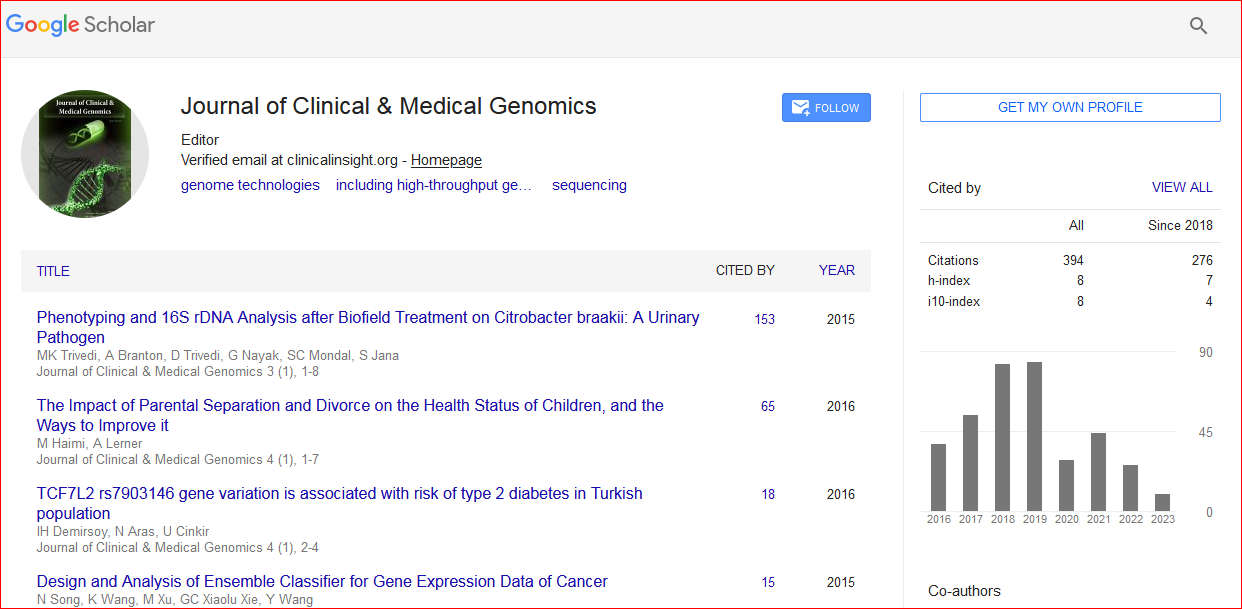
Journal of Clinical & Medical Genomics received 391 citations as per Google Scholar report