Opinion - (2025) Volume 14, Issue 3
Received: 01-Sep-2025, Manuscript No. ara-25-175593;
Editor assigned: 03-Sep-2025, Pre QC No. P-175593;
Reviewed: 17-Sep-2025, QC No. Q-175593;
Revised: 22-Sep-2025, Manuscript No. R-175593;
Published:
29-Sep-2025
, DOI: 10.37421/2168-9695.2025.14.335
Citation: Park, Ha-Yun. ”Next-Gen Robotic Control: Learning, Collaboration, Resilience.” Adv Robot Autom 14 (2025):335.
Copyright: © 2025 Park H. This is an open-access article distributed under the terms of the Creative Commons Attribution License, which permits unrestricted use, distribution and reproduction in any medium, provided the original author and source are credited.
This paper presents a robust impedance control framework tailored for robotic manipulators operating in unstructured environments, emphasizing stability and performance against external disturbances. The authors introduce a novel adaptive observer to estimate environmental uncertainties, allowing the robot to maintain desired interaction forces without precise knowledge of the contact stiffness. What this means for applications is robots can safely and effectively interact with unpredictable surroundings, making them more versatile for tasks like human-robot collaboration or exploration [1].
Here's the thing: this research explores the application of deep reinforcement learning for complex robotic manipulation tasks. The authors propose a novel reward shaping technique that accelerates learning convergence, allowing robots to master intricate operations like picking and placing deformable objects with greater efficiency. The core idea is to enable robots to learn strategies directly from experience, bypassing the need for explicit programming of every motion, which really opens doors for automation in dynamic settings [2].
This article discusses advanced human-robot collaboration strategies, focusing on shared control systems that intuitively blend human guidance with robotic autonomy. The authors introduce a predictive model that anticipates human intentions, enabling smoother and more responsive collaborative tasks without explicit commands. What this really means is a robot can work more naturally alongside a human, adapting its movements to assist in tasks like assembly or material handling, improving both safety and efficiency [3].
Let's break it down: this paper addresses the control of soft robots, specifically focusing on continuum manipulators that inherently exhibit infinite degrees of freedom. The authors propose a real-time shape estimation and control method using embedded sensing, allowing for precise manipulation despite the robot's deformable nature. This work is critical because soft robots offer unparalleled flexibility and safety for interacting with delicate objects or operating in confined spaces, but their control is notoriously difficult [4].
This research investigates robust adaptive control for mobile robots operating in uncertain and dynamic environments. The authors develop a control law that guarantees tracking performance even with unknown disturbances and parameter variations, which is a big deal for autonomous navigation. The approach integrates a neural network to estimate uncertainties, enabling the robot to maintain its trajectory accurately despite environmental changes, making it highly relevant for logistics, exploration, or surveillance [5].
The focus here is on novel control strategies for multi-robot systems, particularly in scenarios requiring complex coordinated manipulation. The paper proposes a decentralized control architecture that allows individual robots to cooperate effectively, even when communication bandwidth is limited or there are partial failures. This is significant because it allows groups of robots to perform tasks like transporting large objects or constructing structures more resiliently and efficiently, without relying on a single central controller [6].
This article delves into control techniques for bipedal robots, aiming to achieve dynamic walking and balance on uneven terrain. The authors present a model predictive control approach that optimizes gait patterns in real-time, considering constraints from friction and joint limits. The crux is enabling robots to navigate complex, real-world environments with human-like agility and stability, moving beyond pre-programmed gaits and reacting intelligently to unexpected ground conditions [7].
Here's the situation: this paper introduces an event-triggered control scheme for robotic systems with communication delays and packet losses, a common challenge in networked control. The authors devise a mechanism where control signals are transmitted only when necessary, reducing network traffic while maintaining stability and performance. This is particularly useful for remote robotic operations or distributed robot teams, ensuring reliable control despite imperfect communication channels [8].
This research focuses on compliance control for robotic manipulators interacting with uncertain environments, particularly in scenarios requiring sensitive force regulation. The authors propose a learning-based impedance control approach that adapts its stiffness and damping parameters in real-time, based on contact dynamics. The primary benefit is enabling robots to perform tasks like grinding or polishing with varying surface properties, making contact interactions smoother and safer for both the robot and the environment [9].
Here, the paper explores vision-based control for robotic systems, specifically tackling tasks that require precise object manipulation in dynamic scenes. The authors develop a deep learning framework that directly maps visual inputs to control commands, bypassing traditional perception-planning-control pipelines. This streamlined approach allows robots to react much faster to visual cues, making them capable of handling high-speed sorting, tracking, or assembly operations more effectively than ever [10].
Significant strides are being made in developing robust control frameworks for robotic manipulators. One paper presents a robust impedance control framework tailored for robotic manipulators operating in unstructured environments, emphasizing stability and performance against external disturbances. The authors introduce a novel adaptive observer to estimate environmental uncertainties, allowing the robot to maintain desired interaction forces without precise knowledge of the contact stiffness. What this means for applications is robots can safely and effectively interact with unpredictable surroundings, making them more versatile for tasks like human-robot collaboration or exploration [1].
Another area focuses on adaptive control for mobile robots operating in uncertain and dynamic environments. This research develops a control law that guarantees tracking performance even with unknown disturbances and parameter variations, which is a big deal for autonomous navigation. The approach integrates a neural network to estimate uncertainties, enabling the robot to maintain its trajectory accurately despite environmental changes, making it highly relevant for logistics, exploration, or surveillance [5]. Further work focuses on compliance control for robotic manipulators interacting with uncertain environments, particularly in scenarios requiring sensitive force regulation. The authors propose a learning-based impedance control approach that adapts its stiffness and damping parameters in real-time, based on contact dynamics. The primary benefit is enabling robots to perform tasks like grinding or polishing with varying surface properties, making contact interactions smoother and safer for both the robot and the environment [9].
A lot of research also goes into advanced learning and collaboration. This research explores the application of deep reinforcement learning for complex robotic manipulation tasks. The authors propose a novel reward shaping technique that accelerates learning convergence, allowing robots to master intricate operations like picking and placing deformable objects with greater efficiency. The core idea is to enable robots to learn strategies directly from experience, bypassing the need for explicit programming of every motion, which really opens doors for automation in dynamic settings [2]. Also, another article discusses advanced human-robot collaboration strategies, focusing on shared control systems that intuitively blend human guidance with robotic autonomy. The authors introduce a predictive model that anticipates human intentions, enabling smoother and more responsive collaborative tasks without explicit commands. What this really means is a robot can work more naturally alongside a human, adapting its movements to assist in tasks like assembly or material handling, improving both safety and efficiency [3].
When it comes to specialized robot designs, like soft robots, this paper addresses the control of soft robots, specifically focusing on continuum manipulators that inherently exhibit infinite degrees of freedom. The authors propose a real-time shape estimation and control method using embedded sensing, allowing for precise manipulation despite the robot's deformable nature. This work is critical because soft robots offer unparalleled flexibility and safety for interacting with delicate objects or operating in confined spaces, but their control is notoriously difficult [4]. Another article delves into control techniques for bipedal robots, aiming to achieve dynamic walking and balance on uneven terrain. The authors present a model predictive control approach that optimizes gait patterns in real-time, considering constraints from friction and joint limits. The crux is enabling robots to navigate complex, real-world environments with human-like agility and stability, moving beyond pre-programmed gaits and reacting intelligently to unexpected ground conditions [7]. There's also a paper that explores vision-based control for robotic systems, specifically tackling tasks that require precise object manipulation in dynamic scenes. The authors develop a deep learning framework that directly maps visual inputs to control commands, bypassing traditional perception-planning-control pipelines. This streamlined approach allows robots to react much faster to visual cues, making them capable of handling high-speed sorting, tracking, or assembly operations more effectively than ever [10].
The focus is on novel control strategies for multi-robot systems, particularly in scenarios requiring complex coordinated manipulation. The paper proposes a decentralized control architecture that allows individual robots to cooperate effectively, even when communication bandwidth is limited or there are partial failures. This is significant because it allows groups of robots to perform tasks like transporting large objects or constructing structures more resiliently and efficiently, without relying on a single central controller [6]. This paper introduces an event-triggered control scheme for networked robotic systems with communication delays and packet losses, a common challenge in networked control. The authors devise a mechanism where control signals are transmitted only when necessary, reducing network traffic while maintaining stability and performance. This is particularly useful for remote robotic operations or distributed robot teams, ensuring reliable control despite imperfect communication channels [8].
This collection of papers highlights significant advancements in robotic control, addressing complex challenges across diverse robot types and operational environments. A key focus is on enabling robots to interact safely and effectively with unpredictable surroundings, using methods like robust impedance control with adaptive observers, ensuring stable performance against external disturbances. Researchers are also developing learning-based approaches, such as deep reinforcement learning, to help robots master intricate manipulation tasks by learning directly from experience, thereby improving efficiency and reducing the need for explicit programming. Collaborative robotics receives attention with shared control systems that intuitively blend human guidance with robotic autonomy, featuring predictive models for smoother interactions in tasks like assembly. The control of specialized robots, including soft continuum manipulators and bipedal robots, sees progress through real-time shape estimation, embedded sensing, and model predictive control for dynamic walking on uneven terrain. Here's the thing: advancements extend to multi-robot systems through decentralized coordinated control, enhancing resilience and efficiency despite communication limitations. Furthermore, networked robotic systems are becoming more reliable with event-triggered control schemes that mitigate communication delays and packet losses. What this really means is vision-based control is getting an overhaul with end-to-end deep learning, allowing robots to react faster to visual cues for dynamic object manipulation. Overall, these works collectively push the boundaries of robotic capabilities, from precise force regulation in uncertain environments to autonomous navigation and human-robot teamwork.
None
None
Liyuan L, Hao S, Guang-Zhong Y. "Robust Impedance Control for Robotic Manipulators with Adaptive Observer".IEEE Robotics and Automation Letters 7 (2022):9098-9105.
Indexed at, Google Scholar, Crossref
Wenlong H, Fang W, Sibo Z. "Deep Reinforcement Learning for Robotic Manipulation with Enhanced Reward Shaping".IEEE Transactions on Industrial Electronics 69 (2022):11786-11795.
Indexed at, Google Scholar, Crossref
Dong-Min K, Min-Joon K, Jinoh L. "Human-Robot Collaboration Control with Predictive Human Intention Estimation for Assembly Tasks".IEEE/ASME Transactions on Mechatronics 27 (2022):4100-4111.
Indexed at, Google Scholar, Crossref
Zhenglong S, Jiefu L, Jihong L. "Real-Time Shape Estimation and Control for Soft Continuum Manipulators with Embedded Sensing".IEEE Transactions on Robotics 39 (2023):1538-1550.
Indexed at, Google Scholar, Crossref
Haotian C, Jun L, Yuanqing X. "Robust Adaptive Control for Mobile Robots With Unknown Disturbances Using Neural Networks".IEEE Transactions on Systems, Man, and Cybernetics: Systems 53 (2023):3458-3469.
Indexed at, Google Scholar, Crossref
Yuan L, Yongchun F, Qinggang Y. "Decentralized Coordinated Control for Multi-Robot Systems With Limited Communication".IEEE Transactions on Industrial Informatics 19 (2023):553-562.
Indexed at, Google Scholar, Crossref
Meng-Meng L, Ming-Xin C, Lei Z. "Dynamic Walking Control for Bipedal Robots on Uneven Terrain Using Model Predictive Control".IEEE/ASME Transactions on Mechatronics 28 (2023):1184-1195.
Indexed at, Google Scholar, Crossref
Mengjie H, Jianquan L, Bin Y. "Event-Triggered Control for Networked Robotic Systems With Communication Delays and Packet Losses".IEEE Transactions on Industrial Electronics 70 (2023):5092-5101.
Indexed at, Google Scholar, Crossref
Chenglin W, Long H, Jiankun W. "Learning-Based Impedance Control for Robotic Manipulators with Environmental Uncertainty".IEEE Transactions on Robotics 40 (2024):241-253.
Indexed at, Google Scholar, Crossref
Xinchen L, Long Z, Yongchao X. "Vision-Based Robotic Control via End-to-End Deep Learning for Dynamic Object Manipulation".IEEE Robotics and Automation Letters 9 (2024):2838-2845.
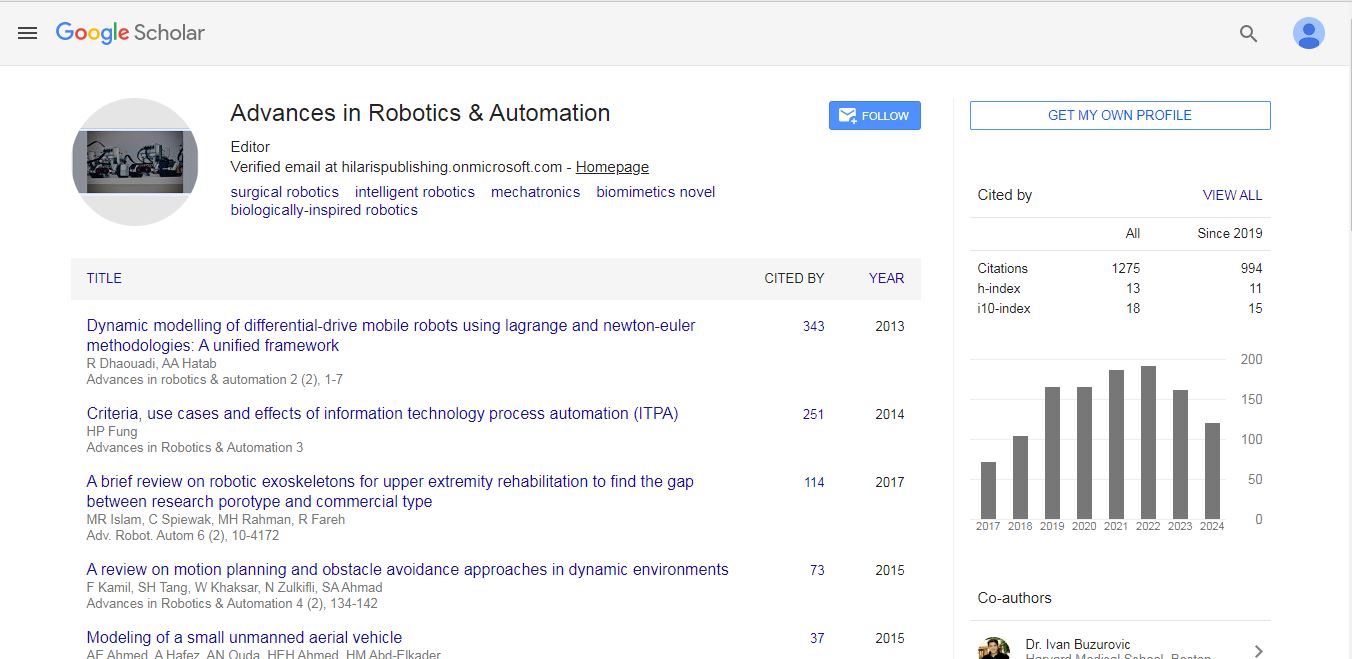
Advances in Robotics & Automation received 1275 citations as per Google Scholar report