Perspective - (2025) Volume 15, Issue 3
Received: 01-May-2025, Manuscript No. jnt-26-178938;
Editor assigned: 05-May-2025, Pre QC No. P-178938;
Reviewed: 19-May-2025, QC No. Q-178938;
Revised: 22-May-2025, Manuscript No. R-178938;
Published:
29-May-2025
, DOI: 10.37421/2161-0959.2025.15.567
Citation: Mensah, Kojo. ”New Oral Therapies Revolutionize Renal Anemia Management.” J Nephrol Ther 15 (2025):567.
Copyright: © 2025 Mensah K. This is an open-access article distributed under the terms of the Creative Commons Attribution License, which permits unrestricted use, distribution and reproduction in any medium, provided the original author and source are credited.
The management of anemia in patients with chronic kidney disease (CKD) has historically relied on erythropoiesis-stimulating agents (ESAs). However, recent advancements have introduced novel pharmacological strategies that move beyond these traditional treatments, offering new avenues for patient care. Emerging research highlights the significant potential of oral agents, particularly hypoxia-inducible factor prolyl hydroxylase inhibitors (HIF-PHIs), which operate through distinct mechanisms compared to ESAs, and have demonstrated promising efficacy and safety profiles [1].
The clinical application of these innovative therapies is increasingly being explored, with a focus on specific agents like Roxadustat. This first-in-class oral HIF-PHI has shown effectiveness in managing anemia in non-dialysis dependent CKD patients, influencing hemoglobin levels, iron metabolism, and potentially cardiovascular risk factors, underscoring the importance of individualized treatment approaches [2].
As the landscape of anemia management in CKD evolves, there is a pronounced shift towards oral therapies like HIF-PHIs. These agents are being evaluated for their safety and efficacy, particularly concerning thromboembolic events and iron handling, when contrasted with conventional ESAs, with investigations into their benefits across various CKD populations [3].
A comprehensive analysis of agents such as Daprodustat, another oral HIF-PHI, has been presented for the treatment of anemia in CKD patients not undergoing dialysis. This research details its efficacy in maintaining hemoglobin levels and its impact on iron status and potential cardiovascular outcomes, positioning it as an alternative to injectable ESAs [4].
The advent of HIF-PHIs represents a significant paradigm shift in the management of renal anemia. Their oral availability and potential benefits in iron regulation are notable, though ongoing debates regarding their safety profile, especially in comparison to ESAs, necessitate careful patient selection and continued research [5].
Further evidence emerges from reviews of Vadadustat, an HIF-PHI designed for anemia in CKD patients. This article scrutinizes clinical trial data, concentrating on hemoglobin response, iron homeostasis, and cardiovascular safety, thereby establishing Vadadustat as a new therapeutic option with a unique pharmacological profile [6].
The profound impact of HIF-PHIs on iron metabolism in CKD patients with anemia is a critical area of study. These agents can enhance iron absorption and utilization, potentially reducing the reliance on intravenous iron supplementation, and modulate the complex interplay between erythropoiesis, iron, and inflammation via HIF pathways [7].
The cardiovascular safety of HIF-PHIs in CKD patients is a crucial consideration, with evaluations drawing from clinical trials and real-world evidence. Research addresses concerns about thromboembolic events and other cardiovascular risks, emphasizing the necessity of thorough risk stratification and vigilant monitoring [8].
Beyond clinical efficacy, patient-reported outcomes and quality of life associated with novel pharmacological approaches, especially oral HIF-PHIs, are gaining attention. These treatments may offer improved convenience and adherence compared to traditional ESAs, ultimately enhancing the overall patient experience [9].
Navigating the complexities of renal anemia management requires a deep understanding of its pathophysiology and the implementation of personalized treatment strategies. Future directions anticipate further advancements in pharmacological interventions and supportive care to address the evolving needs of CKD patients [10].
Emerging pharmacological strategies for managing renal anemia are shifting focus from traditional erythropoiesis-stimulating agents (ESAs) to novel oral agents, including hypoxia-inducible factor prolyl hydroxylase inhibitors (HIF-PHIs). These novel agents possess distinct mechanisms of action, and their efficacy and safety profiles are being compared to those of ESAs, with implications for personalized treatment approaches and addressing unmet needs in specific patient populations [1].
The clinical application and patient outcomes associated with Roxadustat, a first-in-class oral HIF-PHI for anemia in non-dialysis dependent chronic kidney disease (CKD) patients, are being extensively examined. This includes evaluating its efficacy in achieving and maintaining hemoglobin levels, as well as its effects on iron metabolism and cardiovascular risk factors, emphasizing the critical role of individualized dosing and monitoring [2].
The evolving landscape of anemia management in CKD is marked by a transition towards oral therapies such as HIF-PHIs. These new agents are scrutinized for their safety and efficacy, with particular attention paid to potential thromboembolic events and their impact on iron handling compared to conventional ESAs, alongside their potential benefits in specific CKD populations [3].
A comprehensive analysis of Daprodustat, another oral HIF-PHI, has been conducted for treating anemia in CKD patients who are not on dialysis. This research details its effectiveness in maintaining hemoglobin levels and its influence on iron status and cardiovascular outcomes, presenting it as an alternative to injectable ESAs [4].
The introduction of HIF-PHIs signifies a paradigm shift in renal anemia management. Their oral administration and potential advantages in iron regulation are significant, yet the ongoing discussion surrounding their safety profile, particularly when contrasted with ESAs, underscores the need for careful patient selection and continued research [5].
Reviews of Vadadustat, an HIF-PHI, for anemia in CKD patients have been published, examining clinical trial data that focuses on hemoglobin response, iron homeostasis, and cardiovascular safety. This positions Vadadustat as a new therapeutic option with a unique pharmacological profile [6].
The impact of HIF-PHIs on iron metabolism in CKD patients experiencing anemia is a critical area of focus. These agents have shown the capacity to improve iron absorption and utilization, potentially diminishing the requirement for intravenous iron supplementation, and influencing the complex interplay between erythropoiesis, iron, and inflammation through HIF pathways [7].
The cardiovascular safety of HIF-PHIs in CKD patients is being rigorously evaluated through a review of clinical trial data and real-world evidence. This research addresses concerns regarding thromboembolic events and other cardiovascular risks associated with these novel agents, highlighting the importance of risk stratification and ongoing monitoring [8].
Patient-reported outcomes and quality of life associated with novel pharmacological approaches for renal anemia, especially oral HIF-PHIs, are being investigated. The potential for these new treatments to enhance convenience and adherence compared to traditional ESAs is explored, aiming to improve the patient experience [9].
The management of renal anemia faces ongoing challenges and necessitates future directions that acknowledge the complex pathophysiology of anemia in CKD and the importance of personalized treatment strategies. Anticipated advancements include further developments in pharmacological interventions and supportive care [10].
Recent advancements in managing renal anemia are shifting away from traditional erythropoiesis-stimulating agents (ESAs) towards novel oral therapies, particularly hypoxia-inducible factor prolyl hydroxylase inhibitors (HIF-PHIs). Agents like Roxadustat, Daprodustat, Vadadustat, and others are being studied for their efficacy in improving hemoglobin levels, influencing iron metabolism, and offering potential cardiovascular benefits. While these HIF-PHIs present a paradigm shift with oral administration and improved convenience, ongoing research continues to evaluate their safety profiles, especially concerning thromboembolic events, and their long-term impact on patients. The focus is increasingly on personalized treatment strategies and enhancing patient-reported outcomes and quality of life.
None
None
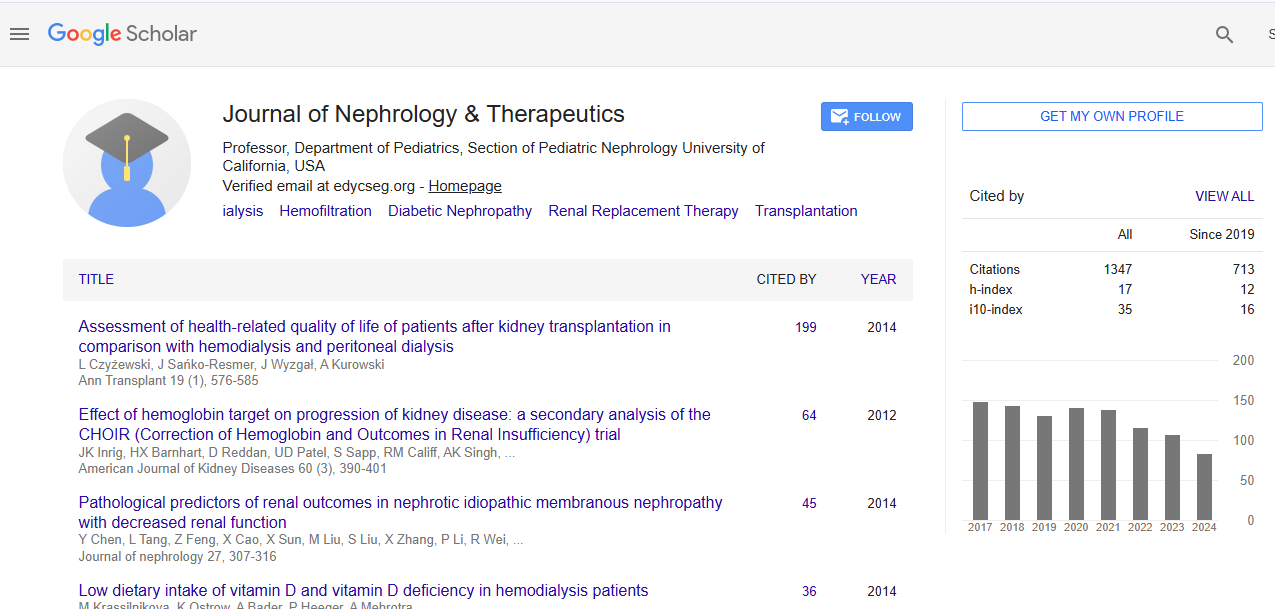
Journal of Nephrology & Therapeutics received 784 citations as per Google Scholar report