Short Communication - (2025) Volume 10, Issue 3
Received: 02-Jun-2025, Manuscript No. jomp-26-185094;;
Editor assigned: 04-Jun-2025, Pre QC No. P-185094;;
Reviewed: 18-Jun-2025, QC No. Q-185094;;
Revised: 23-Jun-2025, Manuscript No. R-185094;;
Published:
30-Jun-2025
, DOI: 10.37421/2576-3857.2025.10.312
Citation: Haddad, Yara. ”Neoantigens: Personalized Immunotherapy’s Precision Targets.” J Oncol Med and Pract 10 (2025):312.
Copyright: © 2025 Haddad Y. This is an open-access article distributed under the terms of the Creative Commons Attribution License, which permits unrestricted use, distribution and reproduction in any medium, provided the original author and source are credited.
Tumor neoantigens, which arise from somatic mutations within cancer cells, represent a significant advancement in the field of personalized cancer immunotherapy. These unique antigens are highly specific to an individual's tumor, making them attractive targets for therapeutic interventions designed to elicit a robust anti-tumor immune response. Understanding the immunogenicity of these neoantigens and how they are effectively presented by Major Histocompatibility Complex (MHC) molecules is paramount for the successful development of cancer vaccines and T-cell therapies aimed at eradicating malignant cells. This multifaceted approach necessitates the integration of sophisticated computational prediction tools and rigorous experimental validation to identify and optimize neoantigen candidates for therapeutic strategies, particularly in overcoming the challenges posed by aggressive and refractory malignancies [1].
The landscape of tumor neoantigens is remarkably diverse, with their immunogenic potential being significantly influenced by a complex interplay of factors. These include the specific type of somatic mutation, the level of neoantigen expression within the tumor, and the intricate characteristics of the tumor microenvironment. Accurately identifying truly immunogenic neoantigens, those capable of provoking a potent T-cell response, requires the deployment of advanced bioinformatics pipelines. These pipelines are designed to integrate vast and varied datasets, encompassing genomic, transcriptomic, and proteomic information, alongside critical data on HLA typing and the patient's T-cell repertoire, thereby maximizing the probability of achieving a clinically meaningful response [2].
Neoantigen-based cancer vaccines, which can be formulated as mRNA or peptide vaccines, are engineered to prime the patient's endogenous immune system. The fundamental goal is to educate and activate T-cells to specifically recognize and mount an attack against tumor cells that express these distinctive mutated neoantigens. Clinical trials are actively investigating the efficacy of these innovative vaccines across a broad spectrum of cancer types. Notably, their potential is being explored in malignancies that have historically proven notoriously resistant to conventional therapeutic modalities, signaling a promising new frontier in the pursuit of personalized oncology [3].
The ability of cytotoxic T lymphocytes (CTLs) to effectively recognize and eliminate tumor cells through neoantigen presentation is intricately modulated by the surrounding tumor microenvironment. This microenvironment can often adopt an immunosuppressive phenotype, thereby hindering the anti-tumor immune response. Consequently, research is actively exploring synergistic strategies, such as the combination of neoantigen vaccines with immune checkpoint inhibitors. The aim of such combinatorial approaches is to overcome these immunosuppressive barriers, thereby significantly enhancing the efficacy of anti-tumor immunity and improving clinical outcomes for patients [4].
A crucial determinant of a tumor's susceptibility to neoantigen-based therapies is its mutational burden, which refers to the total number of mutations within the tumor genome. A higher mutational burden is strongly correlated with a greater likelihood of response to immunotherapies, including those targeting neoantigens. Tumors characterized by elevated mutation rates, such as melanomas and certain types of lung cancers, tend to generate a larger repertoire of neoantigens. This increased neoantigen load can render these tumors more vulnerable to immunogenic cell death, making them more amenable to immune-mediated eradication [5].
Beyond the mere presence of mutations, several other critical factors govern the capacity of T-cells to recognize neoantigens. These include the intricate processes of neoantigen processing within the tumor cell and their subsequent presentation on the surface of the tumor cell by HLA molecules. Inefficient processing of a mutated peptide or a low-affinity binding interaction with an HLA molecule can render a potentially immunogenic neoantigen effectively invisible to the immune system. Therefore, a comprehensive understanding of these underlying cellular mechanisms is essential for optimizing neoantigen-based therapeutic strategies [6].
The field of personalized neoantigen identification and the subsequent development of vaccination strategies are experiencing rapid advancements. The continuous evolution of high-throughput sequencing technologies, coupled with the ongoing refinement of sophisticated computational algorithms, is significantly accelerating the process of selecting the most promising neoantigen targets for individual patients. This technological progress is steadily bringing the routine clinical application of personalized neoantigen therapies closer to reality [7].
The inherent heterogeneity of neoantigens, both within a single tumor and across different patients, presents a significant challenge to the development of broadly effective therapies. However, this complexity also concurrently unlocks opportunities for the design of innovative combination therapies. These strategies can be tailored to target multiple neoantigens simultaneously or to bolster the immune response against neoantigens that may exhibit weak immunogenicity on their own, thereby enhancing overall therapeutic efficacy [8].
The successful development of optimal neoantigen vaccines hinges on the careful selection of both the type of neoantigen to be targeted (e.g., mutated peptides, tumor-associated antigens) and the most appropriate delivery platform. Delivery platforms under investigation include mRNA, DNA, and various viral vectors, each with its own advantages and disadvantages. The ultimate goal is to engineer a vaccine capable of inducing a potent, durable, and specific T-cell response that can effectively control or eliminate tumor growth [9].
The process of identifying and validating neoantigens is inherently iterative, involving a cyclical approach that begins with computational prediction and is followed by rigorous experimental validation. Techniques such as T-cell assays and mass spectrometry are employed to confirm the immunogenicity of predicted neoantigens and to ensure that the selected targets are indeed relevant and present on the patient's tumor cells, thereby bridging the gap between computational discovery and clinical application [10].
Tumor neoantigens, originating from somatic mutations, are foundational to the advancement of personalized cancer immunotherapy, serving as critical targets for therapeutic intervention. The efficacy of these therapies relies heavily on understanding their immunogenicity and the intricate mechanisms by which they are presented by MHC molecules, a crucial step in designing effective vaccines and T-cell therapies. This understanding underpins strategies aimed at specifically eradicating tumor cells, involving advanced computational prediction coupled with experimental validation to refine neoantigen candidates and optimize treatment approaches, especially for challenging malignancies [1].
The immunological profile of tumor neoantigens is highly variable, with their immunogenic capacity being subject to numerous influences, including the type of mutation, expression levels, and the specific tumor microenvironment. The precise identification of genuinely immunogenic neoantigens necessitates the utilization of sophisticated bioinformatics pipelines. These pipelines are designed to integrate diverse data types, such as genomic, transcriptomic, and proteomic information, alongside HLA typing and T-cell repertoire analysis, to maximize the likelihood of achieving a positive clinical outcome [2].
Cancer vaccines based on neoantigens, including mRNA and peptide vaccines, are designed to stimulate the patient's immune system to recognize and eliminate tumor cells expressing these unique mutated antigens. Ongoing clinical trials are evaluating their effectiveness across a range of cancer types, including those that exhibit resistance to conventional treatments, highlighting a significant promise in personalized oncology [3].
The immune system's capacity to recognize neoantigens is significantly influenced by the tumor microenvironment, which can often be immunosuppressive, thereby impeding anti-tumor immunity. Current research is focused on developing strategies to counteract these inhibitory effects, such as combining neoantigen vaccines with checkpoint inhibitors, with the objective of enhancing anti-tumor immune responses and improving patient outcomes [4].
A key biomarker for predicting response to neoantigen-based therapies is the tumor mutational burden (TMB). Tumors with a high mutation rate, such as melanomas and lung cancers, generally produce a greater number of neoantigens, rendering them more susceptible to immune-mediated destruction [5].
In addition to the presence of mutations, the processing and presentation of neoantigens by HLA molecules are critical for their recognition by T-cells. Inefficiencies in these processes, such as suboptimal processing or weak HLA binding, can render a potentially immunogenic neoantigen undetectable by the immune system, underscoring the importance of a detailed understanding of these cellular mechanisms [6].
The development of personalized neoantigen identification and vaccination strategies is progressing rapidly, driven by advances in sequencing technologies and computational algorithms. These innovations are accelerating the selection of optimal neoantigen targets for individual patients, moving personalized cancer immunotherapy closer to widespread clinical application [7].
The heterogeneity observed in neoantigens, both within individual tumors and across different patient populations, presents a considerable challenge. However, this complexity also opens avenues for the development of combination therapies designed to target multiple neoantigens or to enhance the immune response against less immunogenic targets [8].
Crafting effective neoantigen vaccines requires meticulous selection of the antigen type, such as mutated peptides or tumor-associated antigens, and the choice of a suitable delivery platform, including mRNA, DNA, or viral vectors. The overarching goal is to achieve a potent and sustained T-cell response capable of controlling tumor progression [9].
The process of identifying and validating neoantigens is an ongoing, iterative cycle. It commences with computational prediction, followed by experimental confirmation using methods like T-cell assays and mass spectrometry to verify immunogenicity and ensure the relevance of the selected targets to the patient's specific tumor [10].
Tumor neoantigens, derived from somatic mutations, are central to personalized cancer immunotherapy, offering unique targets for vaccine and T-cell therapies. Their immunogenicity and presentation by MHC molecules are key factors influencing treatment efficacy. Advanced computational and experimental methods are employed to identify and validate these targets, particularly for challenging cancers. Factors like mutation type, expression levels, and the tumor microenvironment influence neoantigen immunogenicity. Sophisticated bioinformatics integrating genomic, transcriptomic, and proteomic data, along with HLA typing, are crucial for identifying immunogenic neoantigens. Neoantigen vaccines aim to prime the immune system against tumor cells expressing these mutations, with ongoing clinical trials exploring their potential in various cancers. The tumor microenvironment can suppress immune responses, leading to investigations into combination therapies with checkpoint inhibitors. Tumor mutational burden is a predictor of response, with highly mutated tumors being more susceptible to immune attack. Efficient processing and presentation of neoantigens by HLA molecules are vital for T-cell recognition. Advances in sequencing and algorithms are accelerating personalized neoantigen identification. Despite heterogeneity challenges, combination therapies targeting multiple neoantigens are being explored. Vaccine development involves selecting appropriate antigen types and delivery platforms to induce a potent T-cell response. Neoantigen identification is an iterative process of computational prediction and experimental validation.
None
None
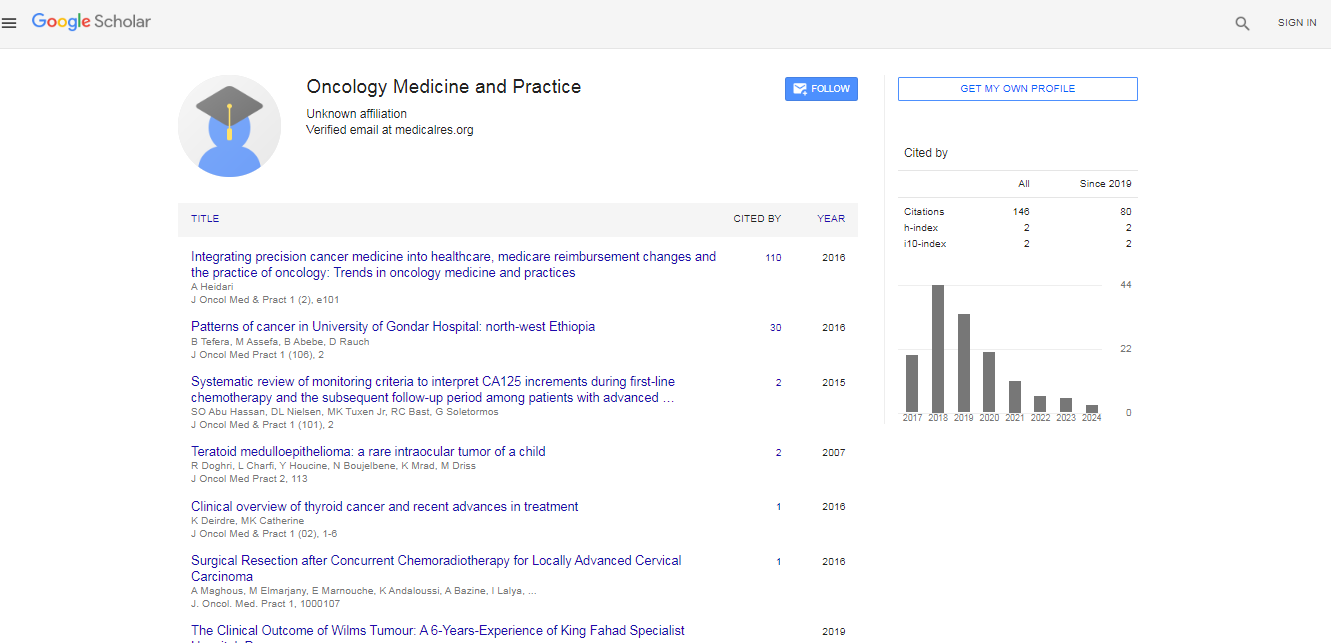
Journal of Oncology Medicine & Practice received 142 citations as per Google Scholar report