Perspective - (2025) Volume 14, Issue 3
Received: 02-Jun-2025, Manuscript No. jeom-26-188169;
Editor assigned: 04-Jun-2025, Pre QC No. P-188169;
Reviewed: 18-Jun-2025, QC No. Q-188169;
Revised: 23-Jun-2025, Manuscript No. R-188169;
Published:
30-Jun-2025
, DOI: 10.37421/2169-026X.2025.14.532
Citation: Benali, Youssef. ”Navigating Uncertainty: Competitive Entrepreneurial Success Factors.” J Entrepren Organiz Manag 14 (2025):532.
Copyright: © 2025 Benali Y. This is an open-access article distributed under the terms of the Creative Commons Attribution License, which permits unrestricted use, distribution and reproduction in any medium, provided the original author and source are credited
Entrepreneurial decision-making in competitive markets is profoundly influenced by how founders perceive and actively manage inherent uncertainty, risk, and resource constraints. Successful entrepreneurs consistently demonstrate a remarkable tolerance for ambiguity and proactively identify nascent opportunities, skillfully leverage their established networks, and fluidly adapt their strategies in real-time to effectively outmaneuver rivals and establish a competitive edge. This dynamic and iterative process inherently involves continuous learning and a high degree of strategic flexibility in response to market shifts. [1] The pervasive influence of cognitive biases on entrepreneurial choices within highly competitive landscapes is a significant factor that cannot be overlooked. Entrepreneurs may exhibit a tendency to overestimate their own abilities or conversely, underestimate the actual competitive threats posed by rivals, which can inevitably lead to suboptimal strategic decisions and potential market disadvantages. Consequently, a keen awareness and the implementation of robust mitigation strategies for these ingrained biases are absolutely crucial for enabling informed decision-making and achieving sustained competitive advantage in the long run. [2] Competitive intensity exerts a direct and substantial impact on both the speed and the fundamental nature of entrepreneurial decision-making processes. In markets characterized by high levels of competition, firms are invariably compelled to make decisions with greater rapidity and enhanced adaptability concerning critical areas such as innovation development, market entry strategies, and the precise allocation of limited resources to remain relevant and effectively capture market share. This heightened pressure necessitates a strong and unwavering emphasis on comprehensive market intelligence gathering and analysis. [3] The strategic utilization of alliances and partnerships plays a pivotal role in entrepreneurial decision-making within competitive markets, offering a valuable pathway for acquiring essential resources, critical knowledge, and broader market access. These collaborations serve to effectively mitigate intense competitive pressures and significantly enhance a firm's innovative capacity. Indeed, such cooperative endeavors are often pivotal for ensuring both the survival and subsequent growth of entrepreneurial ventures. [4] Effective resource orchestration by entrepreneurial firms stands out as a key differentiator that significantly separates successful ventures from their competitors in dynamic market environments. Astute entrepreneurs consistently make decisions that enable them to efficiently acquire, seamlessly integrate, and strategically deploy their resources, often in novel and innovative ways, to create unique value propositions and secure a sustainable, defensible edge over their rivals. [5] The impact of a strong market orientation on entrepreneurial decision-making processes is demonstrably substantial and far-reaching. Firms that actively cultivate and maintain a high degree of market orientation are demonstrably better equipped to deeply understand evolving customer needs and accurately assess complex competitive dynamics. This enhanced understanding directly translates into more informed, effective, and relevant strategic choices that are finely tuned to current market demands. [6] Entrepreneurial experimentation and the continuous process of learning are absolutely critical for navigating and succeeding in rapidly evolving competitive markets. Founders who consciously embrace and foster a culture of experimentation are empowered to make decisions that inherently involve rigorously testing hypotheses, actively gathering crucial feedback, and iteratively refining their strategies. This approach enables them to adapt to changing competitive landscapes with significantly greater effectiveness and agility. [7] The influence of dynamic capabilities on entrepreneurial decision-making within competitive environments is undeniably profound and cannot be overstated in its importance. Firms possessing robust dynamic capabilities are uniquely positioned to effectively reconfigure their existing resources and core competencies to not only respond swiftly to but also proactively shape market changes, thereby consistently outperforming less agile and adaptable competitors. [8] Entrepreneurial decision-making specifically concerning innovation strategy in competitive markets necessitates a careful and deliberate balancing act between the imperatives of exploration and exploitation. Firms must make critical strategic choices regarding whether to invest in potentially disruptive radical innovations or more incremental improvements, and crucially, how to effectively manage the inherent risks associated with each approach to maintain and enhance their competitive edge. [9] The influence of a well-defined and robust organizational culture on entrepreneurial decision-making processes within competitive markets is profoundly significant. An organizational culture that actively fosters innovation, encourages calculated risk-taking, and embraces adaptability inherently empowers entrepreneurs to make bolder, more strategic, and ultimately more impactful choices that can lead to a superior and more sustainable competitive positioning. [10]
Entrepreneurial decision-making in competitive markets is fundamentally shaped by how founders perceive and actively manage inherent uncertainty, risk, and resource limitations. Successful entrepreneurs often exhibit a notably higher tolerance for ambiguity and adopt a proactive stance in identifying opportunities, leveraging their social and professional networks, and adapting strategies in real-time to surpass rivals. This dynamic process is characterized by continuous learning and strategic flexibility. [1] The impact of cognitive biases on entrepreneurial choices within competitive landscapes is substantial. Entrepreneurs may exhibit biases such as overestimating their capabilities or underestimating competitive threats, leading to suboptimal decisions. Awareness and active mitigation strategies for these biases are essential for informed decision-making and achieving lasting competitive advantage. [2] Competitive intensity directly influences the pace and nature of entrepreneurial decision-making. In highly competitive markets, firms are compelled to make faster, more adaptive choices concerning innovation, market entry, and resource allocation to maintain relevance and secure market share. This necessitates a strong focus on market intelligence. [3] Strategic alliances and partnerships offer a crucial avenue in entrepreneurial decision-making within competitive markets, facilitating the acquisition of vital resources, knowledge, and market access. These collaborations effectively mitigate competitive pressures and enhance innovative capacity, often proving pivotal for survival and growth. [4] Resource orchestration by entrepreneurial firms acts as a significant differentiator in competitive markets. Effective entrepreneurs make decisions enabling them to acquire, integrate, and deploy resources efficiently, often in novel ways, to create unique value propositions and establish a sustainable competitive edge over rivals. [5] The role of market orientation in entrepreneurial decision-making is substantial. Firms with a strong market orientation are better equipped to understand customer needs and competitive dynamics, leading to more informed and effective strategic choices that align with market demands and opportunities. [6] Entrepreneurial experimentation and learning are critical in dynamic competitive markets. Founders who embrace experimentation make decisions that involve testing hypotheses, gathering feedback, and iterating on strategies, allowing them to adapt more effectively to changing competitive landscapes and customer preferences. [7] The influence of dynamic capabilities on entrepreneurial decision-making in competitive environments is paramount. Firms with strong dynamic capabilities can reconfigure resources and competencies to respond to, and even shape, market changes, thereby outperforming less agile competitors. [8] Entrepreneurial decision-making regarding innovation strategy in competitive markets demands a careful balance between exploration and exploitation. Firms must decide whether to invest in radical or incremental innovations and manage associated risks to maintain and enhance their competitive advantage. [9] The influence of organizational culture on entrepreneurial decision-making in competitive markets is profound. A culture that champions innovation, risk-taking, and adaptability empowers entrepreneurs to make bolder, more strategic choices, leading to superior competitive positioning and sustained success. [10]
Entrepreneurial decision-making in competitive markets is heavily influenced by how founders manage uncertainty, risk, and resources. Key success factors include a high tolerance for ambiguity, proactive opportunity identification, effective network utilization, and real-time strategy adaptation. Cognitive biases can lead to poor decisions, necessitating awareness and mitigation. High competitive intensity demands rapid, adaptive choices in innovation and resource allocation. Strategic alliances and partnerships are vital for resource acquisition, knowledge sharing, and market access. Effective resource orchestration, market orientation, and a culture of experimentation are crucial for gaining a competitive edge. Dynamic capabilities enable firms to adapt and shape market changes, while balancing innovation exploration and exploitation is key. An organizational culture that fosters innovation and risk-taking empowers bolder strategic choices.
None
None
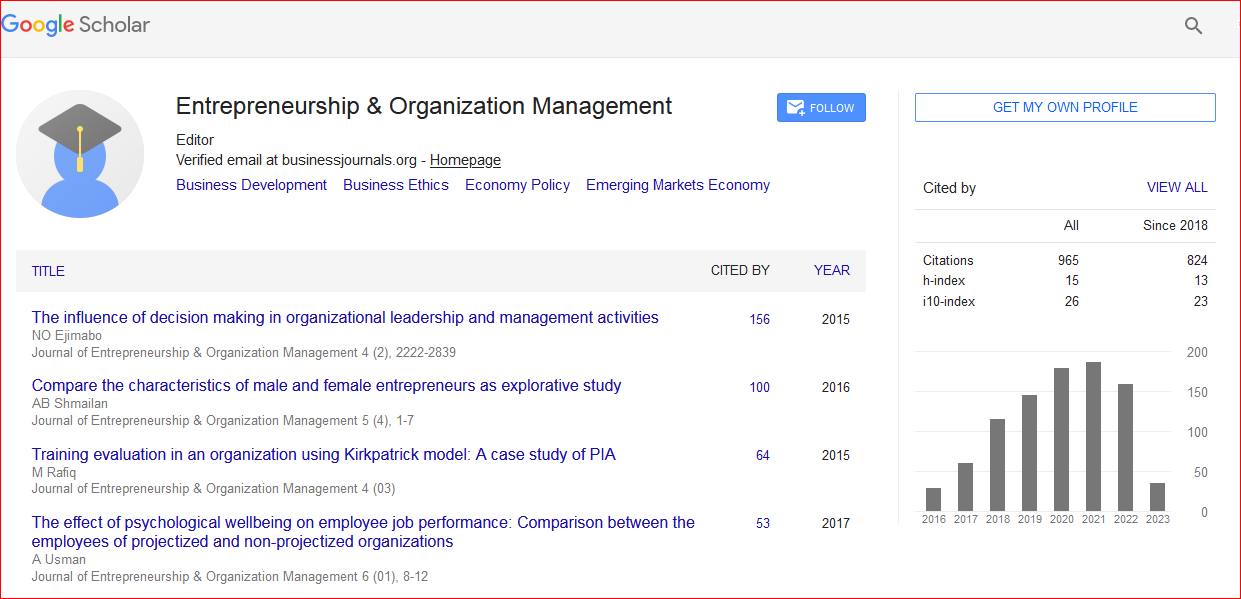
Entrepreneurship & Organization Management received 1115 citations as per Google Scholar report