Commentary - (2025) Volume 14, Issue 4
Received: 01-Aug-2025, Manuscript No. jeom-26-188184;
Editor assigned: 04-Aug-2025, Pre QC No. P-188184;
Reviewed: 18-Aug-2025, QC No. Q-188184;
Revised: 22-Aug-2025, Manuscript No. R-188184;
Published:
29-Aug-2025
, DOI: 10.37421/2169-026X.2025.14.547
Citation: Castro, Juliana. ”Navigating Sustainable Entrepreneurship: Strategies and Drivers.” J Entrepren Organiz Manag 14 (2025):547.
Copyright: © 2025 Castro J. This is an open-access article distributed under the terms of the Creative Commons Attribution License, which permits unrestricted use, distribution and reproduction in any medium, provided the original author and source are credited.
The landscape of business is undergoing a profound transformation, driven by an increasing imperative for sustainability. This shift necessitates a re-evaluation of traditional business models and the adoption of new strategies that integrate social and environmental considerations with economic viability. Social enterprises, in particular, are at the forefront of this movement, navigating complex environments to achieve both their mission and market success. Their ability to adapt and innovate within regulatory and institutional frameworks is critical for fostering sustainable development [1].
The performance of businesses committed to sustainability is intrinsically linked to how effectively they engage with their stakeholders. Building strong, collaborative relationships with a diverse range of stakeholders, from customers and employees to local communities and governing bodies, is not merely beneficial but essential for long-term resilience and impact. Proactive stakeholder management fosters legitimacy and ensures the enduring viability of these ventures [2].
Small and medium-sized enterprises (SMEs) in developing economies face unique challenges and opportunities in their pursuit of sustainability. The adoption of circular economy principles, for instance, is influenced by factors such as resource scarcity and market demand, but can be hindered by a lack of technical expertise and financial constraints. Understanding these drivers and barriers is crucial for enabling SMEs to integrate sustainable business models effectively [3].
Innovation serves as a powerful engine for sustainable entrepreneurship. Various forms of innovation, encompassing products, processes, social initiatives, and business models, all contribute significantly to achieving positive environmental and social outcomes. A comprehensive and holistic approach to innovation is paramount for creating enterprises that deliver lasting sustainability [4].
Developing green business models in emerging markets presents a distinct set of challenges and opportunities. Companies operating in these contexts must effectively balance profitability with ecological responsibility, often by leveraging local resources and addressing specific environmental concerns. A well-defined framework for designing and implementing these strategies is vital for success [5].
The pervasive influence of digital technologies is reshaping the realm of sustainable business development. Advanced tools such as artificial intelligence, big data analytics, and the Internet of Things (IoT) empower businesses to enhance resource efficiency, minimize waste generation, and develop more sustainable products and services. Digitalization holds immense transformative potential for achieving ambitious sustainability goals [6].
Securing adequate financing is a critical hurdle for sustainable ventures. The landscape of funding sources is diverse, including impact investors, green bonds, and venture capital. Entrepreneurs must understand the specific criteria and expectations of these investors to attract the necessary capital for their sustainable businesses, making an analysis of funding sources and investor expectations essential [7].
Organizational culture plays a pivotal role in nurturing sustainable entrepreneurship. A culture that inherently values ethical conduct, environmental stewardship, and social responsibility is fundamental to embedding sustainability into the core of business operations. Leadership commitment and active employee involvement are key determinants in cultivating such a supportive culture [8].
For entrepreneurial firms, effective sustainability reporting is crucial for building credibility and attracting support. Transparent and comprehensive reporting enhances legitimacy, appeals to investors, and strengthens stakeholder relationships. Tailoring reporting strategies to the specific needs of different types of sustainable ventures is therefore essential for maximizing their impact [9].
Government policy and support systems are instrumental in fostering the growth of sustainable entrepreneurship. A range of policy instruments, including tax incentives, subsidies, and appropriate regulatory frameworks, can significantly influence the development of sustainable businesses. Creating an enabling policy environment is a prerequisite for the widespread adoption of sustainable practices [10].
The institutional environment presents both challenges and opportunities for social enterprises aiming to drive sustainable development. Their success hinges on their capacity for adaptive strategies to surmount obstacles and achieve a dual objective of social and economic impact. A deep understanding of the local context is indispensable when formulating business models designed for sustainability [1].
Effective stakeholder engagement is a cornerstone for the performance of businesses focused on sustainability. Cultivating robust collaborations with a wide array of stakeholders, encompassing customers, employees, and local communities, is fundamental to establishing resilient and impactful ventures. The research indicates that proactive engagement with stakeholders enhances a business's legitimacy and its capacity for long-term survival [2].
Small and medium-sized enterprises (SMEs) in emerging economies are increasingly exploring the integration of circular economy principles. Key drivers for this adoption include escalating resource scarcity and growing market demand for sustainable products. However, significant barriers persist, such as a deficit in technical expertise and prevalent financial constraints. Practical guidance for SMEs seeking to implement circular business models is therefore highly valuable [3].
Innovation is a critical catalyst for advancing sustainable entrepreneurship. The study categorizes various forms of innovationâ??product, process, social, and business modelâ??and delineates their respective contributions to positive environmental and social outcomes. A holistic perspective on innovation is emphasized as being vital for the creation of enduring sustainability [4].
Emerging markets offer a dynamic context for the development of green business models, presenting both complex challenges and significant opportunities. Companies must adeptly balance the pursuit of profitability with a commitment to ecological responsibility, often by capitalizing on indigenous resources and addressing localized environmental issues. A conceptual framework for the design and implementation of effective green business strategies is proposed [5].
Digital technologies are proving to be transformative forces in the advancement of sustainable business development. Tools such as artificial intelligence, big data analytics, and the Internet of Things (IoT) enable businesses to optimize resource utilization, curtail waste, and innovate in the creation of sustainable products and services. The profound impact of digitalization on achieving sustainability objectives is highlighted [6].
The process of financing sustainable ventures involves navigating a complex ecosystem of funding sources. These range from specialized impact investors and green bonds to traditional venture capital. Entrepreneurs must comprehend the specific investment criteria and expectations associated with each source to effectively secure the capital required for their sustainable initiatives [7].
Organizational culture serves as a critical foundation for fostering sustainable entrepreneurship. A culture that actively promotes ethical behavior, champions environmental responsibility, and prioritizes social impact is essential for deeply embedding sustainability into operational practices. The research underscores the importance of committed leadership and active employee participation in cultivating such a culture [8].
Sustainability reporting by entrepreneurial firms is a key mechanism for enhancing their legitimacy and attractiveness to investors. Comprehensive and transparent reporting practices contribute to improved stakeholder relations and overall credibility. The effectiveness of reporting strategies is shown to vary depending on the specific characteristics of different sustainable ventures [9].
Policy and government support are pivotal in encouraging the expansion of sustainable entrepreneurship. Various policy mechanisms, including fiscal incentives, financial subsidies, and supportive regulatory frameworks, have been analyzed for their influence on the growth trajectory of sustainable businesses. The establishment of an enabling policy environment is recognized as a crucial factor [10].
This collection of research explores critical aspects of sustainable entrepreneurship. It highlights how social enterprises navigate institutional environments for sustainable development, emphasizing adaptive strategies and local context [1].
Stakeholder engagement is identified as crucial for the performance and legitimacy of sustainable ventures [2].
The study also examines drivers and barriers for SMEs adopting circular economy principles in developing economies [3].
Innovation, in its various forms, is presented as a key driver for sustainable entrepreneurship [4].
Research delves into developing green business models in emerging markets, balancing profitability with ecological responsibility [5].
The impact of digital technologies on resource efficiency and sustainable offerings is explored [6].
The financing landscape for sustainable ventures, including various investor expectations, is analyzed [7].
Organizational culture, driven by ethical behavior and leadership commitment, is found to foster sustainable entrepreneurship [8].
The effectiveness of sustainability reporting for entrepreneurial firms in enhancing legitimacy and stakeholder relations is investigated [9].
Finally, the role of supportive government policies in promoting sustainable businesses is discussed [10].
None
None
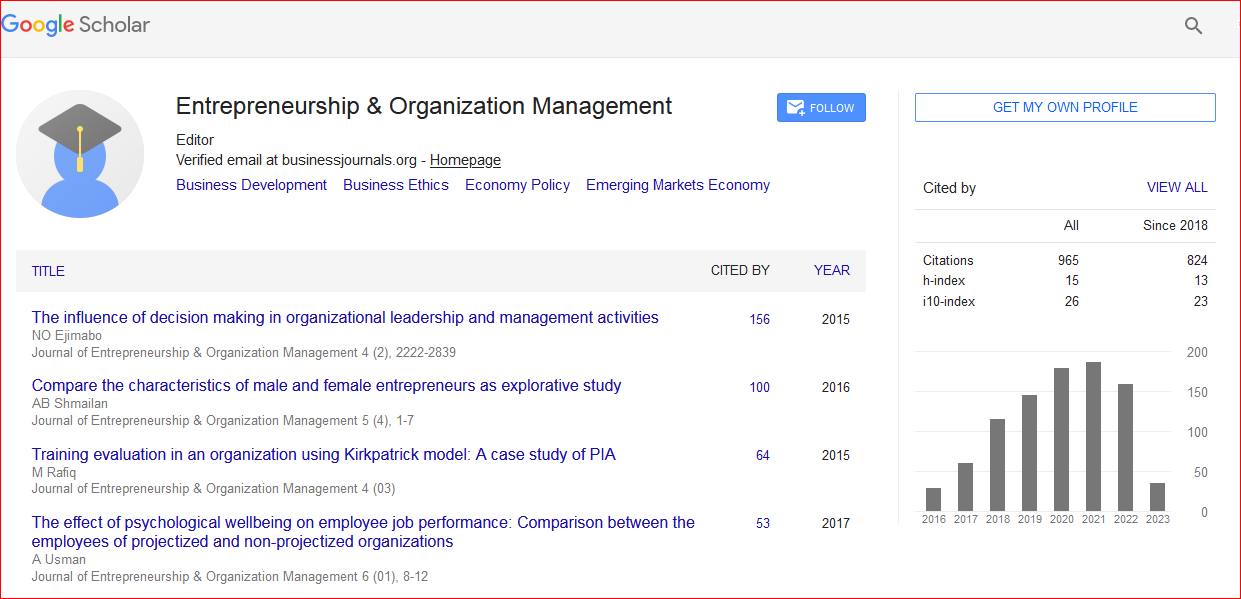
Entrepreneurship & Organization Management received 1115 citations as per Google Scholar report