Brief Report - (2025) Volume 15, Issue 3
Received: 01-May-2025, Manuscript No. jtese-26-184224;
Editor assigned: 05-May-2025, Pre QC No. P-184224;
Reviewed: 19-May-2025, QC No. Q-184224;
Revised: 22-May-2025, Manuscript No. R-184224;
Published:
29-May-2025
, DOI: 10.37421/2165-8064.2025.15.649
Citation: Turner, Michael J.. ”Natural Versus Synthetic Fibers: Properties and Applications.” J Textile Sci Eng 15 (2025):649.
Copyright: © 2025 Turner J. Michael This is an open-access article distributed under the terms of the Creative Commons Attribution License, which permits unrestricted use, distribution and reproduction in any medium, provided the original author and source are credited.
The realm of textile science is characterized by a persistent exploration into the fundamental properties and performance characteristics of various fiber types. This ongoing investigation is crucial for advancing material science, optimizing product design, and meeting diverse application demands across numerous industries. A primary dichotomy within textile fibers lies between those derived from natural sources and those engineered synthetically. Each class possesses inherent attributes that dictate their suitability for specific purposes, leading to a continuous comparative analysis aimed at understanding their respective strengths and limitations. Natural fibers, such as cellulose and protein-based materials, are celebrated for their inherent biocompatibility, biodegradability, and unique sensory qualities. Their molecular structures, forged through biological processes, impart characteristics like breathability and a distinct tactile feel. However, these intrinsic properties often come with trade-offs in terms of mechanical robustness and moisture management compared to their synthetic counterparts. The study by Khan et al. (2022) aptly highlights these distinctions, emphasizing the balance between performance and sustainability that guides material selection in apparel applications. In contrast, synthetic fibers are the product of meticulous chemical engineering, offering remarkable control over properties like tensile strength, durability, and resistance to environmental factors such as wrinkles. Through polymerization processes, these fibers can be tailored to achieve superior performance metrics, though concerns regarding their environmental persistence and breathability remain subjects of active research. The ability to engineer these fibers for specific applications underscores the advancements in material science and manufacturing techniques. The comparative evaluation of thermal comfort in textiles is another area of significant interest. Research, such as that by Miller et al. (2023), demonstrates that while natural fibers like cotton excel in warm conditions due to their moisture-wicking and breathability, synthetic blends provide superior insulation in colder climates. This indicates that the performance of a fabric is not solely dependent on the fiber type but also on its blend composition and structural configuration. Mechanical properties, including tensile strength, elongation, and abrasion resistance, are paramount for durability and performance in many applications. Wilson et al. (2021) have quantified the superior mechanical robustness of synthetic fibers, particularly in demanding scenarios like wear and tear. Nevertheless, the growing emphasis on sustainability is driving renewed interest in natural fibers and their potential for enhancement in composite materials and other advanced applications. Thermal conductivity, a critical factor in thermal regulation and energy efficiency, is also significantly influenced by fiber type. Rodriguez et al. (2023) illustrate how synthetic fibers can be engineered for precise thermal insulation values, making them ideal for technical apparel. Natural fibers, while possessing good insulating qualities, can exhibit performance variability influenced by environmental factors like humidity. Beyond bulk properties, the processing methods employed for both natural and synthetic fibers play a pivotal role in determining their final mechanical characteristics. Brown et al. (2020) underscore how advancements in synthetic fiber extrusion can yield exceptional strength-to-weight ratios, while modifications in natural fiber processing are essential for improving consistency and performance, alongside considerations for environmental impact. Thermal stability and degradation behavior under elevated temperatures are crucial for safety-critical applications. Sharma et al. (2022) reveal that synthetic fibers, especially those with aromatic structures, exhibit higher thermal resistance compared to most natural fibers, though natural fibers like silk and wool possess unique decomposition patterns that are also of scientific interest. Moisture management is a complex interplay of absorption and transport. Chen et al. (2023) differentiate between these properties, noting cotton's high absorption capacity and polyester blends' efficient transport. Understanding these nuances is key to designing fabrics that optimize comfort across a range of environmental conditions. Finally, the surface characteristics and morphology of fibers directly influence their wear resistance and durability. Ng et al. (2021) highlight the inherent uniformity of synthetic fibers leading to superior abrasion resistance, while also pointing to methods for enhancing the durability of natural fibers through surface treatments and structural modifications, further broadening the scope of their potential applications.
The fundamental differences in mechanical and thermal properties between natural and synthetic fibers are extensively documented, stemming from their distinct molecular structures and bonding mechanisms. Natural fibers, such as cellulose and protein-based materials, inherently exhibit characteristics like breathability and biodegradability, often accompanied by a pleasant tactile feel. However, these attributes can be associated with lower tensile strength and higher moisture absorption when compared to many synthetic alternatives. Conversely, synthetic fibers, manufactured through sophisticated polymerization processes, typically offer superior strength, enhanced durability, excellent wrinkle resistance, and controllable thermal insulation. Yet, their environmental persistence and sometimes limited breathability present ongoing challenges. The choice between these fiber types is critically dependent on the intended application, necessitating a careful calibration of performance requirements against sustainability considerations [1].
The research comparing the thermal comfort properties of natural fibers like cotton with synthetic blends such as polyester and nylon reveals nuanced performance profiles. Cotton generally demonstrates superior moisture wicking and breathability, making it more comfortable in warm conditions. In contrast, synthetic blends are often engineered to provide enhanced thermal insulation, proving advantageous in colder environments. Moreover, the impact of fabric structure and finishing treatments can significantly influence these properties, suggesting that strategic blending and modification can effectively bridge any perceived performance gaps between natural and synthetic fibers [2].
Mechanical characterization studies focusing on tensile strength, elongation, and abrasion resistance consistently highlight the superior robustness of synthetic fibers, particularly in terms of wear and tear. Materials like recycled PET and nylon 6 exhibit remarkable durability. Simultaneously, there is a growing appreciation for natural fibers, such as hemp and flax, owing to their favorable sustainability profiles and unique aesthetic qualities. These fibers are also finding utility in composite applications where their mechanical reinforcement properties are essential [3].
Investigating the thermal conductivity of textiles demonstrates a clear influence of fiber type on heat transfer mechanisms. Synthetic fibers, often characterized by lower moisture regain and controlled morphology, can be precisely engineered to achieve specific thermal insulation values, making them highly suitable for performance wear. Natural fibers, such as wool, offer good insulating properties due to their complex microstructures, although their performance can be modulated by ambient humidity levels. This understanding is vital for designing textiles adapted to diverse climatic conditions [4].
Advancements in processing techniques have a profound impact on the mechanical properties of both natural and synthetic yarns. Synthetic fiber extrusion and drawing processes can yield materials with exceptional strength-to-weight ratios. For natural fibers, processing modifications are indispensable for improving consistency and performance, often involving treatments to enhance dimensional stability and reduce the incidence of fiber breakage. The environmental implications of these processing techniques are also a critical consideration in modern textile manufacturing [5].
Thermal stability and degradation behavior under high temperatures vary significantly among different textile fibers. Synthetic fibers, particularly those incorporating aromatic structures like aramids, generally exhibit markedly higher thermal resistance than most natural fibers. Nonetheless, natural fibers such as silk and wool display unique decomposition patterns that are of scientific interest. This research is crucial for applications demanding stringent fire resistance and high-temperature performance, providing essential comparative data on decomposition kinetics [6].
The moisture management capabilities of fabrics are intrinsically linked to the fiber composition. Natural fibers like cotton excel in moisture absorption, contributing to a cooling sensation, while synthetic blends, such as polyester, are engineered for rapid moisture transport, thereby preventing a clammy feeling against the skin. This distinction between absorption and transport is fundamental to understanding and engineering textiles for optimal comfort under varying physiological and environmental conditions [7].
Wear resistance and durability in textiles are significantly influenced by fiber morphology and surface characteristics. Synthetic fibers, due to their inherent uniformity and controlled surface properties, often demonstrate superior abrasion resistance. While natural fibers may offer advantages in terms of feel and biodegradability, they can be more susceptible to mechanical damage. Research in this area explores methods for enhancing the durability of natural fibers through targeted surface treatments and structural modifications [8].
The electrical properties of textile fibers are of increasing importance for functional textiles, including smart textiles and anti-static applications. Synthetic fibers can be tailored to exhibit specific conductive or insulating properties, opening up a broad spectrum of functional capabilities. Natural fibers, generally more conductive due to their moisture absorption tendencies, present a different set of challenges and opportunities in this regard. Comparative analysis of dielectric properties and surface resistivity informs material selection for specialized uses [9].
Flame retardancy is a critical safety parameter, and it varies considerably between natural and synthetic fibers based on their inherent chemical structures. Synthetic fibers often require the addition of flame-retardant treatments, which can sometimes raise environmental concerns. Conversely, natural fibers like wool possess intrinsic flame resistance owing to their proteinaceous composition and charring behavior, making them suitable for applications with high safety requirements. Comparative data on limiting oxygen index (LOI) values and decomposition products are essential for this assessment [10].
This compilation of research explores the diverse properties of natural and synthetic textile fibers. Natural fibers are highlighted for their breathability, biodegradability, and tactile qualities, while synthetic fibers offer superior strength, durability, and wrinkle resistance. Key areas of comparison include mechanical properties like tensile strength and abrasion resistance, where synthetics often lead, and thermal properties, with natural fibers excelling in comfort in warm conditions and synthetics providing better insulation in the cold. Moisture management, thermal stability, flame retardancy, and electrical properties are also discussed, revealing distinct performance profiles. Processing methods and surface characteristics significantly influence fiber performance, leading to ongoing research in enhancing natural fiber durability and functionalizing both types for specific applications. The overarching theme emphasizes the trade-offs between performance, sustainability, and application requirements when selecting between natural and synthetic fibers.
None
None
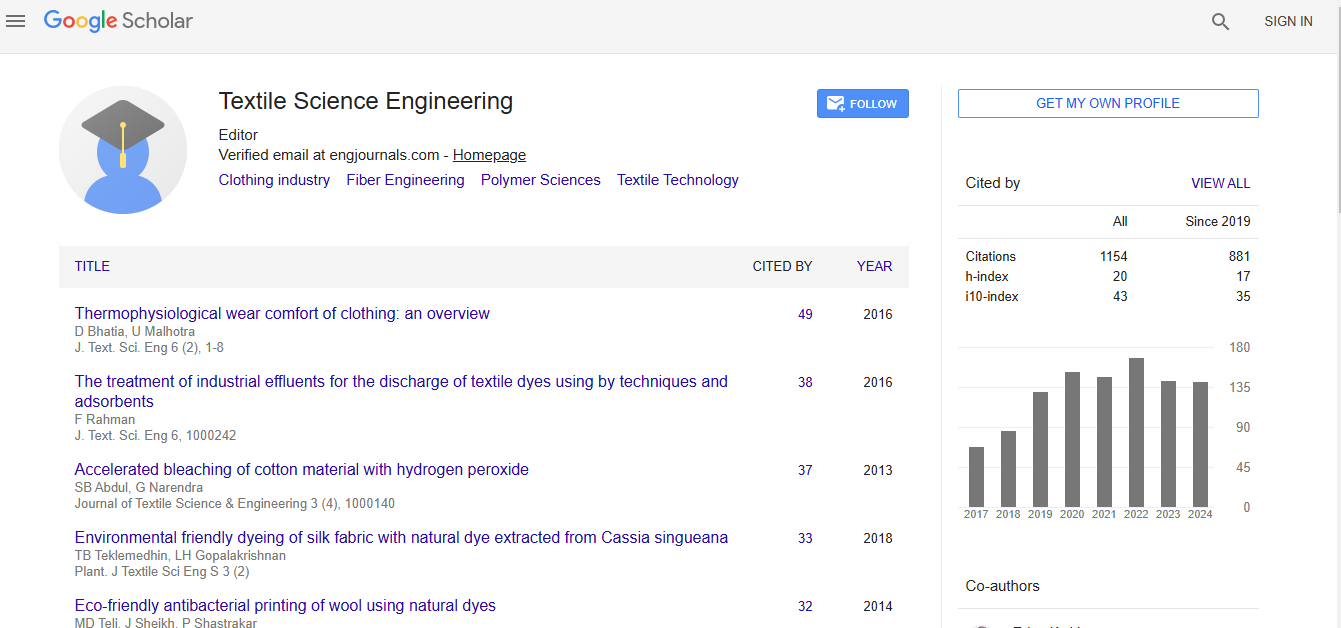
Journal of Textile Science & Engineering received 1008 citations as per Google Scholar report