Perspective - (2025) Volume 11, Issue 3
Received: 02-Jun-2025, Manuscript No. JOV-26-186421;
Editor assigned: 04-Jun-2025, Pre QC No. P-186421;
Reviewed: 18-Jun-2025, QC No. Q-186421;
Revised: 23-Jun-2025, Manuscript No. R-186421;
Published:
30-Jun-2025
, DOI: 10.37421/2471-9544.2025.11.308
Citation: Fernandez, Sofia. ”Vascular Misalignment’s Inflammatory Autoimmune Cascade.” J Vasc 11 (2025):308.
Copyright: © 2025 Fernandez S. This is an open-access article distributed under the terms of the Creative Commons Attribution License, which permits unrestricted use, distribution and reproduction in any medium, provided the original author and source are credited.
Vascular misalignment represents a critical and complex pathological process, particularly salient in the context of inflammatory and autoimmune conditions. This intricate dynamic is characterized by a feedback loop where initial alterations in blood vessels precipitate secondary inflammatory responses, leading to progressive structural and functional deterioration. The concept of the "Spiral Cascade of Vascular Misalignment" elucidates how subtle changes in endothelial function, smooth muscle tone, and perivascular inflammation can exponentially compromise vascular integrity and blood flow, a fundamental understanding crucial for diseases such as vasculitis. Understanding this cascade is paramount for the development of targeted therapeutic strategies capable of interrupting the detrimental cycle before irreversible damage occurs [1].
The sophisticated interplay between immune cells and the vascular endothelium is central to the initiation and propagation of vascular damage in various inflammatory conditions. Dysregulated immune responses can trigger endothelial activation, augment vascular permeability, and promote leukocyte recruitment, thereby establishing the foundation for a cascading pathological process that significantly impacts vessel structure and function. This intricate interaction is a key factor in the development and worsening of vascular pathology in inflammatory states [2].
Inflammatory mediators play a pivotal role in both initiating and amplifying vascular damage. Specific cytokines and chemokines possess the capacity to disrupt the delicate equilibrium of the vascular wall, fostering smooth muscle cell proliferation, extracellular matrix remodeling, and ultimately, vascular misalignment. This underscores the critical importance of elucidating these molecular pathways to identify effective therapeutic targets. Investigating these pathways is essential for developing interventions against vascular damage [3].
The structural integrity of blood vessels is meticulously maintained through a balanced interplay of cellular and molecular signals. Disruptions to this equilibrium, especially those induced by inflammatory insults, can culminate in progressive deterioration. Research into the cellular mechanisms underlying vascular remodeling in inflammatory diseases offers valuable insights into how initial vascular changes can escalate into more significant structural abnormalities. This understanding is vital for addressing vascular remodeling in disease [4].
Autoimmune diseases frequently present with substantial vascular involvement. Aberrant immune responses in conditions like rheumatoid arthritis can directly compromise blood vessels, inducing inflammation and structural alterations. This provides a perspective on how a systemic inflammatory process can translate into localized vascular pathology, thereby contributing to the overall disease cascade. Recognizing this link is important for managing vascular complications [5].
The principle of feedback loops is fundamental to comprehending cascading processes. In the context of vascular misalignment, inflammatory signals can instigate positive feedback mechanisms, where initial damage provokes further inflammation, perpetuating and amplifying the pathological problem. Investigations into these feedback mechanisms within inflammatory vasculopathies are crucial. Exploring these feedback loops is key to understanding disease progression [6].
The endothelium serves as a critical interface between the bloodstream and the vessel wall, and its dysfunction is an early indicator in numerous vascular diseases. When activated by inflammatory signals, endothelial cells contribute to increased vascular permeability and leukocyte adhesion, thereby initiating the cascade of vascular misalignment. Understanding endothelial cell roles is vital in vascular disease [7].
Beyond inflammatory influences, mechanical forces and structural alterations within the vessel wall can also contribute to vascular misalignment. Examining the biomechanical aspects of vascular disease reveals how changes in vessel wall composition and geometry can exacerbate inflammatory processes, leading to a self-sustaining cycle of damage. Considering biomechanical factors is important for a comprehensive view [8].
The progression of vasculitis typically involves a complex synergy of immunological, cellular, and structural changes within affected blood vessels. Initial inflammatory insults can trigger a cascade of events, including endothelial activation, smooth muscle cell dysfunction, and extracellular matrix degradation, ultimately leading to vascular wall remodeling and misalignment. These findings highlight the necessity for early and comprehensive management strategies to interrupt this detrimental process. Effective management requires understanding the full cascade [9].
Vascular repair mechanisms are essential for maintaining vessel homeostasis. However, in chronic inflammatory conditions, these repair processes can become dysregulated, promoting pathological remodeling and misalignment. Research in this area examines how inflammatory mediators interfere with normal vascular repair, fostering a pro-fibrotic and pro-stenotic environment that exacerbates vascular damage. Addressing aberrant repair is a therapeutic goal [10].
Vascular misalignment is a critical pathological process, particularly relevant in inflammatory and autoimmune conditions, characterized by a feedback loop where initial vessel changes trigger secondary inflammatory responses, leading to progressive structural and functional deterioration. The "Spiral Cascade of Vascular Misalignment" describes how subtle alterations in endothelial function, smooth muscle tone, and perivascular inflammation can exponentially worsen vascular integrity and blood flow, a key concept in understanding diseases like vasculitis. Understanding this cascade is essential for developing targeted therapies to interrupt the cycle before irreversible damage occurs [1].
The intricate relationship between immune cells and the vascular endothelium is central to the development and spread of vascular damage in inflammatory conditions. Dysregulated immune responses can result in endothelial activation, increased vascular permeability, and leukocyte recruitment, setting the stage for a cascading pathological process that affects vessel structure and function. This interplay is fundamental to vascular pathology in inflammatory states [2].
Inflammatory mediators are pivotal in initiating and amplifying vascular damage. Specific cytokines and chemokines can disrupt the delicate balance of the vascular wall, leading to smooth muscle cell proliferation, extracellular matrix remodeling, and vascular misalignment, highlighting the importance of understanding these molecular pathways for identifying therapeutic targets. These molecular pathways are crucial for therapeutic development [3].
The structural integrity of blood vessels is maintained by a balance of cellular and molecular signals. Disruption of this balance, particularly by inflammatory insults, can lead to progressive deterioration. Research examining the cellular mechanisms of vascular remodeling in inflammatory disease provides insights into how initial vascular changes can escalate into more significant structural abnormalities. Understanding cellular mechanisms is key to addressing vascular remodeling [4].
Autoimmune diseases often exhibit significant vascular involvement. Aberrant immune responses in conditions like rheumatoid arthritis can directly impact blood vessels, causing inflammation and structural changes. This illustrates how a systemic inflammatory process can manifest as localized vascular pathology, contributing to the overall disease cascade. This systemic-to-local translation is important in autoimmune diseases [5].
The concept of feedback loops is vital for understanding cascading processes. In vascular misalignment, inflammatory signals can create positive feedback, where initial damage prompts more inflammation, perpetuating and amplifying the problem. Research focusing on these feedback mechanisms in inflammatory vasculopathies is crucial. Identifying and targeting feedback mechanisms is important for intervention [6].
The endothelium serves as a critical interface between the blood and the vessel wall, and its dysfunction is an early event in many vascular diseases. Activated endothelial cells contribute to increased vascular permeability and leukocyte adhesion, initiating the cascade of vascular misalignment. Endothelial cell activation is a primary event in the cascade [7].
Beyond inflammation, mechanical forces and structural changes within the vessel wall contribute to misalignment. Alterations in vessel wall composition and geometry can exacerbate inflammatory processes, creating a self-perpetuating cycle of damage. Biomechanical factors play a significant role alongside inflammation [8].
The progression of vasculitis involves a complex interplay of immunological, cellular, and structural changes. Initial inflammatory insults lead to endothelial activation, smooth muscle cell dysfunction, and extracellular matrix degradation, resulting in vascular wall remodeling and misalignment, underscoring the need for early and comprehensive management to interrupt this cascade. Comprehensive management is needed to halt the progression [9].
Vascular repair mechanisms are vital for homeostasis, but in chronic inflammatory conditions, these processes can become dysregulated, promoting pathological remodeling and misalignment. Inflammatory mediators interfere with normal vascular repair, fostering a pro-fibrotic and pro-stenotic environment that worsens vascular damage. Dysregulated repair contributes significantly to disease severity [10].
Vascular misalignment is a significant pathological process, especially in inflammatory and autoimmune conditions. It involves a cascade where initial vascular changes trigger inflammatory responses, leading to worsening structural and functional integrity. This process is driven by the interplay of immune cells and the vascular endothelium, inflammatory mediators, cellular mechanisms of vascular remodeling, biomechanical factors, and dysregulated vascular repair. Understanding the feedback loops and endothelial cell activation is crucial for developing targeted therapies. Autoimmune diseases often manifest with vascular involvement, highlighting the systemic impact on blood vessels. Early and comprehensive management strategies are essential to interrupt this detrimental cascade and prevent irreversible damage.
None
None
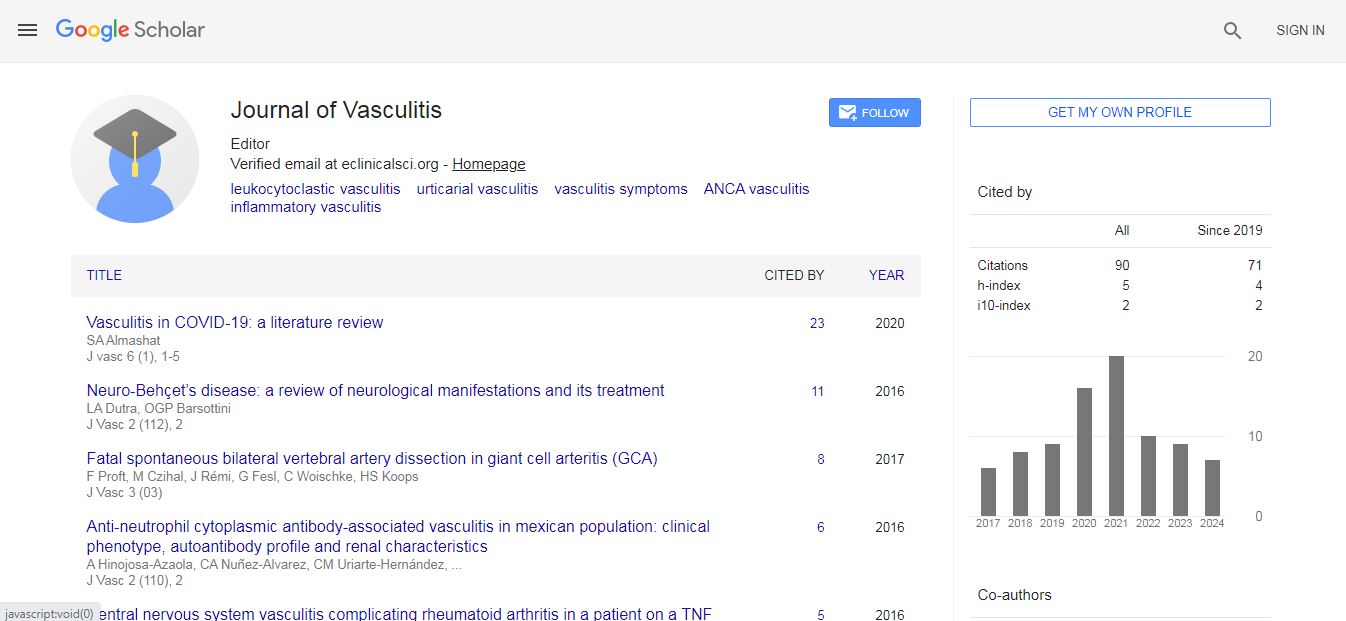
Journal of Vasculitis received 83 citations as per Google Scholar report