Perspective - (2025) Volume 10, Issue 6
Received: 01-Dec-2025, Manuscript No. jcct-26-183281;
Editor assigned: 03-Dec-2025, Pre QC No. P-183281;
Reviewed: 17-Dec-2025, QC No. Q-183281;
Revised: 22-Dec-2025, Manuscript No. R-183281;
Published:
29-Dec-2025
, DOI: 10.37421/2577-0535.2025.9.344
Citation: Dubois, Pauline R.. ”Oncology Outcome Prediction: Precision Medicine Through Data.” J Cancer Clin Trials 10 (2025):344.
Copyright: © 2025 Dubois R. Pauline This is an open-access article distributed under the terms of the Creative Commons Attribution License, which permits unrestricted use, distribution and reproduction in any medium, provided the original author and source are credited.
Outcome prediction models are profoundly transforming oncology, heralding a new era of precision medicine and streamlined clinical research. These sophisticated tools are instrumental in stratifying patients based on their predicted responses to various therapies, thereby optimizing the design of clinical trials and enabling highly personalized treatment strategies. By integrating a diverse array of data, including genomic profiles, detailed clinical histories, and advanced imaging results, these models aim to forecast critical outcomes such as treatment efficacy, patient survival rates, and the likelihood of experiencing treatment-related toxicities. The ultimate goal is to facilitate more efficient and effective clinical trials, ultimately accelerating the pace at which novel and life-saving cancer therapies are developed and brought to patients in need [1].
The integration of real-world data (RWD) into predictive modeling frameworks is becoming increasingly vital for the advancement of oncology research. RWD offers invaluable insights into treatment effectiveness and patient outcomes across broader and more diverse populations than are typically represented in conventional clinical trials. When subjected to advanced statistical and machine learning analyses, this real-world information can significantly inform the design of future trials, aid in the identification of potential predictive biomarkers, and enhance the generalizability and applicability of findings derived from clinical studies to the wider patient community [2].
Predictive models designed to forecast cancer treatment response are foundational to the concept of precision medicine. These models meticulously analyze patient-specific factors, such as genetic mutations, tumor characteristics, and previous treatment history, to accurately predict the probability of a positive response to different therapeutic interventions. This predictive capability empowers clinicians to make more informed treatment selections, potentially sparing patients from undergoing ineffective treatments and enduring associated toxicities, thereby improving both therapeutic efficacy and overall quality of life [3].
The development of robust prognostic models is of paramount importance for accurately understanding cancer patient trajectories and optimizing their ongoing clinical management. These models are capable of predicting crucial aspects of a patient's disease course, including the likelihood of disease progression, the risk of recurrence following initial treatment, and the projected overall survival duration. By providing these critical insights, prognostic models actively guide therapeutic decisions, inform patient counseling, and help set realistic expectations for patients and their families. Continued advances in computational biology and data integration methodologies are progressively enhancing the accuracy and clinical utility of these essential prognostic tools [4].
Biomarker discovery and validation processes within oncology research are experiencing significant acceleration thanks to the application of predictive modeling techniques. By systematically analyzing large-scale datasets, these models are adept at identifying novel molecular signatures that are strongly associated with either a positive response to therapy or the development of treatment resistance. This ability to pinpoint relevant biomarkers is crucial for the development of targeted therapies and companion diagnostics, which are indispensable components of modern cancer drug development strategies [5].
Optimizing the design of clinical trials represents one of the most significant benefits offered by predictive modeling in the field of oncology. These models can effectively identify specific patient populations that are most likely to derive substantial benefit from a particular therapeutic intervention, allowing for more precise patient stratification and thereby enhancing overall trial efficiency. Furthermore, predictive models can even offer insights into potential patient drop-out rates, enabling proactive strategies to mitigate such occurrences. The cumulative effect of these optimizations is the development of clinical trials that are smaller, faster to complete, and more cost-effective, leading to quicker therapeutic advancements [6].
The application of natural language processing (NLP) techniques to analyze unstructured clinical text data is significantly amplifying the power and reach of predictive models in oncology. NLP algorithms are capable of extracting valuable and often subtle information from sources such as physician notes, pathology reports, and radiology findings, data that is frequently overlooked or difficult to process when relying solely on structured data formats. By incorporating this richer, more comprehensive dataset, the accuracy and completeness of predictive algorithms can be substantially improved, leading to more reliable predictions and better clinical decision support [7].
Ethical considerations and navigating regulatory challenges are of paramount importance when deploying outcome prediction models within the complex landscape of clinical research. Ensuring the privacy of sensitive patient data, guaranteeing algorithmic fairness across diverse patient groups, and maintaining transparency in model operations are all critical prerequisites for building trust and facilitating the responsible adoption of these powerful technologies. The development of clear ethical guidelines, robust validation frameworks, and transparent reporting standards is essential to successfully address these inherent complexities and ensure patient safety and well-being [8].
Improving the interpretability of complex predictive models, particularly those based on deep learning architectures, is a critical area of ongoing research and development in oncology. Clinicians and researchers require a clear understanding of the underlying reasoning behind a model's predictions to foster trust, enable informed clinical decision-making, and ensure patient confidence. The advancement and widespread adoption of 'explainable AI' (XAI) methods are therefore vital for translating the immense potential of these powerful predictive tools into routine clinical practice and cutting-edge research endeavors [9].
The successful integration of multi-modal data, encompassing diverse sources such as medical imaging, detailed genomic information, and comprehensive clinical records, is fundamental to the construction of more powerful and accurate predictive models in oncology. This holistic approach allows for a more complete understanding of the tumor microenvironment, patient biology, and disease trajectory. Advanced machine learning techniques are indispensable for effectively fusing and analyzing these disparate data streams, ultimately leading to significant improvements in prediction accuracy and clinical utility [10].
Outcome prediction models are revolutionizing oncology research by enabling more precise patient stratification, optimizing clinical trial design, and facilitating personalized treatment approaches. These models harness diverse data types, including genomic, clinical, and imaging information, to forecast treatment responses, survival probabilities, and potential toxicities. Their implementation leads to more efficient and effective clinical trials, thereby accelerating the development of novel cancer therapies [1].
The integration of real-world data (RWD) into predictive models is critical for advancing oncology clinical research. RWD provides insights into treatment effectiveness and patient outcomes in diverse populations beyond those typically enrolled in clinical trials. When analyzed using advanced statistical and machine learning methods, RWD can inform trial design, identify potential biomarkers, and improve the generalizability of trial findings [2].
Predictive models for cancer treatment response are vital for precision medicine. By analyzing patient-specific factors, these models can forecast the likelihood of a positive response to various therapies, facilitating informed treatment selection. This approach can spare patients from ineffective treatments and associated toxicities, improving both efficacy and quality of life [3].
Robust prognostic models are essential for understanding cancer patient trajectories and optimizing clinical management. These models predict disease progression, recurrence risk, and overall survival, guiding therapeutic decisions and patient counseling. Advances in computational biology and data integration are enhancing the accuracy and utility of these prognostic tools [4].
Biomarker discovery and validation are significantly accelerated by predictive modeling in oncology research. By analyzing large-scale datasets, models can identify novel molecular signatures associated with treatment response or resistance. This facilitates the development of targeted therapies and companion diagnostics, critical components of modern cancer drug development [5].
Optimizing clinical trial design is a key benefit of predictive modeling in oncology. Models can help identify patient populations most likely to benefit from a specific intervention, stratify patients for better trial efficiency, and even predict potential drop-out rates. This leads to smaller, faster, and more cost-effective trials [6].
The application of natural language processing (NLP) in analyzing unstructured clinical text is enhancing the power of predictive models in oncology. NLP can extract valuable information from physician notes, pathology reports, and radiology findings, which are often missed by structured data alone. This richer dataset improves the accuracy and comprehensiveness of predictive algorithms [7].
Ethical considerations and regulatory challenges are paramount when deploying outcome prediction models in clinical research. Ensuring data privacy, algorithmic fairness, and transparency are critical for building trust and facilitating the responsible adoption of these technologies. Clear guidelines and validation frameworks are needed to navigate these complexities [8].
The interpretability of complex predictive models, particularly deep learning algorithms, is a significant area of focus in oncology. Understanding why a model makes a certain prediction is crucial for clinician buy-in and patient trust. Developing 'explainable AI' (XAI) methods is vital for translating these powerful tools into routine clinical practice and research [9].
Integrating multi-modal data, such as imaging, genomics, and clinical records, is key to building more powerful predictive models in oncology. This approach captures a more holistic view of the tumor microenvironment and patient biology. Advanced machine learning techniques are essential for effectively fusing and analyzing these diverse data streams to improve prediction accuracy [10].
Outcome prediction models in oncology are revolutionizing clinical research by enabling personalized treatment strategies and optimizing clinical trial design through the integration of diverse data sources like genomics, clinical information, and imaging. Real-world data (RWD) further enhances these models, providing insights into broader patient populations and improving the generalizability of findings. These predictive tools are vital for precision medicine, forecasting treatment response, and identifying biomarkers, thereby accelerating the development of targeted therapies and companion diagnostics. Prognostic models assist in understanding patient trajectories and guiding management decisions. The application of natural language processing (NLP) enhances model accuracy by extracting information from unstructured clinical text. While powerful, ethical considerations, regulatory challenges, and the interpretability of complex models (explainable AI) are critical areas that require careful attention for responsible implementation. The integration of multi-modal data is key to building more robust and accurate predictive capabilities in oncology.
None
None
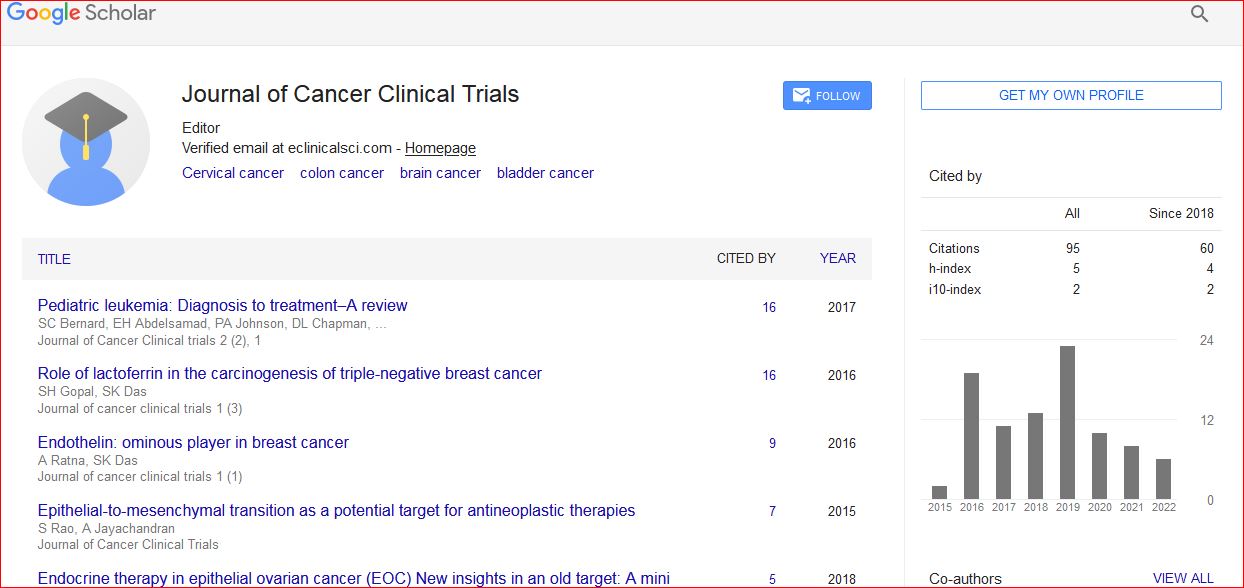
Journal of Cancer Clinical Trials received 95 citations as per Google Scholar report