Commentary - (2026) Volume 16, Issue 2
Received: 02-Mar-2026, Manuscript No. jnt-26-191283;
Editor assigned: 04-Mar-2026, Pre QC No. P-191283;
Reviewed: 18-Mar-2026, QC No. Q-191283;
Revised: 23-Mar-2026, Manuscript No. R-191283;
Published:
30-Mar-2026
, DOI: 10.37421/2161-0959.2026.16.616
Citation: Zielinski, Tomasz. ”Nanomedicine Revolutionizes Nephrology: Diagnostics and Therapeutics.” J Nephrol Ther 16 (2026):616.
Copyright: © 2026 Zielinski T. This is an open-access article distributed under the terms of the Creative Commons Attribution License, which permits unrestricted use, distribution and reproduction in any medium, provided the original author and source are credited.
Nanomedicine is rapidly emerging as a transformative field in nephrology, offering innovative approaches for both the diagnosis and treatment of kidney diseases. This advanced area leverages the unique properties of materials at the nanoscale to create novel therapeutic strategies and diagnostic tools that can target specific kidney tissues and biomarkers with unprecedented precision [1].
The advent of nanotechnology promises to revolutionize how we understand, detect, and manage renal pathologies, moving towards more personalized and effective patient care. The application of nanotechnology in the early diagnosis of kidney diseases is a critical area of development. Nanoparticles can be engineered to recognize and bind to specific biomarkers present in urine or blood, enabling the detection of disease progression at its earliest stages. This early detection is crucial for timely interventions and improving patient outcomes, potentially preventing or slowing the advancement of chronic kidney conditions [2].
Targeted drug delivery systems utilizing nanoparticles represent a cornerstone of nanomedicine's therapeutic potential in nephrology. These systems are designed to deliver renoprotective agents directly to damaged renal cells or tissues. By concentrating therapeutic agents at the site of injury, systemic side effects are minimized, and treatment efficacy is enhanced, offering new hope for managing complex kidney disorders such as diabetic nephropathy [3].
Magnetic nanoparticles (MNPs) are proving to be versatile tools in the realm of nephrology, particularly for advanced diagnostic imaging and targeted therapeutic delivery. Their unique magnetic properties enable enhanced contrast in MRI, aiding in the detailed visualization of kidney pathology. Moreover, MNPs can be functionalized to carry therapeutic payloads, which can then be precisely guided to specific kidney regions using external magnetic fields, allowing for highly controlled treatment [4].
Liposomes and polymeric nanoparticles are extensively investigated for their therapeutic capabilities in kidney diseases. These nanocarriers possess the ability to encapsulate various therapeutic molecules, including anti-inflammatory agents and gene therapies, facilitating sustained release and improved bioavailability within the renal microenvironment. Their inherent biocompatibility and tunable properties make them prime candidates for next-generation nephrological treatments [5].
Quantum dots (QDs) possess unique photophysical characteristics that are being explored for sophisticated renal diagnostics. Their remarkable photostability and adjustable emission wavelengths allow for the multiplexed detection of various biomarkers and an improvement in imaging resolution within preclinical studies. Potential applications include the detailed visualization of kidney vasculature and the identification of specific cellular targets for therapeutic intervention [6].
Gold nanoparticles (AuNPs) are increasingly being adopted in nephrology due to their excellent biocompatibility and adaptable surface functionalization. AuNPs can be engineered as effective drug delivery vehicles or integrated into biosensors for the detection of kidney-related analytes. Furthermore, their surface plasmon resonance properties make them suitable for photothermal therapies aimed at targeting aberrant renal cells [7].
Dendrimers, a class of highly branched macromolecules with well-defined structures, are exceptionally suited for drug delivery and imaging applications in renal medicine. The multiple surface functional groups on dendrimers allow for the facile attachment of drugs, targeting ligands, and imaging agents. This versatility enables the enhancement of drug solubility and stability, as well as targeted accumulation within compromised kidney tissues [8].
Exosomes, which are naturally occurring nanovesicles, are being investigated as promising therapeutic agents and drug delivery platforms in nephrology. These vesicles possess the inherent capability to transport therapeutic molecules and exhibit natural tissue-targeting properties. Modulating exosome production or engineering them to deliver specific therapeutic payloads presents a significant avenue for treating conditions such as kidney fibrosis and inflammation [9].
The synergy between artificial intelligence (AI) and nanomedicine in nephrology holds substantial promise for personalized diagnostics and therapeutics. AI algorithms can process extensive datasets derived from nanomaterial interactions and patient responses to optimize nanodrug design, predict treatment outcomes, and identify novel biomarkers for early disease detection. This integration is poised to accelerate the clinical translation of nanomedicine advancements [10].
Nanomedicine is revolutionizing nephrology by offering novel diagnostic tools and therapeutic strategies. Nanoparticles can be engineered for targeted drug delivery to damaged kidney tissues, minimizing systemic side effects and improving treatment efficacy for conditions like acute kidney injury and chronic kidney disease. Additionally, nanomaterials are showing promise in early disease detection through enhanced imaging and biomarker identification, paving the way for more personalized and proactive renal care [1].
The application of nanotechnology in diagnosing kidney diseases is rapidly evolving. Nanoparticles can be designed to bind specifically to renal biomarkers, enabling earlier and more sensitive detection of disease progression. This includes the development of nanosensors for detecting proteinuria, inflammation, and oxidative stress in urine or blood, potentially leading to earlier interventions and better patient outcomes [2].
Targeted drug delivery systems utilizing nanoparticles are a cornerstone of nanomedicine in nephrology therapeutics. These systems can ferry renoprotective agents directly to injured renal tubules or glomeruli, enhancing drug concentration at the site of damage while minimizing exposure of other organs to potentially toxic treatments. This approach holds significant promise for managing conditions like diabetic nephropathy and hypertensive nephrosclerosis [3].
Magnetic nanoparticles (MNPs) are emerging as versatile tools in nephrology, particularly for diagnostic imaging and targeted delivery. Their superparamagnetic properties allow for enhanced contrast in MRI, aiding in the visualization of renal pathology. Furthermore, MNPs can be functionalized to carry drugs or therapeutic agents, which can then be guided to specific kidney regions using external magnetic fields, offering precise therapeutic control [4].
Liposomes and polymeric nanoparticles are being extensively investigated for their therapeutic potential in kidney diseases. These nanocarriers can encapsulate various therapeutic molecules, including anti-inflammatory agents, immunosuppressants, and gene therapies, for sustained release and improved bioavailability within the renal microenvironment. Their biocompatibility and tunable properties make them attractive candidates for developing next-generation nephrological treatments [5].
Quantum dots (QDs) offer unique photophysical properties that are being explored for advanced renal diagnostics. Their high photostability and tunable emission wavelengths allow for multiplexed biomarker detection and improved imaging resolution in preclinical studies. Potential applications include visualizing kidney vasculature and identifying specific cellular targets for therapeutic intervention [6].
The use of gold nanoparticles (AuNPs) in nephrology is gaining traction due to their biocompatibility and versatile surface functionalization capabilities. AuNPs can be designed as drug delivery vehicles or as components of biosensors for detecting kidney-related analytes. Their surface plasmon resonance properties also make them suitable for photothermal therapies, which could target abnormal renal cells [7].
Dendrimers represent a class of highly branched macromolecules with precise structures that are well-suited for drug delivery and imaging in renal applications. Their multiple surface functional groups allow for the attachment of drugs, targeting ligands, and imaging agents. Dendrimers can be engineered to enhance drug solubility and stability, and to achieve targeted accumulation in damaged kidney tissues [8].
Exosomes, naturally occurring nanovesicles, are being explored as therapeutic agents and drug delivery platforms in nephrology. These vesicles can carry therapeutic molecules and have inherent tissue-targeting capabilities. Modulating exosome production or engineering them to deliver specific therapeutic payloads offers a promising avenue for treating kidney fibrosis and inflammation [9].
The integration of artificial intelligence (AI) with nanomedicine in nephrology holds immense potential for personalized diagnostics and therapeutics. AI algorithms can analyze vast datasets from nanomaterial interactions and patient responses to optimize nanodrug design, predict treatment efficacy, and identify novel biomarkers for early disease detection, thereby accelerating the translation of nanomedicine into clinical practice [10].
Nanomedicine is revolutionizing nephrology, offering novel diagnostic tools and therapeutic strategies. Nanoparticles enable targeted drug delivery to kidney tissues, reducing side effects and improving efficacy for conditions like acute kidney injury and chronic kidney disease. Nanomaterials also aid in early disease detection through enhanced imaging and biomarker identification, leading to personalized renal care. Nanosensors can detect biomarkers for early disease progression. Targeted drug delivery systems use nanoparticles to deliver agents directly to injured renal cells, enhancing concentration and minimizing systemic exposure. Magnetic nanoparticles are used for diagnostic imaging and targeted delivery. Liposomes and polymeric nanoparticles encapsulate therapeutic molecules for sustained release. Quantum dots offer advanced renal diagnostics via multiplexed biomarker detection. Gold nanoparticles are used for drug delivery and biosensing, and in photothermal therapies. Dendrimers act as multifunctional nanocarriers for drug delivery and imaging. Exosomes are explored as therapeutic agents and drug delivery platforms. The integration of AI with nanomedicine promises personalized diagnostics and therapeutics by optimizing nanodrug design and predicting treatment efficacy.
None
None
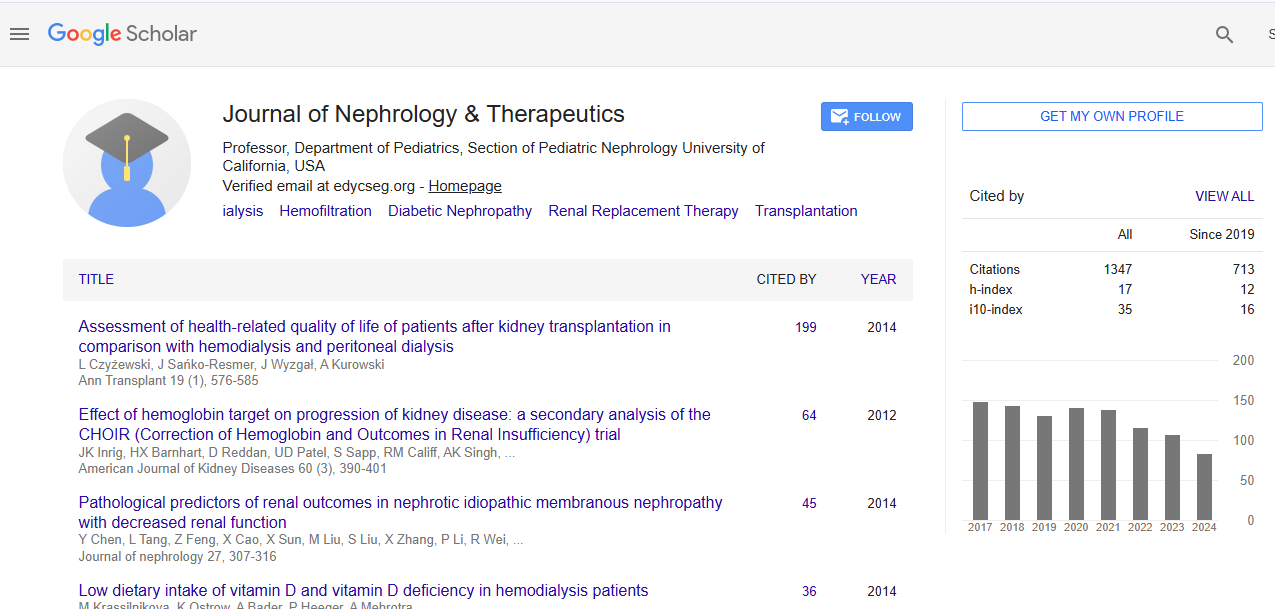
Journal of Nephrology & Therapeutics received 784 citations as per Google Scholar report