Brief Report - (2025) Volume 9, Issue 3
Received: 01-May-2025, Manuscript No. fsb-26-189944;
Editor assigned: 05-May-2025, Pre QC No. P-189944;
Reviewed: 19-May-2025, QC No. Q-189944;
Revised: 22-May-2025, Manuscript No. R-189944;
Published:
29-May-2025
, DOI: 10.37421/2577-0543.2025.9.230
Citation: Laurent, Sofia. ”Nanocrystals Boost Drug Bioavailability And Therapeutic Efficacy.” J Formul Sci Bioavailab 09 (2025):230.
Copyright: © 2025 Laurent S. This is an open-access article distributed under the terms of the Creative Commons Attribution License, which permits unrestricted use, distribution and reproduction in any medium, provided the original author and source are credited.
Nanocrystal technology has emerged as a pivotal strategy in pharmaceutical development, particularly for addressing the challenges associated with poorly water-soluble drugs. This advanced formulation approach significantly enhances the bioavailability of such compounds by augmenting their dissolution rate and increasing their surface area, thereby facilitating more effective absorption within the body [1].
The fundamental principle involves the preparation of drug nanoparticles, which are then typically stabilized by various excipients like surfactants or polymers to mitigate aggregation and ensure stability, effectively overcoming inherent solubility limitations [2].
The benefits derived from employing nanocrystal technology are multifaceted, encompassing not only an improvement in therapeutic efficacy but also a potential reduction in the required dosage, which can lead to fewer side effects and enhanced patient compliance [3].
Furthermore, this technology opens avenues for novel drug delivery routes that were previously not feasible with conventional formulations, broadening the scope of therapeutic interventions [4].
The research landscape in this domain is dynamic, with institutions like the Department of Pharmaceutical Biotechnology at Université Nouvelle de Lyon actively engaged in exploring and refining these advanced formulation strategies to harness the full potential of nanocrystals [1].
A comprehensive understanding of the various preparation techniques is essential for successful implementation, ranging from top-down methods like milling and high-pressure homogenization to bottom-up approaches such as precipitation and solvent evaporation [2].
The critical role of stabilizers in preventing particle aggregation and maintaining the physical integrity of nanocrystals over time cannot be overstated, as it directly impacts the long-term efficacy and safety of the drug product [2].
The impact of key physical characteristics, including particle size, surface charge, and crystallinity, on the dissolution and absorption profiles of nanocrystals forms a central theme in much of the ongoing research [2].
The application of nanocrystal formulations extends across diverse therapeutic areas, with numerous case studies demonstrating their efficacy in improving oral absorption and reducing inter-individual variability in plasma concentration profiles [3].
However, successful translation from laboratory to market requires careful consideration of the challenges associated with scaling up nanocrystal production and navigating complex regulatory pathways [3].
The development of stable amorphous drug nanocrystals, often employing novel polymeric stabilizers, is another area of intense investigation, with a focus on how polymer architecture and molecular weight influence physical stability and drug release kinetics [4].
Optimized polymer systems have consistently shown improved long-term stability and enhanced dissolution rates, underscoring the importance of stabilizer selection [4].
The fabrication of drug nanocrystals involves a spectrum of sophisticated techniques, broadly categorized into top-down and bottom-up methodologies. Top-down approaches, such as wet milling and high-pressure homogenization, break down larger drug particles into nano-sized entities, while bottom-up methods, including precipitation and solvent evaporation, involve the controlled formation of nanoparticles from dissolved drug molecules [2].
The choice of preparation technique is often dictated by the physicochemical properties of the drug and the desired characteristics of the final nanocrystal formulation [5].
Wet milling, for instance, is a widely utilized top-down method that employs milling media to reduce particle size, with parameters like milling media type, processing time, and surfactant concentration critically influencing particle size reduction and drug loading efficiency [5].
High-pressure homogenization, another prominent top-down technique, has demonstrated efficiency and scalability, making it a viable option for industrial-scale production of drug nanocrystals [8].
The physical and chemical stability of drug nanocrystals is paramount to their therapeutic success and shelf life. Strategies to enhance this stability during storage and processing are continuously being explored, including techniques such as lyophilization and spray drying, which can preserve the nanoformulation [6].
Understanding and controlling polymorphic transformations within the nanocrystal structure is also crucial, as different polymorphic forms can exhibit varying solubility and stability profiles, thereby affecting drug performance [6].
The selection and optimization of stabilizers are central to preventing nanocrystal aggregation and ensuring the physical stability of the formulation. These stabilizers, which can include surfactants and polymers, adsorb onto the nanocrystal surface, providing steric or electrostatic repulsion [2].
Novel polymeric stabilizers, in particular, are being investigated for their ability to enhance the physical stability of amorphous drug nanocrystals, with the polymer architecture and molecular weight playing significant roles in achieving improved stability and controlled drug release [4].
The characterization of drug nanocrystals is a critical step in ensuring product quality and performance. This involves a range of analytical techniques to assess particle size distribution, surface area, zeta potential, and polymorphic form [9].
Advanced analytical methods are employed to gain a deeper understanding of the nanocrystal's properties, which are directly linked to its in vivo performance [9].
The impact of particle size and surface characteristics on dissolution and absorption is a recurring theme, with smaller particle sizes and larger surface areas generally leading to enhanced dissolution rates and improved bioavailability [2].
Nanocrystal technology is also being applied to develop advanced dosage forms, such as sustained-release formulations for oral administration. These formulations leverage particle size and matrix properties to control drug release kinetics and enhance oral absorption, potentially allowing for reduced dosing frequency [7].
Furthermore, the potential for nanocrystal technology in the development of orally disintegrating tablets (ODTs) is being explored, where the combination of rapid disintegration and enhanced dissolution can lead to a faster onset of therapeutic action [10].
Nanocrystal technology significantly improves the bioavailability of poorly water-soluble drugs by increasing their dissolution rate and surface area. This approach involves preparing stabilized drug nanoparticles, overcoming solubility limitations and leading to improved therapeutic efficacy and potentially reduced dosages. Key preparation methods include top-down techniques like milling and homogenization, and bottom-up methods such as precipitation. Stabilizers are crucial for preventing aggregation and ensuring physical stability, with particle size and surface characteristics greatly influencing dissolution and absorption. Strategies for enhancing long-term physical and chemical stability, including lyophilization and spray drying, are essential. Nanocrystals also enable advanced formulations like sustained-release systems and orally disintegrating tablets, offering diverse therapeutic benefits and addressing formulation challenges for challenging drug compounds.
None
None
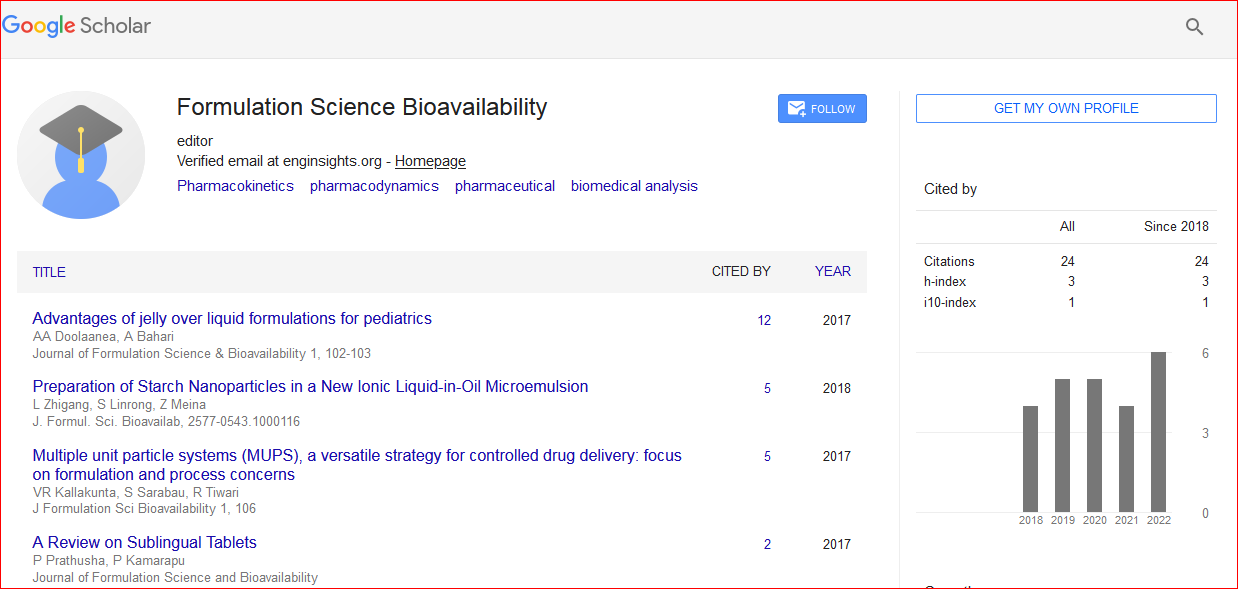
Journal of Formulation Science & Bioavailability received 23 citations as per Google Scholar report