Perspective - (2025) Volume 16, Issue 3
Received: 29-May-2025, Manuscript No. gjto-25-175442;
Editor assigned: 02-Jun-2025, Pre QC No. P-175442;
Reviewed: 16-Jun-2025, QC No. QC-175442;
Revised: 23-Jun-2025, Manuscript No. R-175442;
Published:
30-Jun-2025
, DOI: 10.37421/2229-8711.2025.16.448
Citation: Petrova, Mila. ”Multi-Objective Optimization: Tailored Solutions Across Diverse Fields.” Global J Technol Optim 16 (2025):448.
Copyright: © 2025 Petrova M. This is an open-access article distributed under the terms of the Creative Commons Attribution License, which permits unrestricted use,
distribution and reproduction in any medium, provided the original author and source are credited.
This article details the use of multi-objective optimization to design an active orthosis for stroke recovery. It focuses on finding the best balance between desired therapeutic outcomes, like range of motion and muscle activation, and practical design constraints such as minimizing device weight or energy consumption. The methodology helps tailor rehabilitation devices to individual patient needs, improving effectiveness and usability[1]. This research explores multi-objective optimization for developing advanced drug delivery systems. The goal is to simultaneously optimize multiple conflicting objectives, such as maximizing drug efficacy at the target site while minimizing systemic toxicity and improving drug stability. This approach leads to more efficient and safer therapeutic interventions by considering complex biological and chemical factors during formulation design[2]. This study applies multi-objective optimization to enhance personalized radiation therapy planning for prostate cancer. It aims to achieve an optimal balance between delivering a high radiation dose to the tumor and sparing surrounding healthy tissues, thereby minimizing side effects. The method helps oncologists create more precise and effective treatment plans tailored to each patient's unique anatomy and disease characteristics[3].
This paper explores multi-objective optimization for designing hybrid renewable energy systems in rural areas. The optimization process balances conflicting goals like minimizing overall system cost and maximizing power supply reliability. This approach is crucial for developing sustainable and economically viable electrification solutions, especially in off-grid communities, by integrating various renewable sources effectively[4]. This research applies multi-objective optimization to design personalized footwear for diabetic patients, aiming to prevent foot ulceration. The approach simultaneously optimizes factors such as pressure distribution, comfort, and material properties to create shoes that reduce biomechanical stress and fit individual foot geometries, significantly lowering the risk of complications for at-risk patients[5].
This study uses multi-objective optimization to design an efficient vaccine distribution network. It simultaneously addresses critical objectives like minimizing distribution costs and maximizing vaccine accessibility, all while accounting for cold chain requirements and unpredictable demand. This optimization is vital for public health, ensuring timely and effective vaccine delivery, especially in challenging logistical environments[6]. This research applies multi-objective optimization to manage urban water resources sustainably. It aims to balance competing objectives like minimizing water supply costs, maximizing water quality, and ensuring environmental flow requirements. The approach provides decision-makers with a comprehensive framework for developing robust water management strategies that meet urban demands while protecting ecological systems[7].
This paper focuses on the multi-objective optimization of industrial wastewater treatment plants. Using a genetic algorithm, it simultaneously optimizes operational costs and pollutant removal efficiency. This method helps plants achieve environmental compliance more effectively while minimizing economic expenditure, showcasing the practical application of optimization in environmental engineering[8]. This study employs multi-objective optimization to design robust supply chain networks that are both resilient and sustainable. It seeks to optimize conflicting goals, such as minimizing costs and environmental impact, while maximizing the system's ability to withstand disruptions. This approach is essential for modern supply chains facing increasing complexities and uncertainties[9]. This paper explores multi-objective optimization in building design to enhance both energy performance and indoor environmental quality. It balances objectives like minimizing energy consumption and maximizing occupant comfort (thermal, visual, acoustic). This integrated approach leads to the development of more sustainable and healthier buildings by optimizing various design parameters simultaneously[10].
Multi-objective optimization has profoundly impacted the medical and healthcare sectors, enabling highly personalized and effective interventions. For instance, designing active orthoses for stroke recovery meticulously balances therapeutic outcomes, such as enhancing range of motion and muscle activation, against crucial practical constraints like minimizing device weight or energy consumption [1]. This method ensures rehabilitation devices are precisely tailored to individual patient needs, significantly boosting their effectiveness and usability. Similarly, the development of advanced drug delivery systems leverages this optimization to simultaneously maximize drug efficacy at target sites while diligently minimizing systemic toxicity and improving overall drug stability [2]. This comprehensive approach accounts for complex biological and chemical factors, leading to safer and more efficient therapeutic solutions. In oncology, personalized radiation therapy planning for prostate cancer benefits immensely, striving to achieve an optimal balance between delivering a high radiation dose directly to the tumor and meticulously sparing surrounding healthy tissues, thereby minimizing undesirable side effects [3]. This capability allows oncologists to craft more precise and effective treatment plans, uniquely adapted to each patient’s specific anatomy and disease progression. The application extends to preventive care, such as designing personalized footwear for diabetic patients to actively prevent foot ulceration, where factors like pressure distribution, comfort, and material properties are optimized to reduce biomechanical stress and fit individual foot geometries, substantially lowering the risk of severe complications for at-risk individuals [5].
Beyond healthcare, multi-objective optimization is pivotal in driving sustainability and efficiency across energy and environmental domains. For instance, in designing hybrid renewable energy systems for rural electrification, the optimization process critically balances conflicting goals such as minimizing the overall system cost and maximizing power supply reliability [4]. This framework is essential for creating sustainable and economically viable electrification solutions, particularly in remote, off-grid communities, by effectively integrating diverse renewable energy sources. This concept extends to urban resource management, where multi-objective optimization is applied to manage urban water resources sustainably. It aims to meticulously balance competing objectives like minimizing water supply costs, maximizing water quality, and ensuring environmental flow requirements [7]. Such an approach provides decision-makers with a robust framework for developing comprehensive water management strategies that effectively meet urban demands while protecting vital ecological systems. Furthermore, its utility is evident in industrial wastewater treatment plants, where a genetic algorithm can simultaneously optimize operational costs and pollutant removal efficiency [8]. This application demonstrates how optimization helps plants achieve environmental compliance more effectively while reducing economic expenditure, highlighting its practical value in environmental engineering. In building design, multi-objective optimization enhances both energy performance and indoor environmental quality by balancing objectives like minimizing energy consumption and maximizing occupant comfort, encompassing thermal, visual, and acoustic aspects [10]. This integrated approach leads to the development of more sustainable and healthier buildings through simultaneous optimization of various design parameters.
The complexities of global logistics and supply chain networks also greatly benefit from multi-objective optimization, ensuring both efficiency and resilience. One notable application involves designing efficient vaccine distribution networks, where critical objectives like minimizing distribution costs and maximizing vaccine accessibility are simultaneously addressed [6]. This accounts for essential factors such as cold chain requirements and unpredictable demand. This optimization is crucial for public health, guaranteeing timely and effective vaccine delivery, especially within challenging logistical environments. Similarly, this approach is employed to design robust supply chain networks that are inherently resilient and sustainable [9]. It seeks to optimize conflicting goals, such as minimizing costs and environmental impact, while crucially maximizing the system's ability to withstand disruptions. This strategy is indispensable for modern supply chains grappling with increasing complexities and uncertainties.
What ties these diverse applications together is the fundamental strength of multi-objective optimization: its ability to systematically navigate and resolve trade-offs between competing objectives. Whether it's balancing therapeutic efficacy with minimal side effects in medicine, cost efficiency with environmental sustainability in infrastructure, or operational costs with service accessibility in logistics, this methodology provides a structured framework. It empowers decision-makers to move beyond single-criterion solutions, fostering a holistic view that yields optimized outcomes across multiple dimensions. The consistent theme across these studies is the pursuit of 'best balance' – not just achieving one goal, but finding optimal Pareto fronts that represent a spectrum of superior solutions tailored to specific needs and constraints. This systematic approach is a cornerstone for innovation, driving advancements in personalized care, sustainable development, and resilient systems worldwide.
Multi-objective optimization is a powerful methodology applied across diverse fields to address complex problems involving conflicting goals. In healthcare, it plays a vital role in designing personalized medical devices and treatments. For instance, it's used to develop active orthoses for stroke recovery, balancing therapeutic outcomes with design constraints like weight and energy consumption. It also optimizes drug delivery systems to maximize efficacy while minimizing toxicity and improving stability. In personalized radiation therapy for prostate cancer, this approach helps oncologists deliver high doses to tumors while sparing healthy tissues, thereby reducing side effects. Furthermore, it aids in creating custom footwear for diabetic patients by optimizing pressure distribution and comfort to prevent ulceration. Beyond healthcare, multi-objective optimization enhances the sustainability and efficiency of various systems. It is crucial for designing hybrid renewable energy systems for rural electrification, where it balances cost minimization with maximizing power supply reliability. In urban environments, it supports sustainable water resource management by optimizing supply costs, water quality, and environmental flow. Industrial applications include optimizing wastewater treatment plants to reduce operational costs and boost pollutant removal efficiency. The methodology also fortifies supply chain networks by balancing resilience and sustainability objectives, helping them withstand disruptions while minimizing environmental impact. Lastly, it improves building design by optimizing energy performance and indoor environmental quality, leading to healthier and more sustainable structures. This wide array of applications underscores the method's versatility in creating tailored, effective, and efficient solutions by systematically managing trade-offs among multiple objectives.
None
None
M. T, A. P, J. F. "Multi-objective optimization of an active orthosis for motor recovery after stroke".IEEE Trans. Neural Syst. Rehabil. Eng. 31 (2023):2623-2633.
Indexed at, Google Scholar, Crossref
R. SKA, D. CKR, S. PSS. "Multi-objective optimization of drug delivery systems for targeted therapy".J. Drug Deliv. Sci. Technol. 76 (2022):103759.
Indexed at, Google Scholar, Crossref
C. RC, J. MT, W. JL. "Multi-objective optimization for personalized radiation therapy planning in prostate cancer".Front. Oncol. 11 (2021):713488.
Indexed at, Google Scholar, Crossref
A. AH, M. AE, A. FE. "Multi-objective optimization of hybrid renewable energy systems for rural electrification considering reliability and cost".Energy 192 (2020):116667.
Indexed at, Google Scholar, Crossref
X. L, Y. C, S. Y. "Multi-objective optimization for designing personalized footwear for diabetic patients to prevent ulceration".Comput. Methods Programs Biomed. 199 (2021):105828.
Indexed at, Google Scholar, Crossref
L. L, Z. W, Y. Z. "Multi-objective optimization of a vaccine distribution network considering cold chain and demand uncertainty".Eur. J. Oper. Res. 298 (2022):242-258.
Indexed at, Google Scholar, Crossref
H. W, J. G, S. L. "Multi-objective optimization for sustainable urban water resources management".J. Clean. Prod. 221 (2019):513-524.
Indexed at, Google Scholar, Crossref
A. KS, V. PS, S. KS. "Multi-objective optimization of an industrial wastewater treatment plant using a genetic algorithm".J. Water Process. Eng. 39 (2021):101691.
Indexed at, Google Scholar, Crossref
M. Z, H. MP, M. SF. "Multi-objective optimization of supply chain networks considering resilience and sustainability".J. Clean. Prod. 246 (2020):119102.
Indexed at, Google Scholar, Crossref
S. ZRM, M. M, S. AG. "Multi-objective optimization of building energy performance and indoor environmental quality".Build. Environ. 232 (2023):110298.
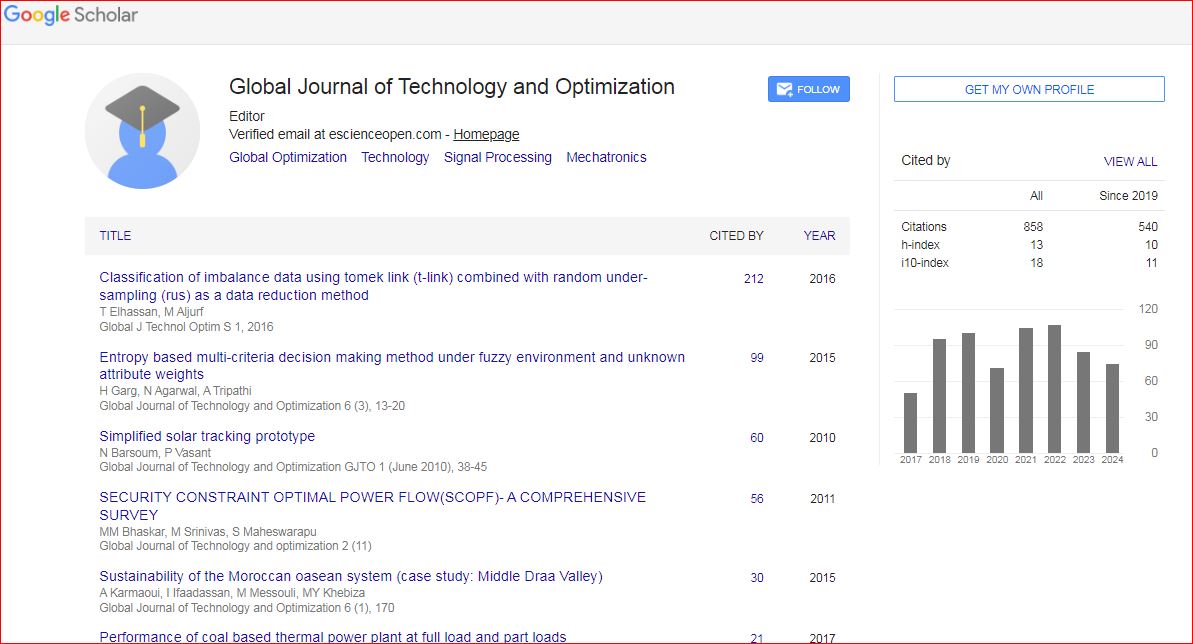
Global Journal of Technology and Optimization received 847 citations as per Google Scholar report