Brief Report - (2025) Volume 14, Issue 2
Received: 01-Apr-2025, Manuscript No. jbfa-25-174130;
Editor assigned: 03-Apr-2025, Pre QC No. P-174130;
Reviewed: 17-Apr-2025, QC No. Q-174130;
Revised: 22-Apr-2025, Manuscript No. R-174130;
Published:
29-Apr-2025
, DOI: 10.37421/2167-0234.2025.14.520
Citation: Liwei, Chen. ”Multifaceted Drivers of Corporate Financial Performance.” J Bus Fin Aff 14 (2025):520.
Copyright: © 2025 Liwei C. This is an open-access article distributed under the terms of the Creative Commons Attribution License, which permits unrestricted use, distribution and reproduction in any medium, provided the original author and source are credited.
Research reveals how digital transformation impacts corporate financial performance, specifically highlighting the moderating effect of Environmental, Social, and Governance (ESG) performance. Businesses that effectively leverage digital technologies often see improved financial outcomes, particularly when they integrate strong ESG practices. One study suggests that ESG initiatives can significantly amplify the positive financial effects of digital adoption. [1] Meta-analyses demonstrate the relationship between Sustainable Supply Chain Management (SSCM) practices and a company's financial performance. It suggests that adopting SSCM practices generally has a positive and significant impact on financial outcomes, making environmental and social responsibility within the supply chain a financially beneficial strategy, not just an ethical one. [2] A study examines the link between Corporate Social Responsibility (CSR) initiatives and financial performance in Indonesia. Findings suggest that engaging in CSR activities positively influences financial outcomes, indicating that companies can benefit financially from being socially responsible, particularly within emerging markets. [3] Systematic reviews of literature indicate the relationship between board diversity and corporate financial performance. It synthesizes findings from various studies, showing that different dimensions of diversityâ??such as gender, expertise, and nationalityâ??can influence financial outcomes, though the exact nature and strength of this relationship vary across different contexts. [4] Investigations reveal how green innovation affects the financial performance of manufacturing firms in China, considering the moderating impact of environmental regulation. Findings show that green innovation generally improves financial performance, and this positive relationship is strengthened by stricter environmental regulations, which effectively push firms towards more sustainable and profitable practices. [5] A study investigates how ownership structure and corporate governance mechanisms affect the financial performance of listed firms in Saudi Arabia. It uncovers that certain ownership concentrations and governance practices significantly influence profitability, suggesting that tailored governance frameworks are essential for enhancing financial health in that specific market. [6] Investigations reveal the relationship between intellectual capital and financial performance, exploring how business strategy and industry type moderate this connection. It shows that intellectual assets significantly contribute to financial success, with their impact varying based on a firm's strategic choices and the specific industry it operates within. [7] A study examines the relationship between innovation capacity and financial performance in Small and Medium-sized Enterprises (SMEs) within developing economies, highlighting the mediating role of knowledge management. Findings suggest that effective knowledge management practices are crucial for translating innovation capabilities into improved financial outcomes for SMEs. [8] Meta-analyses consolidate research on how Enterprise Risk Management (ERM) influences financial performance. It concludes that implementing ERM positively impacts financial outcomes, indicating that a systematic approach to identifying and managing risks contributes to better financial health and stability for organizations. [9] A study investigates how various macroeconomic factors influence the financial performance of commercial banks in Sri Lanka. It identifies key external economic indicators, such as interest rates and inflation, that significantly affect bank profitability, providing insights for strategic planning in dynamic economic environments. [10]
A central focus across recent research delves into the profound interplay between environmental and social considerations and corporate financial success. Digital transformation, for example, is found to significantly enhance corporate financial performance, especially when businesses adeptly integrate strong Environmental, Social, and Governance (ESG) practices. This highlights that leveraging advanced digital technologies in conjunction with a commitment to sustainability and ethical governance can lead to demonstrably superior financial outcomes [1]. In parallel, Sustainable Supply Chain Management (SSCM) practices are not merely about ethical sourcing or responsible operations; they consistently yield a positive and significant impact on a company's financial performance, establishing them as a strategically beneficial approach rather than just a compliance measure [2]. Moreover, Corporate Social Responsibility (CSR) initiatives actively contribute to improved financial outcomes, with compelling evidence from emerging markets like Indonesia showcasing the tangible financial benefits derived from genuine social engagement and community investment [3]. Building on this, green innovation has been shown to substantially improve the financial performance of manufacturing firms, particularly within dynamic markets like China. This positive relationship is notably strengthened by the presence of stricter environmental regulations, which effectively compel firms to adopt more sustainable and, ultimately, more profitable practices [5].
Effective corporate governance frameworks and robust structural elements are equally paramount for maintaining and enhancing financial health. Systematic literature reviews reveal that various dimensions of board diversity, encompassing factors such as gender, professional expertise, and nationality, exert a discernible influence on corporate financial performance. The precise nature and strength of this relationship can vary considerably across different organizational contexts, underscoring the nuanced and complex role that diverse perspectives play in fostering sound strategic decision-making and innovation [4]. Furthermore, in specific regional contexts, such as among listed firms in Saudi Arabia, the ownership structure and the sophistication of corporate governance mechanisms are critical determinants. Studies indicate that particular concentrations of ownership and specific governance practices significantly influence overall profitability, thereby emphasizing the necessity for meticulously tailored governance frameworks to bolster financial stability and operational efficiency within that distinctive market environment [6]. These findings collectively highlight that the internal architecture of organizations and the composition of their leadership are pivotal in shaping a company's long-term economic trajectory and resilience.
The increasing recognition of intangible assets and strategic capabilities as key drivers of financial performance forms another prominent area of contemporary investigation. Intellectual capital, which broadly encompasses a firm's collective knowledge, human capital, structural capital, and relational capital, is unequivocally demonstrated to be a significant contributor to overall financial success. The exact magnitude and nature of its impact, however, are critically moderated by the firm's overarching business strategy and the specific industry sector within which it operates. This interplay clearly indicates that a deliberate strategic alignment is crucial for optimizing the returns derived from these valuable intellectual assets [7]. Concurrently, for Small and Medium-sized Enterprises (SMEs), particularly those operating in developing economies, their inherent innovation capacity stands out as a fundamental determinant of financial performance. This capacity, crucial for competitive advantage, is most effectively translated into improved financial outcomes through the mediating role of robust and strategically implemented knowledge management practices. This emphasizes that the systematic acquisition, sharing, and application of knowledge are paramount for fostering sustainable, innovation-driven growth and economic prosperity within the SME sector [8].
Finally, the implementation of proactive risk management strategies and a sophisticated understanding of the broader external economic environment are indispensable for ensuring sustained financial performance and organizational resilience. Enterprise Risk Management (ERM), through its systematic approach to identifying, assessing, and mitigating potential risks, consistently enhances financial stability and overall health, as comprehensively evidenced by meta-analyses which confirm its positive impact on financial outcomes. This comprehensive risk-conscious framework equips organizations with the necessary tools to navigate unforeseen challenges and uncertainties effectively [9]. Beyond internal controls and strategic initiatives, macroeconomic factors exert a considerable and often decisive influence on financial performance, particularly for specific industry sectors. For instance, detailed research on commercial banks in Sri Lanka has explicitly identified key external economic indicators, such as fluctuating interest rates and inflationary pressures, that significantly affect bank profitability. This demonstrates unequivocally that operating within a dynamic external economic environment necessitates agile, astute strategic planning and continuous monitoring to maintain robust financial health and ensure long-term viability [10].
Research consistently explores the diverse factors influencing corporate financial performance, revealing complex interdependencies. A key area of inquiry shows how digital transformation profoundly impacts financial outcomes, with its positive effects significantly amplified by robust Environmental, Social, and Governance (ESG) performance. Businesses effectively leveraging digital technologies in conjunction with strong ESG practices often achieve superior financial results. Sustainable Supply Chain Management (SSCM) practices also emerge as a critical driver, with meta-analyses confirming their positive and significant impact on financial performance. This highlights that embracing environmental and social responsibility within supply chains is not merely an ethical consideration but a financially beneficial strategy. Corporate Social Responsibility (CSR) initiatives, especially in dynamic emerging markets like Indonesia, are found to directly enhance financial performance, demonstrating tangible returns on social engagement. Furthermore, board diversity, covering aspects such as gender, expertise, and nationality, influences corporate financial outcomes. While the exact nature of this relationship can vary, diverse boards generally contribute to better strategic decisions. Green innovation plays a pivotal role, particularly for manufacturing firms in China, where it demonstrably improves financial performance. This positive effect is often strengthened by more stringent environmental regulations, encouraging sustainable and profitable practices. The foundational elements of ownership structure and corporate governance mechanisms are also vital, with specific concentrations and practices significantly influencing profitability, particularly evident in Saudi Arabian listed firms where tailored governance frameworks are essential. Intellectual capital, encompassing intangible assets, is shown to be a significant contributor to financial success, though its precise impact is moderated by a firm's business strategy and its industry context. For Small and Medium-sized Enterprises (SMEs) operating in developing economies, innovation capacity is crucial for financial success. This capacity is effectively translated into improved financial outcomes through the mediating role of sound knowledge management practices. Enterprise Risk Management (ERM) offers a systematic approach to identifying and managing risks, and its implementation consistently contributes to enhanced financial health and stability across organizations. Lastly, the broader economic landscape, including macroeconomic factors like interest rates and inflation, exerts considerable influence on the financial performance of specific sectors, as observed in commercial banks in Sri Lanka. These external indicators necessitate adaptive strategic planning.
None
None
Indexed at, Google Scholar, Crossref
Indexed at, Google Scholar, Crossref
Indexed at, Google Scholar, Crossref
Indexed at, Google Scholar, Crossref
Indexed at, Google Scholar, Crossref
Indexed at, Google Scholar, Crossref
Indexed at, Google Scholar, Crossref
Indexed at, Google Scholar, Crossref
Indexed at, Google Scholar, Crossref
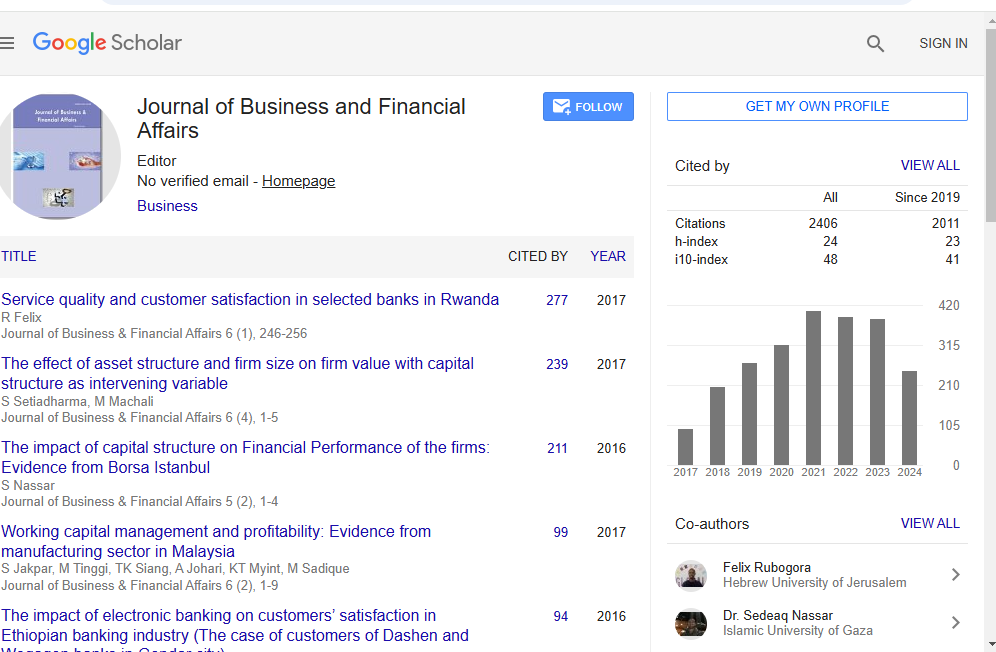
Journal of Business & Financial Affairs received 1726 citations as per Google Scholar report