Perspective - (2025) Volume 9, Issue 3
Received: 02-Jun-2025, Manuscript No. ahbs-26-182436;
Editor assigned: 04-Jun-2025, Pre QC No. P-182436;
Reviewed: 18-Jun-2025, QC No. Q-182436;
Revised: 23-Jun-2025, Manuscript No. R-182436;
Published:
30-Jun-2025
, DOI: 10.37421/2952-8097.2025.9.318
Citation: Hoffmann, Jurgen. "Multi-Faceted Animal Welfare Assessment
in Farming." J Anim Health Behav Sci 09 (2025):318.
Copyright: © 2025 Hoffmann J. This is an open-access article distributed under the terms of the Creative Commons Attribution License, which permits unrestricted use,
distribution and reproduction in any medium, provided the original author and source are credited.
The assessment of animal welfare in intensive production systems is a critical area of research, necessitating the integration of diverse indicators to capture the complexity of an animal's well-being. Current methodologies are evolving to incorporate behavioral, physiological, and structural metrics, aiming for a comprehensive understanding of welfare status. This multifaceted approach acknowledges the challenges in defining and measuring welfare, advocating for perspectives that consider both the animal and its environment [1].
In the realm of poultry production, stocking density emerges as a significant factor influencing broiler welfare. Studies have meticulously investigated the impact of varying densities, employing behavioral observations and physiological stress markers. The findings consistently point towards higher stocking densities compromising welfare, leading to elevated stress levels and reduced physical activity among birds [2].
The application of advanced technologies is revolutionizing how we monitor animal behavior. For instance, in pig farming, accelerometers and GPS trackers are proving invaluable for objectively assessing activity levels, rooting behaviors, and social interactions within enriched environments. These tools offer a more nuanced and detailed understanding of welfare compared to traditional observation methods [3].
Housing design plays a pivotal role in the well-being of farm animals, particularly for sows. Research has highlighted the importance of providing manipulable substrates, which allow for natural behaviors such as rooting and nest building. Such enrichment opportunities have been shown to reduce stereotypic behaviors and significantly improve the overall well-being of sows [4].
Ensuring humane slaughter practices is paramount in animal agriculture, and the evaluation of stunning methods for farmed fish is crucial. Studies have focused on behavioral responses and physiological stress indicators to assess the effectiveness and welfare implications of different stunning techniques, aiming to minimize suffering during the process [5].
Non-invasive monitoring tools are increasingly sought after for assessing animal stress and pain. Thermal imaging, for example, has shown promise in cattle for detecting signs of discomfort. By correlating thermographic patterns with known indicators of pain, this technology offers a potential avenue for early detection of welfare issues in herds [6].
The social environment profoundly influences the welfare of farmed animals. In rabbits, for instance, research has compared social housing with individual confinement, examining behavioral repertoires and physiological stress markers. The findings underscore that social housing, when coupled with appropriate environmental enrichment, promotes superior welfare outcomes [7].
Physiological indicators can provide sensitive insights into an animal's stress levels and overall welfare. Heart rate variability (HRV) has emerged as a valuable tool for assessing stress in sheep. Studies investigating the impact of various farming practices, such as handling and transport, on HRV suggest its utility for real-time welfare evaluation [8].
Early-life experiences lay the foundation for an animal's long-term well-being. For pigs, the perinatal period, encompassing farrowing crate design and maternal care, is particularly critical. Research indicates that positive early-life experiences contribute to the development of resilience and reduce the incidence of stress-related behaviors later in life [9].
In dairy cow management, the effectiveness of animal-based welfare indicators is under continuous evaluation. A critical review of indicators such as lameness, body condition score, and cleanliness assesses their validity, reliability, and practicality in commercial settings. The goal is to promote the standardized use of robust indicators for effective welfare assessment [10].
The ongoing advancement in assessing animal welfare within intensive production systems relies heavily on the integration of a broad spectrum of indicators. Methodologies are increasingly incorporating behavioral, physiological, and structural data to construct a holistic view of animal well-being. Recognizing the inherent complexities in defining and quantifying welfare, this approach emphasizes the necessity of considering both the animal's subjective experience and the characteristics of its production environment [1].
Within the specific context of broiler chicken farming, stocking density has been identified as a significant determinant of welfare. Research efforts have focused on dissecting the impact of various stocking densities through detailed behavioral analyses and the measurement of physiological stress markers. These investigations consistently reveal that higher densities adversely affect welfare, manifesting as increased stress responses and diminished activity levels in the birds [2].
Technological innovations are transforming the capacity to objectively monitor animal behavior. For swine, the deployment of accelerometers and GPS technology has yielded substantial benefits in evaluating activity patterns, exploratory behaviors like rooting, and social dynamics within enriched housing systems. This technological integration facilitates a more precise and comprehensive understanding of welfare status [3].
The architectural design of housing facilities is a crucial determinant of animal welfare, especially for gestating sows. Studies have underscored the benefits of providing substrates that allow for natural behaviors, such as rooting and nest construction. The availability of such environmental enrichments has been linked to a reduction in stereotypic behaviors and an overall enhancement of sow well-being [4].
Addressing the welfare implications of slaughter practices is a vital component of ethical animal production. For farmed fish, the efficacy of various stunning methods is under scrutiny, with research focusing on behavioral indicators and physiological stress responses. The objective is to establish humane slaughter protocols that minimize any potential suffering experienced by the fish [5].
The development and validation of non-invasive tools for welfare assessment are of paramount importance. In cattle, thermal imaging has emerged as a promising technique for detecting signs of stress and pain. By establishing correlations between thermographic patterns and recognized indicators of discomfort, this technology holds potential for the early identification of welfare concerns within herds [6].
The importance of the social environment for animal welfare is well-documented. In farmed rabbits, comparative studies of social versus individual housing arrangements, alongside an examination of behavioral repertoires and physiological stress indicators, have demonstrated that social housing, augmented with appropriate environmental enrichment, leads to improved welfare outcomes [7].
Physiological markers offer sensitive insights into an animal's stress state and overall welfare. Heart rate variability (HRV) has been recognized as a valuable indicator of stress in sheep. Research exploring the effects of different agricultural practices, including handling and transportation, on HRV suggests its applicability as a real-time welfare assessment tool [8].
Early-life developmental periods are critical for shaping an animal's lifelong welfare trajectory. In pigs, the perinatal phase, encompassing aspects of farrowing crate design and the quality of maternal care, is especially influential. Evidence suggests that positive early-life experiences contribute significantly to enhanced resilience and a reduced likelihood of developing stress-related behaviors later in life [9].
Within the dairy industry, the efficacy of animal-based welfare indicators is subject to ongoing critical evaluation. This involves assessing the validity, reliability, and practical applicability of indicators such as lameness, body condition scores, and cleanliness in commercial settings. The aim is to standardize the use of effective indicators for comprehensive welfare assessment [10].
This compilation of research underscores the importance of a multi-faceted approach to assessing animal welfare in intensive farming. Studies examine various aspects, including the integration of behavioral, physiological, and structural indicators, the impact of stocking density on poultry, and the use of advanced technologies like accelerometers and GPS for monitoring pig behavior. Housing design, particularly the provision of enrichment for sows, is highlighted as crucial for well-being. Research also covers humane stunning methods for fish, non-invasive stress detection in cattle using thermal imaging, the benefits of social housing for rabbits, heart rate variability as a welfare indicator in sheep, and the long-term effects of early-life experiences on pig welfare. Finally, a review of animal-based welfare indicators for dairy cows emphasizes the need for standardized and practical assessment tools.
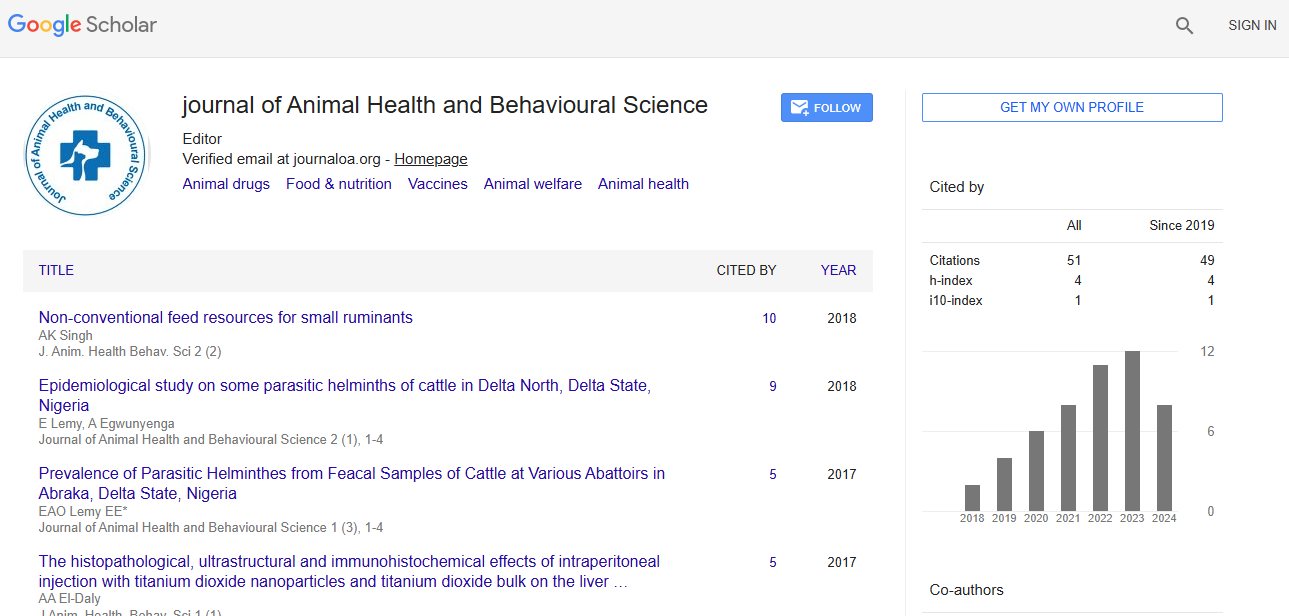
Journal of Animal Health and Behavioural Science received 38 citations as per Google Scholar report