Short Communication - (2025) Volume 11, Issue 5
Received: 02-Dec-2025, Manuscript No. ohcr-25-174330;
Editor assigned: 04-Sep-2025, Pre QC No. P-174330;
Reviewed: 17-Sep-2025, QC No. Q-174330;
Revised: 23-Sep-2025, Manuscript No. R-174330;
Published:
30-Sep-2025
, DOI: 10.37421/2471-8726.2025.11.219
Citation: Wright, Hannah. ”Multidisciplinary Dental Approaches: Superior Patient Outcomes.” Oral Health Case Rep 11 (2025):219.
Copyright: © 2025 Wright H. This is an open-access article distributed under the terms of the Creative Commons Attribution License, which permits unrestricted use, distribution and reproduction in any medium, provided the original author and source are credited.
The landscape of modern dentistry increasingly necessitates a collaborative, multidisciplinary approach to tackle complex oral health issues. Traditional single-specialty treatments often fall short when addressing intricate patient needs, making integrated care a critical component for achieving optimal functional and aesthetic outcomes. This collection of research underscores the pervasive need for such cooperative strategies across various dental and medical disciplines. Highlighting the collaborative approach required for treating complex dental trauma, specifically in the aesthetic zone. It emphasizes the importance of involving multiple dental specialties, such as endodontics, periodontics, and restorative dentistry, to achieve optimal functional and aesthetic outcomes, demonstrating that single-specialty treatment often falls short for such intricate cases [1].
Demonstrating the effectiveness of a multidisciplinary approach in treating medication-related osteonecrosis of the jaw (MRONJ). It synthesizes evidence showing that a collaborative effort, involving oral surgeons, oncologists, and other specialists, leads to better patient outcomes compared to single-specialty management, emphasizing prevention and early intervention [2].
Showcasing the successful management of intricate periodontal-orthodontic conditions through a multidisciplinary strategy. It illustrates how integrated planning and treatment by periodontists and orthodontists can address issues like severe crowding, gum recession, and bone loss, leading to stable and aesthetically pleasing results that would be challenging with a single specialty focus [3].
Emphasizing the critical contribution of a multidisciplinary team in optimizing outcomes for patients with oral squamous cell carcinoma. It outlines how coordinated efforts among oral surgeons, oncologists, radiation therapists, and restorative dentists ensure comprehensive treatment planning, from diagnosis to rehabilitation, improving survival rates and quality of life [4].
Illustrating a multidisciplinary strategy for treating severe dental erosion. It highlights the necessity of collaboration between restorative dentists, periodontists, and sometimes gastroenterologists, to address both the underlying cause and the extensive dental damage, leading to successful functional and aesthetic restoration of the dentition [5].
Discussing the comprehensive dental management of cleft lip and palate patients through a multidisciplinary lens. It emphasizes the long-term, coordinated care required from various specialists, including pediatric dentists, orthodontists, oral surgeons, and prosthodontists, to address the complex oral health challenges from infancy through adulthood [6].
Illustrating the successful aesthetic rehabilitation of anterior teeth using a multidisciplinary approach. It demonstrates how collaboration among orthodontists, periodontists, and prosthodontists is crucial to address underlying issues like malocclusion and gingival discrepancies before achieving optimal, long-lasting aesthetic and functional outcomes [7].
Exploring the necessity of multidisciplinary oral health care for older adults facing complex needs. It highlights how integrating geriatric medicine, dentistry, and other healthcare specialties can effectively address the unique challenges of aging, polypharmacy, and comorbidities, ensuring comprehensive and patient-centered dental management [8].
Delving into the current concepts of managing complex endodontic-periodontic lesions through a multidisciplinary approach. It underscores the importance of a combined effort between endodontists and periodontists to accurately diagnose and treat these interconnected conditions, leading to better prognosis and tooth preservation [9].
Examining the crucial role dentists play within a multidisciplinary team for managing obstructive sleep apnea (OSA). It highlights how dentists contribute through the fabrication of oral appliances and collaborate with sleep physicians and other specialists to provide comprehensive treatment strategies, improving patient respiratory function and overall health [10].
Collectively, these studies affirm that complex oral and maxillofacial conditions, ranging from traumatic injuries and chronic diseases to developmental anomalies and age-related complications, benefit immensely from an integrated care model. The synergy created by different specialists working in concert consistently yields superior outcomes, emphasizing that fragmented, single-specialty care is often insufficient for comprehensive patient needs. This shift towards multidisciplinary frameworks represents a significant advancement in delivering patient-centered and effective dental and oral healthcare.
Multidisciplinary approaches are now fundamental in addressing complex dental and oral health conditions, moving beyond the limitations of single-specialty care to ensure more comprehensive and effective patient outcomes. A prime example is the management of complex dental trauma in the aesthetic zone. Optimal functional and aesthetic results are achieved through the integrated efforts of endodontists, periodontists, and restorative dentists, who collaboratively address the intricate nature of these injuries [1]. This collaborative model consistently demonstrates that isolated treatment often falls short for such nuanced cases, underscoring the critical need for combined expertise.
The efficacy of multidisciplinary teams extends significantly into the treatment of systemic conditions with oral manifestations and critical oncology cases. Medication-related osteonecrosis of the jaw (MRONJ), for instance, is far more effectively managed through a concerted effort involving oral surgeons, oncologists, and other relevant specialists. This integrated approach synthesizes evidence for better patient outcomes, placing a strong emphasis on prevention and early intervention [2]. Similarly, in the challenging landscape of oral squamous cell carcinoma, a multidisciplinary team proves indispensable. Coordinated efforts among oral surgeons, oncologists, radiation therapists, and restorative dentists ensure a holistic treatment plan from diagnosis to rehabilitation, ultimately improving survival rates and enhancing the patientâ??s overall quality of life [4].
Complex periodontal-orthodontic conditions represent another area where integrated planning and treatment by specialists yield superior results. Issues like severe crowding, gum recession, and bone loss, which are notoriously difficult to manage with a single-specialty focus, are successfully addressed through combined periodontist and orthodontist intervention, leading to stable and aesthetically pleasing outcomes [3]. Furthermore, the aesthetic rehabilitation of anterior teeth heavily relies on this collaborative model. Orthodontists, periodontists, and prosthodontists work in concert to resolve underlying problems such as malocclusion and gingival discrepancies, ensuring optimal, long-lasting aesthetic and functional results for patients [7].
Specific dental challenges like severe dental erosion often necessitate a detailed multidisciplinary strategy. This involves collaboration between restorative dentists, periodontists, and sometimes gastroenterologists, to effectively tackle both the extensive dental damage and any underlying systemic causes. Such a comprehensive approach leads to successful functional and aesthetic restoration of the dentition [5]. Moreover, the successful management of complex endodontic-periodontic lesions underscores the importance of a combined effort. Accurate diagnosis and effective treatment of these interconnected conditions are best achieved through the integrated expertise of endodontists and periodontists, significantly improving prognosis and tooth preservation [9].
The broader impact of multidisciplinary oral healthcare is evident in conditions requiring long-term, coordinated care and those affecting vulnerable populations. Patients with cleft lip and palate require a comprehensive, multidisciplinary dental management approach from infancy through adulthood, involving pediatric dentists, orthodontists, oral surgeons, and prosthodontists to address their complex oral health challenges [6]. Similarly, older adults with complex needs greatly benefit from integrated oral health care, where geriatric medicine, dentistry, and other healthcare specialties collaboratively address challenges like aging, polypharmacy, and comorbidities, ensuring patient-centered dental management [8]. Lastly, dentists play a crucial role within multidisciplinary teams addressing obstructive sleep apnea (OSA). Their contributions, particularly in fabricating oral appliances and collaborating with sleep physicians and other specialists, are vital for comprehensive treatment strategies that improve patient respiratory function and overall health [10]. This demonstrates the expansive and crucial role of interdisciplinary care across all facets of dentistry and healthcare.
Multidisciplinary approaches are essential in contemporary dental practice, addressing a wide range of complex oral health conditions. This collaborative model has proven effective across various specialties, moving beyond single-specialty limitations for intricate cases. For instance, managing dental trauma in the aesthetic zone requires coordinated efforts among endodontists, periodontists, and restorative dentists to achieve optimal functional and aesthetic outcomes. Similarly, medication-related osteonecrosis of the jaw (MRONJ) shows better patient results with involvement from oral surgeons, oncologists, and other specialists, emphasizing prevention and early intervention. Complex periodontal-orthodontic conditions, including severe crowding, gum recession, and bone loss, are successfully managed through integrated planning by periodontists and orthodontists. The comprehensive treatment of oral squamous cell carcinoma heavily relies on coordinated teams of oral surgeons, oncologists, radiation therapists, and restorative dentists, improving survival rates and quality of life. Even severe dental erosion necessitates a collaborative strategy, often involving restorative dentists, periodontists, and sometimes gastroenterologists, for functional and aesthetic restoration. Furthermore, patients with cleft lip and palate benefit from long-term, coordinated care provided by pediatric dentists, orthodontists, oral surgeons, and prosthodontists. Aesthetic rehabilitation of anterior teeth, addressing malocclusion and gingival discrepancies, also thrives on multidisciplinary efforts. Integrated oral health care is vital for older adults with complex needs, covering challenges like aging, polypharmacy, and comorbidities. The management of complex endodontic-periodontic lesions benefits significantly from combined specialty efforts. Finally, dentists contribute significantly to multidisciplinary teams for obstructive sleep apnea (OSA) through oral appliance fabrication, working with sleep physicians and other specialists to improve patient respiratory function and overall health. This body of work collectively underscores the indispensability of interdisciplinary collaboration for superior patient care.
None
None
1. Salem AA, Nada Q, Rawan AA. "Multidisciplinary Management of Dental Trauma in the Aesthetic Zone".Case Rep Dent 2023 (2023):6972410.
Indexed at, Google Scholar, Crossref
2. Ritesh K, Ashok KS, Bharat S. "Multidisciplinary management of medication-related osteonecrosis of the jaw: A systematic review and meta-analysis".Natl J Maxillofac Surg 14 (2023):472-479.
Indexed at, Google Scholar, Crossref
3. Poorva S, Soumya H, Deepti H. "Multidisciplinary approach in the management of complex periodontal-orthodontic cases: A case series".J Indian Soc Periodontol 24 (2020):85-88.
Indexed at, Google Scholar, Crossref
4. Piyush K, Shivani V, Divyanshu S. "The Role of the Multidisciplinary Team in the Management of Oral Squamous Cell Carcinoma".Indian J Surg Oncol 13 (2022):815-820.
Indexed at, Google Scholar, Crossref
5. Fatima A, Abdullah A, Bader A. "Multidisciplinary Approach to Management of Severe Dental Erosion: A Case Report".Case Rep Dent 2021 (2021):6654030.
Indexed at, Google Scholar, Crossref
6. Shilpi S, Deepanshu S, Simarpreet K. "Multidisciplinary approach to comprehensive dental management in patients with cleft lip and palate: A review".J Indian Soc Periodontol 24 (2020):166-171.
Indexed at, Google Scholar, Crossref
7. Shweta Y, Shikha K, Ankur G. "Multidisciplinary approach for aesthetic rehabilitation of anterior teeth: A clinical case report".J Indian Prosthodont Soc 19 (2019):379-383.
Indexed at, Google Scholar, Crossref
8. Haiwen C, Chun HC, Ka YC. "Multidisciplinary oral health care for older adults with complex needs: A narrative review".Gerodontology 40 (2023):315-323.
Indexed at, Google Scholar, Crossref
9. Shivani S, Vikas A, Ruchi G. "Multidisciplinary approach for the management of endo-perio lesions: A review of current concepts".J Clin Exp Dent 12 (2020):e792-e797.
Indexed at, Google Scholar, Crossref
10. Georgios R, Aikaterini R, Dimitrios M. "The Multidisciplinary Approach to Obstructive Sleep Apnea: A Role for Dentists".J Clin Med 12 (2023):4100.
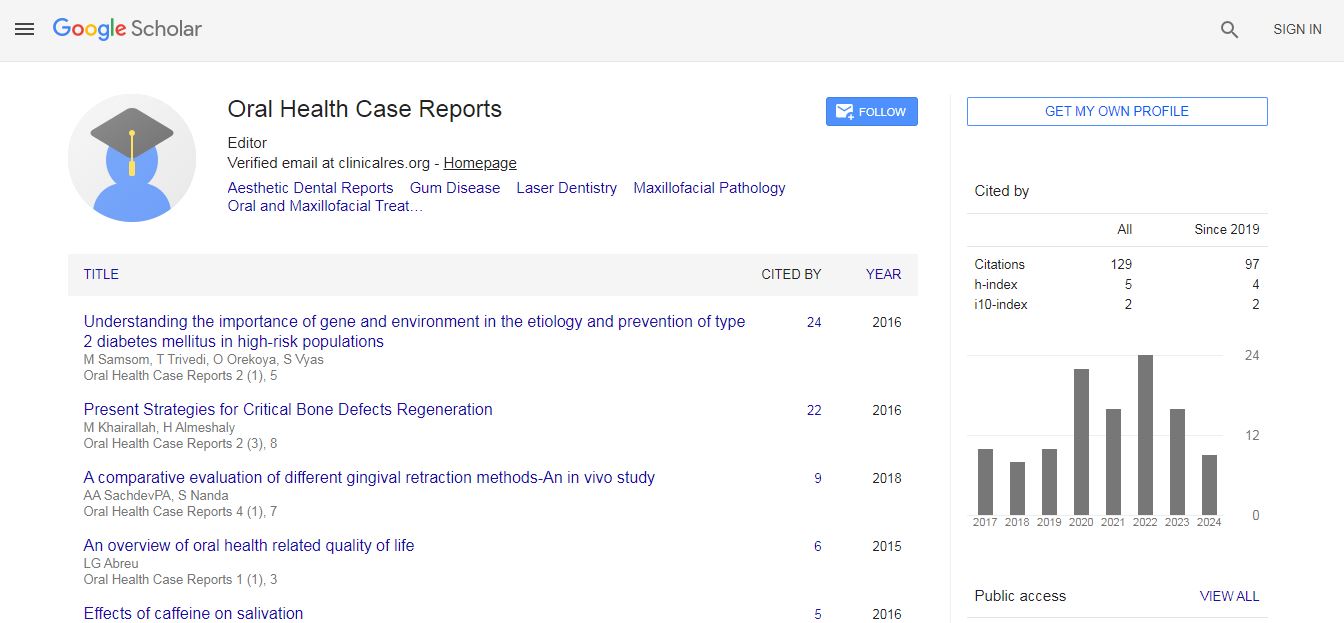
Oral Health Case Reports received 120 citations as per Google Scholar report