Commentary - (2025) Volume 15, Issue 3
Received: 01-Sep-2025, Manuscript No. jpdbd-25-174979;
Editor assigned: 03-Sep-2025, Pre QC No. P-174979;
Reviewed: 17-Sep-2025, QC No. Q-174979;
Revised: 22-Sep-2025, Manuscript No. R-174979;
Published:
29-Sep-2025
, DOI: 10.37421/2153-0769.2025.15.426
Citation: Langford, David. ”MS: Diverse Applications, Transformative Technology.” Metabolomics 15 (2025):426.
Copyright: © 2025 Langford D. This is an open-access article distributed under the terms of the Creative Commons Attribution License, which permits unrestricted use, distribution and reproduction in any medium, provided the original author and source are credited.
Mass spectrometry (MS) stands as a cornerstone technology in modern analytical chemistry, continually evolving to address complex biological and medical questions. The field has witnessed remarkable progress across various applications, from clinical diagnostics to fundamental structural biology.This paper reviews how mass spectrometry-based proteomics has evolved for clinical research, highlighting new methods and applications in disease diagnosis and biomarker discovery. It covers advancements in sample preparation, data acquisition, and bioinformatics that enable more precise and comprehensive proteome analysis [1].
This article explores the role of mass spectrometry-based proteomics in advancing precision medicine. It discusses how these techniques are used to identify disease biomarkers and understand drug mechanisms, while also addressing current hurdles in clinical translation and data analysis [2].
This review covers the evolving field of single-cell mass spectrometry, outlining its capabilities for analyzing individual cells at a molecular level. It discusses various technical approaches and their applications in biological research, looking ahead to potential developments that could broaden its impact [3].
This article details the progress in native mass spectrometry, a technique used to study proteins and their complexes in their natural, folded states. It highlights how this method provides insights into protein structure, interactions, and dynamics, critical for understanding biological functions [4].
This review focuses on the application of targeted metabolomics using mass spectrometry in precision medicine. It explains how this approach identifies and quantifies specific metabolites, offering valuable insights into disease mechanisms, diagnosis, and therapeutic responses [5].
This paper examines the latest developments in mass spectrometry techniques for lipid analysis. It covers innovations in ionization methods and fragmentation strategies that enhance the identification and quantification of diverse lipid species, important for understanding cellular processes and disease [6].
This review highlights the critical role of mass spectrometry in various stages of drug discovery and development. It discusses its applications in compound identification, pharmacokinetic studies, and metabolite profiling, which are crucial for bringing new drugs to market efficiently [7].
This article explores the capabilities of ion mobility-mass spectrometry as a significant tool in structural biology. It explains how this technique provides insights into the gas-phase conformation of molecules, helping to understand complex biological structures and interactions [8].
This review details the progress in ambient mass spectrometry imaging, a technique that allows direct molecular analysis of surfaces without extensive sample preparation. It discusses improvements in sensitivity and spatial resolution, broadening its utility in diverse fields like medicine and forensic science [9].
This primer introduces computational mass spectrometry methods essential for identifying and characterizing metabolites. It explains how computational tools process complex mass spectrometry data to annotate chemical structures, which is fundamental for metabolomics research [10].
Mass spectrometry (MS) continues to redefine analytical capabilities across numerous scientific disciplines, playing a pivotal role in advancing our understanding of biological systems and disease. Its evolution in clinical research, particularly in mass spectrometry-based proteomics, has introduced new methodologies for disease diagnosis and biomarker discovery [1]. These advancements span across improved sample preparation, sophisticated data acquisition techniques, and robust bioinformatics tools, allowing for more precise and comprehensive proteome analysis. In the realm of precision medicine, MS-based proteomics is instrumental in identifying key disease biomarkers and elucidating drug mechanisms. While current challenges in clinical translation and data analysis exist, ongoing research actively addresses these [2]. Furthermore, targeted metabolomics using mass spectrometry offers valuable insights into disease mechanisms, diagnosis, and therapeutic responses by identifying and quantifying specific metabolites, making it a powerful tool for personalized treatment strategies [5].
Delving into fundamental biological understanding, single-cell mass spectrometry represents a significant leap forward. This technique allows for the molecular analysis of individual cells, offering unprecedented detail into cellular processes and opening new avenues in biological research [3]. Similarly, native mass spectrometry has progressed remarkably, enabling the study of proteins and their complexes in their natural, folded states. This method provides critical insights into protein structure, interactions, and dynamics, which are foundational for comprehending biological functions [4]. The capabilities of ion mobility-mass spectrometry further augment structural biology, providing detailed insights into the gas-phase conformation of molecules. This understanding is crucial for unraveling complex biological structures and their interactions [8].
Technological innovations are also expanding the scope of MS. Recent developments in techniques for lipid analysis have significantly enhanced the identification and quantification of diverse lipid species, which are critical for understanding cellular processes and disease progression [6]. These innovations include improvements in ionization methods and fragmentation strategies. Additionally, ambient mass spectrometry imaging offers a distinct advantage by allowing direct molecular analysis of surfaces without requiring extensive sample preparation. Improvements in sensitivity and spatial resolution are broadening its utility across diverse fields, from medical diagnostics to forensic science [9].
Lastly, the application of mass spectrometry in drug discovery and development is profound, covering crucial stages like compound identification, pharmacokinetic studies, and metabolite profiling. These applications are essential for bringing new drugs to market efficiently and safely [7]. Complementing these experimental advancements, computational mass spectrometry methods are introduced as essential tools for identifying and characterizing metabolites. These tools are fundamental for processing complex mass spectrometry data, enabling the accurate structural annotation of metabolites, which is a cornerstone of metabolomics research [10]. The integration of these computational approaches with experimental techniques continues to push the boundaries of what is possible in molecular analysis.
Mass spectrometry (MS) has emerged as an indispensable analytical tool, undergoing continuous advancements that reshape clinical research, precision medicine, and fundamental biological understanding. This collection of studies highlights the expansive utility of MS, particularly in proteomics for disease diagnosis and biomarker discovery, driven by improved sample preparation, data acquisition, and bioinformatics. MS-based proteomics also powers precision medicine by identifying disease biomarkers and clarifying drug mechanisms, even as researchers tackle existing hurdles in clinical translation and data analysis. The field now embraces single-cell MS, offering molecular analysis at the individual cell level, alongside native MS, which reveals crucial insights into protein structure and dynamics in their natural states. Beyond proteins, MS facilitates targeted metabolomics for disease mechanism understanding and therapeutic responses, and it continues to advance lipid analysis through innovative ionization and fragmentation techniques. Its role extends critically into drug discovery and development, assisting in compound identification, pharmacokinetic studies, and metabolite profiling. Moreover, ion mobility-MS provides essential structural biology insights into molecular conformations, while ambient MS imaging broadens molecular surface analysis without extensive preparation, finding utility in medicine and forensics. Finally, computational MS methods are fundamental for processing complex data to accurately annotate metabolites, a cornerstone for metabolomics research. These diverse applications collectively underscore MS as a transformative technology in modern science.
None
None
Xiaoming C, Chunhui Z, Yanbo P. "Advances in mass spectrometry-based proteomics for clinical research".Signal Transduct Target Ther 8 (2023):236.
Indexed at, Google Scholar, Crossref
Peng H, Jing L, Jia L. "Mass spectrometry-based proteomics in precision medicine: advances and challenges".Front Pharmacol 13 (2022):894576.
Indexed at, Google Scholar, Crossref
Liqiang C, Xiaotong C, Wei W. "Single-cell mass spectrometry: current status and future prospects".Anal Chem 93 (2021):4-19.
Indexed at, Google Scholar, Crossref
Carol VR, Brandon TR, Helen RS. "Advances in native mass spectrometry of proteins and protein complexes".Nat Rev Chem 4 (2020):549-562.
Indexed at, Google Scholar, Crossref
Xiaodong Y, Qing-Yan X, Ya-Jun L. "Mass spectrometry-based targeted metabolomics for precision medicine".Chin Med J (Engl) 136 (2023):1-9.
Indexed at, Google Scholar, Crossref
Jing L, Hao Z, Xiaojuan Y. "Recent advances in mass spectrometry for the analysis of lipids".Mass Spectrom Rev 43 (2024):e21796.
Indexed at, Google Scholar, Crossref
Min W, Jian-Gang S, Yan-Bo P. "Mass spectrometry in drug discovery and development: a critical review".Drug Metab Dispos 49 (2021):281-291.
Indexed at, Google Scholar, Crossref
Judit SO, Balazs JNS, Zoltan T. "Ion mobility-mass spectrometry: a powerful tool for structural biology".Annu Rev Anal Chem 13 (2020):279-300.
Indexed at, Google Scholar, Crossref
Lingbo L, Pengyu L, Haiou L. "Recent advances in ambient mass spectrometry imaging".Trends Anal Chem 153 (2022):116669.
Indexed at, Google Scholar, Crossref
Emma LS, Timothy JDW, Tobias K. "Computational mass spectrometry for structural annotation of metabolites".Nat Rev Methods Primers 1 (2021):26.
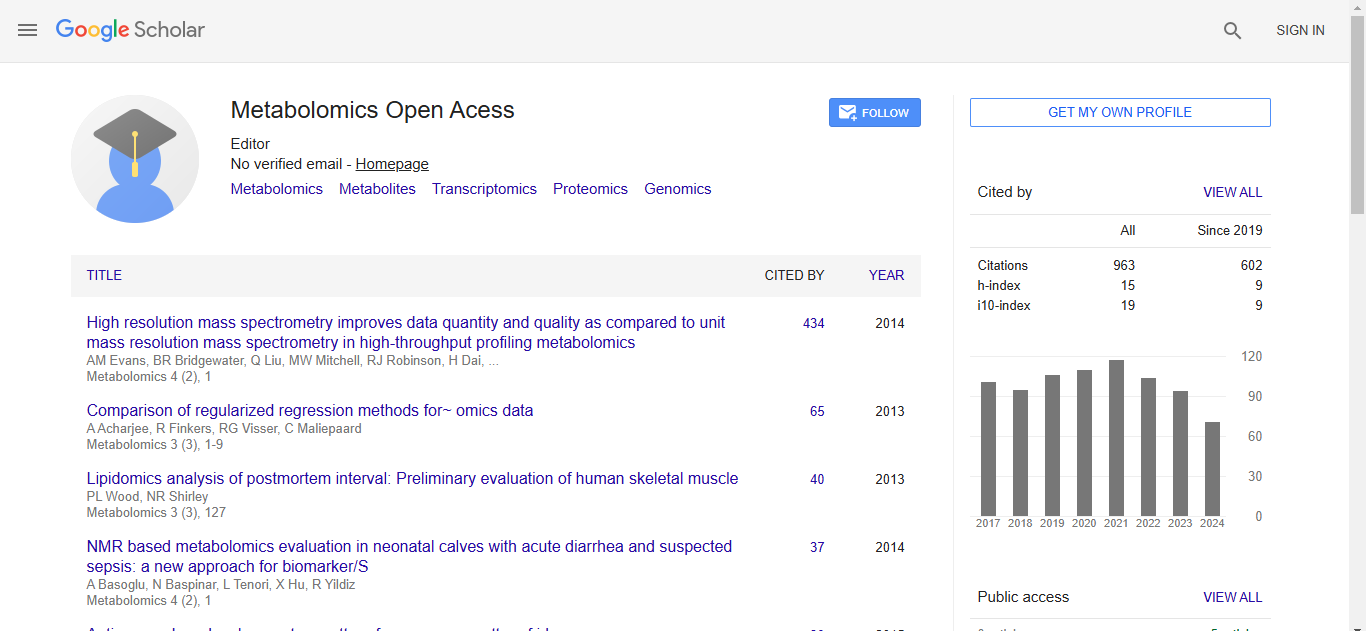
Metabolomics:Open Access received 895 citations as per Google Scholar report