Brief Report - (2025) Volume 9, Issue 2
Received: 01-Apr-2025, Manuscript No. jid-26-186457;
Editor assigned: 03-Apr-2025, Pre QC No. P-186457;
Reviewed: 17-Apr-2025, QC No. Q-186457;
Revised: 22-Apr-2025, Manuscript No. R-186457;
Published:
29-Apr-2025
, DOI: 10.37421/2684-4559.2025.9.315
Citation: Ortega, Javier. "MRSA Colonization in ICUs: A Persistent Challenge." Clin Infect Dis 13 (2025):315.
Copyright: © 2025 Ortega J. This is an open-access article distributed under the terms of the Creative Commons Attribution License, which permits unrestricted use, distribution and reproduction in any medium, provided the original author and source are credited.
The persistent challenge of Methicillin-Resistant Staphylococcus aureus (MRSA) colonization within Intensive Care Units (ICUs) remains a significant concern for healthcare systems globally. This study delves into the longitudinal dynamics of MRSA colonization, highlighting the complex interplay of patient factors, healthcare practices, and environmental contributions to its ongoing transmission within these critical care settings [1].
Understanding these intricate patterns is crucial for developing targeted and effective interventions to reduce the overall MRSA burden and, consequently, improve patient outcomes in the ICU environment [1].
Identifying the key risk factors associated with MRSA colonization and its subsequent progression to infection in ICU patients is of paramount importance for effective prevention strategies. This research points to several significant drivers, including prolonged ICU stays, prior exposure to broad-spectrum antibiotics, and the increased use of invasive medical devices as major contributors to MRSA acquisition and persistence [2].
The findings underscore the critical need for the implementation of robust screening protocols and the promotion of judicious antibiotic stewardship practices to effectively interrupt the MRSA transmission cycle within healthcare facilities [2].
The environmental reservoir of MRSA within ICUs has been identified as playing a critical role in the colonization of patients. This study emphasizes the indispensable importance of rigorous environmental cleaning and comprehensive disinfection strategies to mitigate MRSA persistence in these high-risk areas [3].
Furthermore, the research suggests that the exploration and adoption of novel technologies specifically designed for surface decontamination may offer additional significant benefits in further reducing the environmental burden of MRSA and limiting its spread [3].
Interventions specifically aimed at the decolonization of MRSA carriers within ICU settings have shown considerable promise in reducing the prevalence of this pathogen. This body of work comprehensively explores the efficacy of a variety of topical and systemic antimicrobial agents in successfully clearing MRSA colonization from infected individuals [4].
It is important to note that the findings indicate that sustained clearance of MRSA often necessitates a multifaceted and integrated approach, rather than relying on a single intervention [4].
The results strongly support the integration of decolonization protocols as a key component within broader and more comprehensive infection control programs [4].
The genomic epidemiology of MRSA strains currently circulating within ICUs provides invaluable and detailed insights into the complex transmission pathways and evolutionary dynamics of this pathogen. This research rigorously utilizes whole-genome sequencing techniques to accurately trace the evolution and spread of specific MRSA clades, thereby identifying particular clonal lineages that demonstrate a remarkable adeptness at colonizing and subsequently infecting vulnerable patient populations [5].
This high level of molecular detail significantly aids in the refinement of both surveillance strategies and control measures aimed at combating MRSA [5].
Patient screening for MRSA colonization upon admission to the ICU is recognized as a critical and essential control strategy for preventing nosocomial infections. This study meticulously evaluates the overall effectiveness of such admission screening programs, finding that they can lead to the earlier and more timely implementation of vital contact precautions, thereby potentially reducing the overall incidence of MRSA transmission within the ICU [6].
However, it is important to acknowledge that the optimal frequency and the specific target populations for such screening remain areas of ongoing and active clinical investigation and research [6].
Healthcare worker hand hygiene compliance consistently remains a cornerstone of effective MRSA prevention strategies within the demanding environment of the ICU. This research strongly reinforces the critical and undeniable importance of maintaining consistent and correct hand hygiene practices among all healthcare personnel to minimize the inadvertent and often silent transfer of MRSA between patients [7].
Therefore, rigorous adherence monitoring and the provision of timely feedback are recognized as essential and indispensable components of any effective hand hygiene program aimed at MRSA prevention [7].
The economic burden associated with MRSA colonization and subsequent infection within ICUs has been demonstrated to be substantial and significant. This study meticulously quantifies the considerable increase in healthcare costs, which encompass extended hospital stays, the need for additional and often expensive diagnostic tests, and the utilization of more costly therapeutic interventions, all directly attributable to the presence of MRSA [8].
This crucial economic data can significantly strengthen the rationale and justification for increased investment in comprehensive and robust MRSA prevention strategies [8].
Continuous surveillance of antibiotic resistance patterns, including the specific trends related to MRSA, is absolutely fundamental for the successful implementation of effective antimicrobial stewardship programs. This research diligently tracks the current prevalence of MRSA and its evolving susceptibility patterns to various critically important antibiotics within diverse ICU populations [9].
The data generated from such surveillance efforts directly informs clinical decision-making and guides the appropriate and judicious use of antimicrobials, which is absolutely crucial for preserving their long-term effectiveness and combating the rise of further resistance [9].
The role of patient-to-patient transmission in the sustained maintenance of MRSA colonization within the complex ICU environment is undeniably significant. This study employs sophisticated mathematical modeling techniques in conjunction with detailed molecular data to effectively demonstrate how both direct and indirect transmission events contribute substantially to the overall persistence of MRSA within the ICU setting [10].
The findings clearly highlight the absolute necessity for the consistent implementation of effective barrier precautions and the rapid identification of any newly colonized or infected individuals to contain outbreaks [10].
The study addresses the persistent challenge posed by Methicillin-Resistant Staphylococcus aureus (MRSA) colonization within Intensive Care Units (ICUs), examining its longitudinal dynamics. It highlights the complex interplay between patient-specific factors, prevailing healthcare practices, and environmental influences that contribute to the ongoing transmission of MRSA. Understanding these transmission patterns is paramount for the development of targeted interventions designed to reduce the burden of MRSA and enhance patient outcomes in critical care environments [1].
A critical aspect of managing MRSA in ICUs involves identifying the primary risk factors for colonization and subsequent infection. Research in this area points to prolonged stays in the ICU, prior exposure to antibiotics, and the use of invasive devices as significant drivers of MRSA acquisition. Consequently, there is a pressing need for robust screening protocols and judicious antibiotic stewardship to effectively interrupt the MRSA transmission cycle within these units [2].
The environment within ICUs serves as a significant reservoir for MRSA, playing a critical role in patient colonization. This underscores the importance of implementing rigorous environmental cleaning and disinfection strategies. Moreover, the investigation into novel technologies for surface decontamination suggests their potential to further reduce MRSA persistence in healthcare settings [3].
Strategies focused on decolonizing MRSA carriers in ICUs have demonstrated promising results. Studies exploring various topical and systemic agents reveal their efficacy in clearing MRSA colonization, although sustained clearance often requires a comprehensive, multifaceted approach. This evidence supports integrating decolonization protocols into broader infection control programs [4].
Advancements in genomic epidemiology are providing deeper insights into MRSA transmission pathways within ICUs. By employing whole-genome sequencing, researchers can trace the evolution and spread of specific MRSA clades, identifying those strains particularly adept at colonizing and infecting vulnerable patients. This detailed molecular information is invaluable for refining surveillance and control measures [5].
Admission screening for MRSA colonization upon ICU entry is a vital control measure. Evaluation of these screening programs indicates their effectiveness in enabling earlier implementation of contact precautions, potentially reducing MRSA transmission. However, the optimal frequency and target populations for screening remain subjects of ongoing research [6].
Healthcare worker hand hygiene is a fundamental element in MRSA prevention within ICUs. Studies consistently reinforce the critical importance of adherence to correct hand hygiene practices by all staff to minimize the inadvertent transfer of MRSA between patients. Effective programs necessitate continuous monitoring and feedback mechanisms [7].
The economic implications of MRSA colonization and infection in ICUs are substantial. Quantifying the increased healthcare costs, including extended hospital stays, additional diagnostic procedures, and more expensive treatments, highlights the financial impact of MRSA. This data strengthens the argument for investing in comprehensive prevention strategies [8].
Surveillance of antibiotic resistance patterns, particularly for MRSA, is essential for effective antimicrobial stewardship. Tracking the prevalence of MRSA and its susceptibility to various antibiotics within ICU populations provides data that informs clinical decisions and guides the appropriate use of antimicrobial agents, thereby preserving their efficacy [9].
Patient-to-patient transmission significantly contributes to the persistence of MRSA colonization in ICUs. Mathematical modeling and molecular data illustrate how direct and indirect transmission events drive MRSA persistence, emphasizing the need for robust barrier precautions and rapid identification of colonized individuals to control spread [10].
This collection of research highlights the persistent challenge of MRSA colonization in Intensive Care Units (ICUs). Key findings emphasize the complex interplay of patient factors, healthcare practices, and environmental contamination in MRSA transmission. Prolonged ICU stays, prior antibiotic use, and invasive devices are identified as significant risk factors. Rigorous environmental cleaning, effective hand hygiene, and robust screening protocols upon admission are crucial for prevention. Genomic epidemiology provides detailed insights into transmission pathways, while decolonization strategies show promise when integrated into comprehensive infection control programs. The economic burden of MRSA is substantial, underscoring the importance of sustained investment in prevention. Antimicrobial resistance surveillance is vital for stewardship, and mathematical modeling confirms the significant role of patient-to-patient transmission. Overall, a multifaceted approach involving enhanced surveillance, stringent infection control measures, and judicious antibiotic use is necessary to combat MRSA in ICUs.
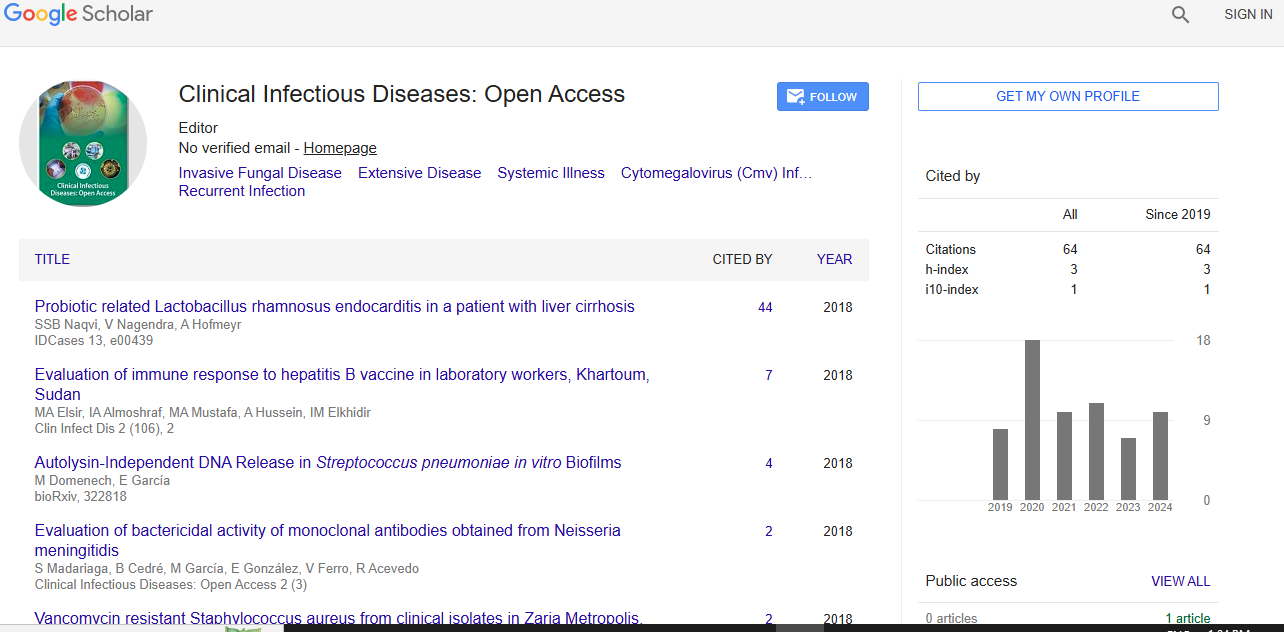
Clinical Infectious Diseases: Open Access received 1149 citations as per Google Scholar report