Perspective - (2025) Volume 19, Issue 3
Received: 01-Jun-2025, Manuscript No. jmgm-26-185650;
Editor assigned: 03-Jun-2025, Pre QC No. P-185650;
Reviewed: 17-Jun-2025, QC No. Q-185650;
Revised: 23-Jun-2025, Manuscript No. R-185650;
Published:
30-Jun-2025
, DOI: 10.37421/1747-0862.2025.19.728
Citation: Al-Haddad, Sara. ”Molecular Cancer Therapies: Targets, Resistance, and Future.” J Mol Genet Med 19 (2025):728.
Copyright: © 2025 Al-Haddad S. This is an open-access article distributed under the terms of the Creative Commons Attribution License, which permits unrestricted use, distribution and reproduction in any medium, provided the original author and source are credited.
Targeted molecular therapies have fundamentally reshaped the approach to cancer treatment, shifting away from traditional broad-spectrum cytotoxic agents towards interventions that precisely target the molecular underpinnings of malignancy [1].
This evolution is driven by a sophisticated understanding of the specific genetic mutations and aberrant signaling pathways that promote cancer cell growth and survival [1].
By designing drugs that specifically inhibit these key pathways or exploit unique vulnerabilities present in tumor cells, clinicians can achieve higher therapeutic efficacy while simultaneously minimizing damage to healthy tissues, thereby improving patient outcomes and fostering a more personalized paradigm in oncology [1].
The identification of actionable genetic alterations has emerged as the cornerstone of modern precision oncology [2].
Advances in next-generation sequencing (NGS) technologies have revolutionized the ability to comprehensively profile tumor genomes, revealing a complex landscape of mutations, copy number alterations, and gene fusions [2].
This detailed genomic information is instrumental in guiding the selection of targeted therapies, which are engineered to inhibit the specific proteins produced by these altered genes [2].
However, the development of therapeutic resistance, often through the acquisition of new mutations or the activation of bypass signaling pathways, remains a significant and persistent challenge, underscoring the necessity for continuous research into novel therapeutic targets and innovative combination strategies [2].
Drug resistance presents a critical hurdle to the long-term success and sustained benefit of targeted cancer therapies [3].
Tumors exhibit a remarkable capacity to develop resistance through a diverse array of mechanisms, including the emergence of secondary mutations within the targeted gene, the activation of alternative signaling cascades that circumvent the blocked pathway, or alterations in how the drug is metabolized by the body [3].
A deep comprehension of these intricate resistance mechanisms is paramount for the development of effective strategies to overcome them, such as employing combination therapies, sequentially administering different targeted agents, or actively exploring entirely new drug targets that can bypass existing resistance pathways [3].
The advent of immunotherapies, particularly immune checkpoint inhibitors (ICIs), has profoundly transformed the treatment landscape for a wide spectrum of cancers [4].
These therapies function by releasing the brakes on the patient's endogenous immune system, enabling it to more effectively recognize and mount an attack against cancer cells [4].
While ICIs have demonstrated remarkable efficacy in a notable subset of patients, it is important to acknowledge that not all individuals achieve a significant response to these treatments [4].
Consequently, extensive research is actively underway to identify reliable biomarkers that can predict treatment response and to devise combination strategies with other therapeutic modalities, including targeted therapies, with the ultimate goal of amplifying anti-tumor immunity and surmounting resistance mechanisms [4].
Liquid biopsies, which facilitate the non-invasive analysis of circulating tumor DNA (ctDNA), circulating tumor cells (CTCs), or exosomes present in bodily fluids such as blood, offer a powerful tool for monitoring cancer progression and guiding therapeutic decisions [5].
These techniques are capable of detecting critical genetic alterations within the tumor, tracking the effectiveness of ongoing treatment, and identifying the emergence of resistance mutations in near real-time [5].
This capability allows for dynamic and adaptive adjustments to therapeutic regimens, thereby enabling a more personalized and responsive approach to cancer management [5].
The seamless integration of liquid biopsy insights with the application of targeted therapies holds substantial promise for significantly improving patient outcomes [5].
The field of targeted cancer therapies is in a state of continuous and dynamic expansion, fueled by the ongoing discovery of novel molecular targets and the development of increasingly selective and potent therapeutic agents [6].
Promising emerging areas of investigation include therapies aimed at modulating epigenetic modifiers, targeting DNA damage response pathways critical for cancer cell survival, and exploiting metabolic vulnerabilities unique to cancer cells [6].
Furthermore, the development and application of antibody-drug conjugates (ADCs) represent a sophisticated strategy that ingeniously combines the inherent specificity of antibodies for tumor cells with the potent cytotoxic capabilities of attached drug molecules, thereby enabling the direct and precise delivery of therapeutic agents to cancerous sites [6].
The integration of artificial intelligence (AI) and machine learning (ML) is initiating a profound transformation across cancer research and clinical practice [7].
AI and ML algorithms possess the remarkable capability to analyze vast and complex datasets, encompassing genomic, proteomic, and clinical information, to facilitate the identification of novel drug targets, predict patient responses to therapy, and optimize the selection of treatment strategies [7].
This data-driven paradigm holds the potential to significantly accelerate the discovery and development of innovative targeted therapies and to refine their application on an individual patient basis, ushering in an era of truly personalized cancer care [7].
An increasingly critical factor in the development of effective targeted therapies is a thorough understanding of the tumor microenvironment (TME) [8].
The TME, a complex ecosystem composed of stromal cells, various immune cell populations, and the extracellular matrix, exerts a profound influence on tumor growth dynamics, disease progression, and the overall response to therapeutic interventions [8].
Therapies designed to modulate the TME, shifting it towards a state that is less supportive of cancer proliferation or more conducive to immune surveillance and attack, are gaining significant traction [8].
These TME-modulating strategies can be effectively combined with direct targeted agents to achieve synergistic therapeutic effects [8].
The broader field of molecular therapy is progressively advancing towards the implementation of sophisticated combination strategies as a means to enhance therapeutic efficacy and to effectively overcome the pervasive challenge of drug resistance [9].
Rational combinations are frequently designed to involve drugs that target parallel signaling pathways, interact with both upstream and downstream signaling nodes, or integrate targeted therapy with other treatment modalities such as immunotherapy or conventional chemotherapy [9].
The critical task of identifying optimal combination regimens necessitates a profound and comprehensive understanding of tumor biology, the multifaceted mechanisms of resistance, and the potential for synergistic interactions between different agents, often guided by data derived from rigorous preclinical models and extensive clinical trials [9].
The ethical and societal implications associated with the widespread adoption of precision medicine are substantial and warrant careful consideration [10].
While precision medicine promises highly personalized and potentially more effective treatments, significant challenges remain, including ensuring equitable access to often prohibitively expensive therapies, safeguarding patient data privacy in the context of extensive genomic information collection, and establishing robust regulatory frameworks to govern these advanced modalities [10].
Open, inclusive dialogue and proactive policy development are indispensable to ensure that the transformative benefits of targeted molecular therapies are equitably accessible to all patients who stand to benefit from them [10].
Targeted molecular therapies represent a significant paradigm shift in cancer treatment, moving beyond generalized cytotoxic agents to precisely target the molecular drivers of malignancy [1].
This approach is predicated on a deep understanding of the specific genetic mutations and signaling pathways that fuel cancer growth [1].
By developing drugs that inhibit these aberrant pathways or exploit unique tumor vulnerabilities, greater efficacy can be achieved with reduced off-target toxicity, leading to improved patient outcomes and a more personalized approach to oncology [1].
The identification of actionable genetic alterations is central to the practice of precision oncology [2].
Next-generation sequencing (NGS) has revolutionized the ability to profile tumor genomes, revealing a complex landscape of mutations, copy number alterations, and gene fusions [2].
This genomic information is crucial for selecting targeted therapies designed to inhibit the proteins produced by these altered genes [2].
However, the emergence of resistance through acquired mutations or bypass pathways remains a significant challenge, requiring ongoing research into novel targets and combination strategies [2].
Drug resistance is a critical obstacle to the long-term success of targeted cancer therapies [3].
Tumors can develop resistance through various mechanisms, including secondary mutations in the target gene, activation of alternative signaling pathways, or alterations in drug metabolism [3].
Understanding these resistance mechanisms is essential for developing strategies to overcome them, such as using combination therapies, sequential treatment with different agents, or exploring novel targets that circumvent existing resistance [3].
The development of immunotherapies, particularly immune checkpoint inhibitors (ICIs), has transformed cancer treatment [4].
ICIs work by activating the patient's own immune system to attack cancer cells [4].
While highly effective in a subset of patients, not all individuals respond to ICIs [4].
Research is ongoing to identify biomarkers predicting response and to develop combination strategies with other treatments, including targeted therapies, to enhance anti-tumor immunity and overcome resistance [4].
Liquid biopsies, which analyze circulating tumor DNA (ctDNA), circulating tumor cells (CTCs), or exosomes in blood, offer a non-invasive method for cancer monitoring and treatment guidance [5].
They can detect genetic alterations, track treatment response, and identify emergent resistance mutations in real-time [5].
This allows for dynamic adjustments to therapy, enabling a more personalized and adaptive approach to cancer management [5].
The integration of liquid biopsies with targeted therapies holds significant promise for improving patient outcomes [5].
The landscape of targeted therapies is continuously expanding with the discovery of novel molecular targets and the development of more selective and potent drugs [6].
Emerging areas include therapies targeting epigenetic modifiers, DNA damage response pathways, and metabolic vulnerabilities in cancer cells [6].
Furthermore, antibody-drug conjugates (ADCs) combine the specificity of antibodies with the cytotoxic power of drugs, offering a sophisticated approach to deliver therapeutic agents directly to tumor cells [6].
The integration of artificial intelligence (AI) and machine learning (ML) is transforming cancer research and treatment [7].
AI/ML algorithms can analyze vast datasets, including genomic, proteomic, and clinical information, to identify novel drug targets, predict treatment response, and optimize therapy selection [7].
This data-driven approach promises to accelerate the discovery and development of new targeted therapies and personalize their application for individual patients [7].
Understanding the tumor microenvironment (TME) is increasingly crucial for developing effective targeted therapies [8].
The TME, comprising stromal cells, immune cells, and extracellular matrix, can significantly influence tumor growth, progression, and response to treatment [8].
Therapies that can modulate the TME to be less supportive of cancer growth or more permissive to immune attack are gaining traction and can be combined with direct targeted agents for synergistic effects [8].
The field of molecular therapy is moving towards combination strategies to enhance efficacy and overcome resistance [9].
Rational combinations often involve drugs targeting parallel pathways, upstream and downstream signaling nodes, or combining targeted therapy with immunotherapy or conventional chemotherapy [9].
Identifying optimal combinations requires a deep understanding of tumor biology, resistance mechanisms, and synergistic interactions, often guided by preclinical models and clinical trial data [9].
The ethical and societal implications of precision medicine are significant [10].
While offering personalized and potentially more effective treatments, challenges include equitable access to expensive therapies, data privacy concerns related to genomic information, and the need for robust regulatory frameworks [10].
Open discussions and proactive policy development are essential to ensure that the benefits of targeted molecular therapies are accessible to all patients who can benefit [10].
Targeted molecular therapies represent a paradigm shift in cancer treatment, focusing on specific genetic mutations and signaling pathways that drive cancer growth. This approach leverages advances in genomic profiling, particularly through next-generation sequencing, to identify actionable alterations and guide the selection of tailored treatments. However, challenges such as drug resistance, arising from various mechanisms including secondary mutations and pathway activation, necessitate ongoing research into novel targets and combination strategies. Immunotherapies, like immune checkpoint inhibitors, have also transformed treatment landscapes, with efforts underway to predict response and overcome resistance, often in combination with targeted agents. Liquid biopsies offer a non-invasive method for monitoring cancer and guiding adaptive treatment strategies. Emerging therapeutic avenues include targeting epigenetic modifiers, DNA damage response pathways, and metabolic vulnerabilities, alongside the development of antibody-drug conjugates. The integration of artificial intelligence and machine learning is accelerating the discovery and personalization of therapies. Furthermore, understanding and modulating the tumor microenvironment is becoming crucial for enhancing treatment efficacy. Ultimately, combination strategies, guided by a deep understanding of tumor biology and resistance, are key to advancing molecular therapy, while ethical and societal considerations surrounding equitable access and data privacy must be addressed.
None
None
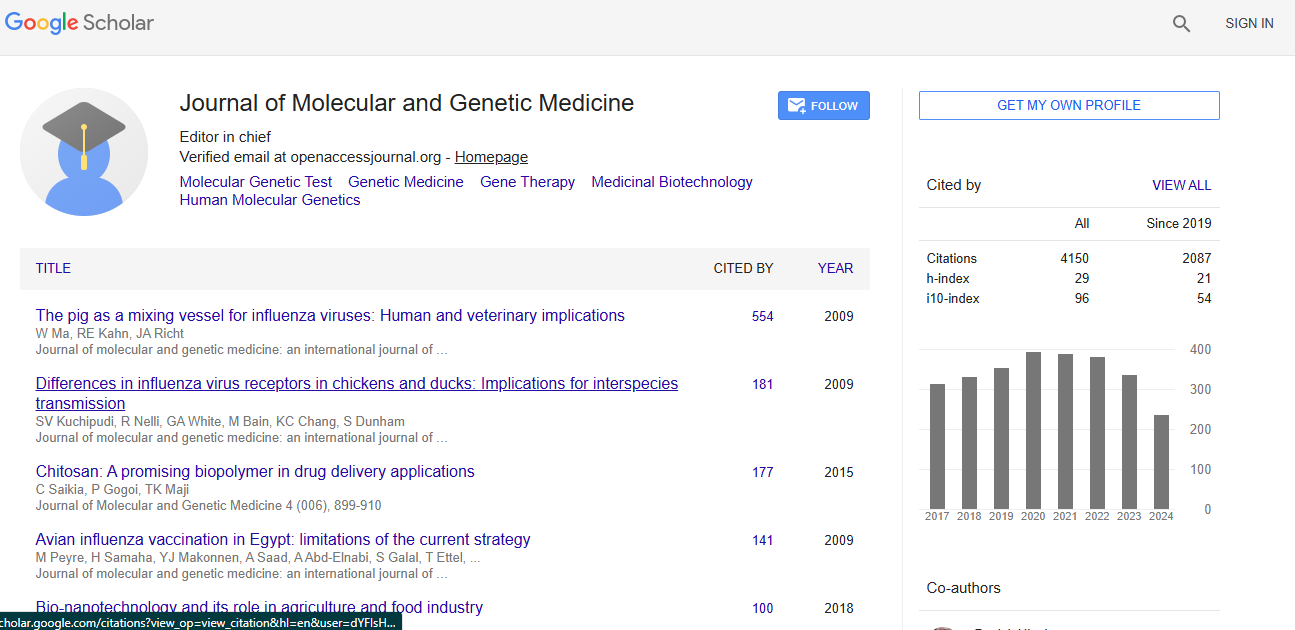
Molecular and Genetic Medicine received 3919 citations as per Google Scholar report