Brief Report - (2025) Volume 16, Issue 4
Received: 01-Aug-2025, Manuscript No. jmbd-26-179468;
Editor assigned: 04-Aug-2025, Pre QC No. P-179468;
Reviewed: 14-Aug-2025, QC No. Q-179468;
Revised: 21-Aug-2025, Manuscript No. R-179468;
Published:
29-Aug-2025
, DOI: 10.37421/2155-9929.2025.16.711
Citation: Pereira, João. ”Molecular Biomarkers: Translating Research to Clinical Practice.” J Mol Biomark Diagn 16 (2025):711.
Copyright: © 2025 Pereira J. This is an open-access article distributed under the terms of the Creative Commons Attribution License, which permits unrestricted use,
distribution and reproduction in any medium, provided the original author and source are credited.
Translational molecular biomarkers are essential for advancing medical science by connecting fundamental research with practical clinical applications. They enable more accurate diagnoses, better prognoses, and the development of more effective therapeutic strategies, thereby improving patient care across various diseases [1].
The advent of liquid biopsies has revolutionized the field of translational molecular biomarker research, offering non-invasive methods for disease monitoring and early detection. Analyzing circulating nucleic acids, proteins, and extracellular vesicles in bodily fluids like blood allows for a paradigm shift in how we approach cancer diagnostics and treatment management [2].
Genomic profiling, particularly through next-generation sequencing (NGS), has become a cornerstone of personalized medicine. It plays a critical role in identifying actionable mutations that guide the selection of targeted therapies, leading to more precise and effective treatment regimens [3].
The translation of complex omics data into clinically actionable biomarkers necessitates sophisticated bioinformatics pipelines and rigorous validation processes. Computational strategies and statistical methods are crucial for identifying and validating molecular signatures that can improve diagnostic accuracy [4].
Epigenetic modifications, such as DNA methylation and histone alterations, are increasingly recognized for their potential as molecular biomarkers. These changes can inform early disease detection, prognosis, and the development of novel therapeutic targets, offering a deeper understanding of disease pathogenesis [5].
MicroRNAs (miRNAs) have emerged as a promising class of biomarkers for molecular diagnostics. Their stability in circulation and role in gene regulation make them valuable for improving diagnostic accuracy and guiding treatment strategies in a variety of diseases [6].
Proteomics provides a powerful lens through which to discover and validate novel biomarkers with significant clinical utility. Mass spectrometry-based approaches enable the analysis of complex biological samples, and integrating this data with other omics layers can enhance predictive capabilities [7].
Circulating tumor cells (CTCs) represent a critical component of liquid biopsy research. Their isolation and analysis offer potential for early cancer detection, monitoring treatment response, and predicting metastatic potential, marking a significant advancement in oncology [8].
The integration of artificial intelligence (AI) and machine learning (ML) is fundamentally transforming biomarker discovery and validation. These advanced computational tools can decipher intricate patterns within large datasets, paving the way for predictive models and personalized therapeutic approaches [9].
Developing robust assay platforms is paramount for the reliable translation of molecular biomarkers from the laboratory to clinical practice. Technologies like PCR, microarrays, NGS, and mass spectrometry are continuously evolving to ensure accuracy and reproducibility in biomarker measurements [10].
Translational molecular biomarkers are instrumental in bridging the gap between fundamental biological research and its application in clinical settings. Their importance lies in facilitating more precise diagnostics, accurate prognostics, and the development of tailored therapeutic strategies. The journey of these biomarkers from initial laboratory discovery to their integration into patient care is a complex process that involves several critical stages, including the development of robust assay technologies capable of reliably detecting and quantifying biomarkers, rigorous validation in diverse patient cohorts to ensure generalizability, and a thorough understanding of their predictive value in guiding treatment decisions. This is particularly evident in fields such as oncology and infectious diseases, where molecular insights are being translated into actionable clinical tools that demonstrably improve patient outcomes [1].
The emergence and refinement of liquid biopsy technologies mark a significant advancement in the realm of translational molecular biomarker research. By enabling the non-invasive analysis of circulating tumor DNA (ctDNA), RNA, proteins, or extracellular vesicles in bodily fluids such as blood, liquid biopsies offer unprecedented opportunities for monitoring disease progression, detecting recurrence at its earliest stages, and assessing the effectiveness of treatment responses. This innovative approach, however, is accompanied by considerable technical challenges, including the need for standardization and rigorous validation of assay methods to ensure the reliability and reproducibility of results, ultimately paving the way for widespread clinical adoption and success [2].
Genomic profiling has become an indispensable tool in the arsenal of personalized medicine, particularly in identifying specific actionable mutations within a patient's tumor that can be targeted with precision therapies. The evolution of next-generation sequencing (NGS) technologies has been pivotal in this regard, enabling the discovery of novel molecular targets and providing a comprehensive view of a tumor's genetic landscape. Nevertheless, significant challenges remain in the interpretation of complex genomic alterations and the seamless integration of this intricate information into clinical decision-making pathways to ensure that patients benefit from improved outcomes [3].
The successful translation of omics data into clinically useful biomarkers is contingent upon the development and application of robust bioinformatics pipelines and stringent validation protocols. This process involves meticulously examining the computational strategies and statistical methodologies employed to identify and validate molecular signatures derived from high-throughput biological data. Emphasis is placed on adhering to reproducible research practices and developing sophisticated algorithms capable of navigating the inherent complexity of biological systems to achieve enhanced diagnostic accuracy and clinical utility [4].
Epigenetic modifications, including alterations in DNA methylation patterns and histone modifications, are increasingly being recognized as valuable molecular biomarkers with profound implications for disease understanding and management. This area of research explores how these epigenetic changes contribute to the pathogenesis of various diseases and how they can be effectively leveraged for early detection, accurate prognosis, and the development of targeted therapeutic interventions. Nonetheless, significant challenges persist in translating these epigenetic markers into routine clinical practice, such as the standardization of detection methods and the accurate interpretation of their dynamic and context-dependent nature [5].
The field of microRNA (miRNA) biomarkers is experiencing rapid growth and evolution, offering new horizons in molecular diagnostics. This area focuses on the discovery and validation of circulating miRNAs that can serve as sensitive indicators for various diseases, with a particular emphasis on their potential to enhance diagnostic accuracy and inform the selection of appropriate treatment strategies. Critical challenges that must be addressed for successful clinical translation include mitigating pre-analytical variability in sample handling and ensuring the standardization of assay methodologies to guarantee reliable and reproducible results [6].
Proteomics offers a powerful and comprehensive approach to the identification of novel biomarkers that hold significant promise for clinical application. This research area investigates the application of advanced techniques, particularly mass spectrometry-based proteomics, for biomarker discovery and validation in complex biological matrices. A key aspect of this endeavor is the integration of proteomic data with other omics layers and relevant clinical information to augment the predictive power and clinical utility of the identified molecular markers [7].
The study of circulating tumor cells (CTCs) represents a pivotal area within liquid biopsy research, offering a unique window into tumor biology and disease progression. This research explores the advancements in CTC isolation and analysis techniques and their burgeoning clinical applications, which include early cancer detection, the monitoring of treatment response, and the prediction of metastasis. However, significant hurdles remain in standardizing CTC enumeration and characterization methods to facilitate their widespread adoption and reliable use in clinical practice [8].
The integration of artificial intelligence (AI) and machine learning (ML) is increasingly revolutionizing the processes of identifying and validating molecular biomarkers. These advanced computational techniques are adept at analyzing vast and complex datasets generated from genomic, proteomic, and other omics studies, enabling the uncovering of subtle patterns and the prediction of disease outcomes with enhanced accuracy. Alongside these advancements, critical ethical considerations and regulatory challenges associated with translating AI-driven biomarker discoveries into the clinical domain are being actively explored [9].
The development and implementation of robust assay platforms are fundamental prerequisites for the reliable translation of molecular biomarkers from research settings to clinical applications. This review examines the current state-of-the-art technologies utilized for biomarker detection, encompassing a range of methodologies such as polymerase chain reaction (PCR), microarrays, next-generation sequencing (NGS), and mass spectrometry. A central theme is the paramount importance of rigorous analytical validation and stringent quality control measures to ensure the accuracy, reliability, and reproducibility of biomarker measurements within clinical environments [10].
Molecular biomarkers are crucial for translating research into clinical practice, enabling precise diagnostics, prognostics, and therapies. Key advancements include the development of robust assay technologies, validation in diverse patient groups, and understanding predictive values for treatment guidance, particularly in oncology and infectious diseases. Liquid biopsies, analyzing circulating biomarkers like ctDNA, offer non-invasive disease monitoring and early detection, though standardization remains a challenge. Genomic profiling via next-generation sequencing is indispensable for personalized medicine, identifying targets for therapy, but interpretation of complex alterations is complex. Bioinformatics and AI/ML are transforming the analysis of omics data to identify and validate biomarkers, improving diagnostic accuracy. Epigenetic modifications, microRNAs, and proteomics also offer significant potential for biomarker development, with ongoing efforts to overcome validation and standardization hurdles for clinical translation. Circulating tumor cells represent another key area in liquid biopsy research. The ultimate goal is to translate these molecular insights into actionable clinical tools that improve patient outcomes.
None
None
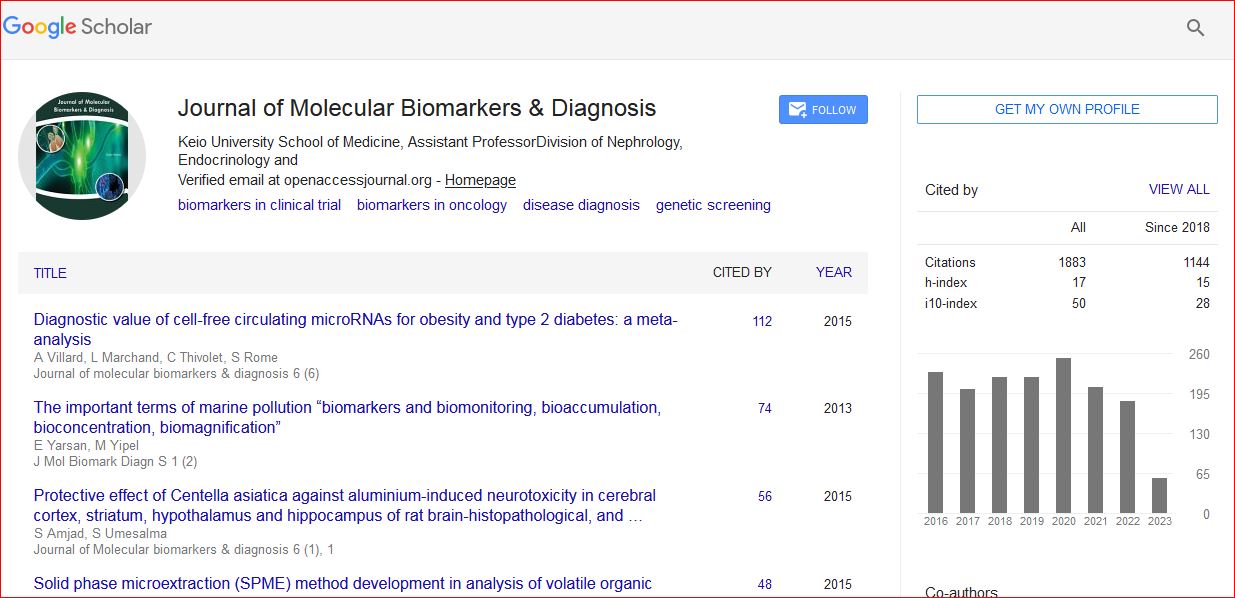
Journal of Molecular Biomarkers & Diagnosis received 2054 citations as per Google Scholar report