Short Communication - (2025) Volume 16, Issue 2
Received: 01-Apr-2025, Manuscript No. jmbd-26-179373;
Editor assigned: 03-Apr-2025, Pre QC No. P-179373;
Reviewed: 14-Apr-2025, QC No. Q-179373;
Revised: 22-Apr-2025, Manuscript No. R-179373;
Published:
29-Apr-2025
, DOI: 10.37421/2155-9929.2025.16.698
Citation: Haddad, Yara. ”Molecular Biomarkers: Revolutionizing Disease Detection And Treatment.” J Mol Biomark Diagn 16 (2025): 698.
Copyright: © 2025 Haddad Y. This is an open-access article distributed under the terms of the Creative Commons Attribution License, which permits unrestricted use, distribution and reproduction in any medium, provided the original author and source are credited.
Molecular biomarkers are at the forefront of revolutionizing disease monitoring and therapeutic strategies. By providing an unprecedentedly precise window into biological processes, these markers enable earlier detection, more accurate prognostication, and the selection of highly personalized treatment regimens. The integration of advanced omics technologies and sophisticated analytical tools is paramount to fully unlocking their potential in routine clinical practice, ushering in an era of precision medicine [1].
The application of liquid biopsies, particularly circulating tumor DNA (ctDNA), is fundamentally transforming the landscape of cancer management. ctDNA offers a minimally invasive approach to track tumor evolution in real-time, detect elusive minimal residual disease, and accurately monitor treatment response, thereby guiding crucial clinical decisions dynamically. Despite ongoing challenges in achieving standardization and refining interpretation, significant and rapid progress is being made in this field [2].
Genomic profiling of tumors is increasingly becoming a standard component of care in oncology, instrumental in selecting appropriate targeted therapies. The identification of actionable mutations empowers clinicians to prescribe drugs that are statistically more likely to be effective, thereby improving patient outcomes and minimizing exposure to treatments that are unlikely to yield benefits. A significant challenge, however, lies in the complex translation of intricate genomic data into clear, actionable clinical recommendations [3].
The role of proteomics in the ongoing advancement of disease monitoring is steadily gaining momentum. While genomics provides the fundamental blueprint of an organism, proteomics offers a dynamic snapshot of protein expression, directly reflecting the functional states of cells and tissues. This approach is invaluable for uncovering disease-specific molecular signatures and identifying potential novel drug targets, effectively complementing genomic investigations [4].
Biomarkers for infectious disease monitoring are absolutely critical for facilitating timely diagnosis and ensuring the implementation of effective treatment strategies. The development of rapid, highly sensitive, and specific molecular diagnostic tests, such as advanced PCR-based assays, allows for the efficient detection of pathogens and precise characterization of their strains. This capability is instrumental in controlling outbreaks and tailoring personalized antimicrobial therapies [5].
Epigenetic biomarkers, encompassing phenomena such as DNA methylation patterns and microRNA profiles, provide a crucial dynamic layer of biological information. This information can be strategically harnessed for disease prognosis and the prediction of therapeutic response. Their significant potential in non-invasive monitoring, exemplified by the early detection of cancer recurrence, represents a particularly active and promising area of current research [6].
The integration of multi-omics data, which synergistically combines information from genomics, transcriptomics, proteomics, and metabolomics, is essential for achieving a more comprehensive understanding of disease pathogenesis and progression. This holistic, integrated approach is indispensable for identifying complex biomarker signatures that can effectively inform and guide personalized therapeutic decisions, moving towards truly individualized patient care [7].
Pharmacogenomics is playing an increasingly vital role in optimizing drug therapy by providing predictive insights into individual patient responses to specific medications. The identification of genetic variations that significantly influence drug metabolism, overall efficacy, and potential toxicity allows for the precise tailoring of drug selection and dosage adjustments. This personalized approach dramatically improves treatment outcomes and substantially reduces the incidence of adverse drug reactions [8].
The remarkable advancement of single-cell technologies is enabling the detailed analysis of molecular heterogeneity within complex biological systems, including tissues and tumors. This capability provides unprecedented resolution for identifying distinct cell populations, elucidating their specific roles in disease states, and discovering novel biomarkers. These biomarkers are crucial for precise therapeutic targeting and effective monitoring of disease [9].
Biomarker discovery for neurological disorders is of paramount importance for achieving early diagnosis and implementing effective management strategies. Significant progress is being made in the development of neuroimaging techniques, cerebrospinal fluid (CSF) analysis, and blood-based biomarkers. These tools are designed to meticulously track disease progression and evaluate therapeutic efficacy, offering substantial hope for improved patient care in debilitating conditions such as Alzheimer's and Parkinson's disease [10].
Molecular biomarkers represent a paradigm shift in disease management, offering unparalleled precision in monitoring and therapeutic intervention. Their ability to provide a detailed glimpse into underlying biological processes facilitates early disease detection, enhances prognostic accuracy, and enables the selection of patient-specific treatment strategies. The synergistic combination of omics technologies and advanced analytics is essential to fully harness their clinical utility [1].
Liquid biopsies, particularly circulating tumor DNA (ctDNA), are revolutionizing cancer care by providing a non-invasive method for tracking tumor evolution, detecting minimal residual disease, and monitoring treatment response in real-time. While standardization and interpretation remain areas of active development, the progress in this domain is exceptionally rapid, offering new hope for cancer patients [2].
Genomic profiling has become a cornerstone in oncology for guiding targeted therapy selection. Identifying actionable mutations allows clinicians to choose treatments with a higher probability of success, thereby improving patient outcomes and minimizing unnecessary exposure to ineffective treatments. The translation of complex genomic data into clear clinical guidance remains a key challenge [3].
Proteomics is emerging as a critical tool for disease monitoring, complementing genomics by reflecting the functional status of cells through protein expression analysis. This approach is valuable for uncovering disease-specific patterns and identifying potential therapeutic targets, thereby enriching our understanding of disease mechanisms [4].
Effective monitoring of infectious diseases relies heavily on accurate biomarkers for timely diagnosis and appropriate treatment. Molecular diagnostic tools, such as sensitive and specific PCR-based assays, are crucial for rapid pathogen detection and strain characterization, aiding in outbreak control and personalized antimicrobial strategies [5].
Epigenetic biomarkers, including DNA methylation and microRNA profiles, offer insights into dynamic biological regulation relevant to disease prognosis and predicting treatment response. Their potential for non-invasive monitoring, such as in the early detection of cancer recurrence, is a significant focus of ongoing research [6].
The integration of multi-omics data, encompassing genomics, transcriptomics, proteomics, and metabolomics, provides a holistic view essential for understanding complex diseases. This comprehensive approach is vital for identifying integrated biomarker signatures that can inform precise, individualized therapeutic decisions [7].
Pharmacogenomics is instrumental in optimizing drug therapy by predicting how individuals will respond to medications. Identifying genetic variations that influence drug metabolism, efficacy, and toxicity enables personalized drug selection and dosage, leading to improved outcomes and reduced adverse events [8].
Single-cell technologies are advancing our ability to analyze molecular variations within tissues and tumors at an unprecedented resolution. This allows for the identification of distinct cell populations, understanding their roles in disease, and discovering novel biomarkers for precise therapeutic targeting and monitoring [9].
Biomarker development for neurological disorders is critical for early diagnosis and effective management. Neuroimaging, CSF analysis, and blood-based biomarkers are actively being developed to track disease progression and assess treatment effectiveness, offering significant potential for improving patient care in conditions like Alzheimer's and Parkinson's disease [10].
Molecular biomarkers are revolutionizing healthcare by enabling earlier disease detection, more accurate prognoses, and personalized treatments. Techniques like liquid biopsies (ctDNA) and genomic profiling are transforming cancer management, while proteomics and epigenetics offer complementary insights into disease states. Advanced molecular diagnostics are crucial for infectious diseases, and multi-omics integration provides a comprehensive understanding of complex conditions. Pharmacogenomics optimizes drug therapy by predicting individual responses, and single-cell technologies allow for detailed molecular analysis. Biomarker research for neurological disorders is also advancing rapidly, aiming to improve diagnosis and management of debilitating conditions.
None
None
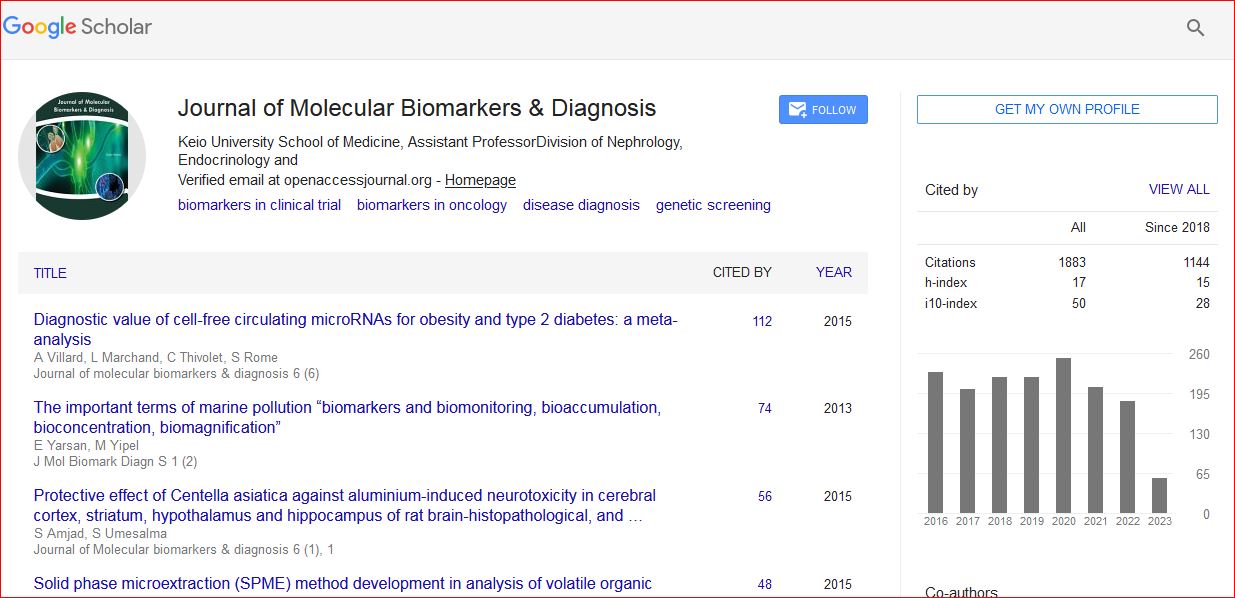
Journal of Molecular Biomarkers & Diagnosis received 2054 citations as per Google Scholar report