Commentary - (2025) Volume 10, Issue 5
Received: 01-Sep-2025, Manuscript No. jncr-26-190099;
Editor assigned: 03-Sep-2025, Pre QC No. P-190099;
Reviewed: 17-Sep-2025, QC No. Q-190099;
Revised: 22-Sep-2025, Manuscript No. R-190099;
Published:
29-Sep-2025
, DOI: 10.37421/2572-0813.2025.10.315
Citation: Johnson, Emily. ”MOFs: Revolutionizing Gas Storage and Catalysis.” J Nanosci Curr Res 10 (2025):315.
Copyright: © 2025 Johnson E. This is an open-access article distributed under the terms of the Creative Commons Attribution License, which permits unrestricted use, distribution and reproduction in any medium, provided the original author and source are credited.
Metalâ??organic frameworks (MOFs) represent a revolutionary class of porous materials with exceptional tunability, positioning them as ideal platforms for significant advancements in gas storage and catalysis [1].
Their intrinsic porous structure, coupled with the ability to customize pore environments, enables selective adsorption of various gases and precise control over active sites for catalytic reactions [1].
This review aims to highlight recent breakthroughs in MOF design specifically engineered for high-capacity gas storage, with a particular emphasis on hydrogen and carbon dioxide [1].
Furthermore, it delves into their diverse applications in various catalytic processes, underscoring how deliberate structural modifications directly influence their performance [1].
The precise control over pore size, chemical functionality, and the overall topology within MOF structures is paramount for optimizing gas adsorption capabilities [2].
Researchers are actively developing novel MOF architectures meticulously designed with tailored pore characteristics to substantially enhance storage capacities for challenging gases, including methane and hydrogen [2].
This ongoing work details how sophisticated rational design strategies are leading to the creation of MOFs that demonstrably outperform traditional porous materials in gas storage applications [2].
MOFs are increasingly recognized as powerful heterogeneous catalysts due to their exceptionally high surface areas and the inherent ability to integrate catalytically active sites directly within their frameworks [3].
This research explores the intricate mechanisms by which MOF pore environments can profoundly influence reaction selectivity and overall activity, particularly in crucial oxidation and reduction reactions [3].
The inherent tunability of MOFs allows for the fine-tuning of both the electronic and steric properties of the integrated catalytic centers, leading to enhanced catalytic performance [3].
The persistent challenge of achieving highly selective carbon dioxide (CO2) capture is being actively addressed through the strategic design of MOFs incorporating specific functional groups engineered to enhance interactions with carbon dioxide molecules [4].
This study presents novel MOFs functionalized with amine groups, which exhibit exceptional CO2 uptake capacities and superior selectivity over nitrogen, a critical factor for the efficacy of carbon capture technologies [4].
MOFs are being meticulously engineered to function as robust heterogeneous catalysts for a wide array of organic transformations, including essential C-C coupling reactions and various oxidation processes [5].
The distinct ability to precisely position metal centers or organic linkers possessing catalytic activity within the MOF structure results in remarkably high activity and excellent recyclability, thereby overcoming significant limitations often associated with homogeneous catalysts [5].
Hydrogen storage remains a grand challenge, particularly in the context of realizing a clean energy future, and MOFs are emerging as highly promising materials for this critical application [6].
This research specifically focuses on MOFs characterized by high surface areas and optimal pore sizes tailored for the physisorption of hydrogen at cryogenic temperatures [6].
The inherent structural flexibility observed in certain MOFs further contributes to improved hydrogen uptake, even at lower pressures [6].
The catalytic activity of MOFs can be substantially amplified through post-synthetic modification strategies, a process wherein functional groups or catalytically active species are introduced after the MOF framework has already been constructed [7].
This paper effectively demonstrates the successful incorporation of nanoparticles within MOF pores, leading to synergistic effects that significantly enhance catalytic reactions, such as oxidation processes [7].
MOFs engineered with hierarchical pore structures offer a significant advantage in terms of improved mass transport kinetics, a feature that is critically important for both gas storage and catalytic applications [8].
This work introduces MOFs that have been synthesized with both meso- and micropores, demonstrating demonstrably enhanced accessibility of gas molecules to the internal surfaces and exhibiting improved catalytic efficiency owing to faster diffusion of reactants and products [8].
The crucial aspect of MOF stability under demanding operational conditions is a key consideration for their practical and widespread application [9].
This study meticulously investigates the hydrothermal and chemical stability of several MOFs specifically designed for gas storage purposes [9].
The findings reveal that a judicious selection of metal nodes and organic linkers is instrumental in developing robust MOF frameworks capable of withstanding harsh environmental conditions [9].
MOFs possessing chiral cavities are currently being explored for their potential in enantioselective catalysis, a highly sought-after capability in the synthesis of complex pharmaceuticals and other fine chemicals [10].
This paper reports on the development of chiral MOFs that demonstrate remarkable enantioselectivity in asymmetric hydrogenation reactions, thereby showcasing the significant potential of MOFs in sophisticated stereoselective transformations [10].
Metalâ??organic frameworks (MOFs) offer an unparalleled level of tunability, making them exceptionally well-suited for advancements in gas storage and catalysis [1].
Their inherent porous nature and the capacity for customizable pore environments facilitate the selective adsorption of gases and provide precise control over active sites crucial for catalytic reactions [1].
This review critically examines recent breakthroughs in MOF design aimed at achieving high-capacity gas storage, particularly for hydrogen and carbon dioxide, and explores their multifaceted applications in various catalytic processes, highlighting the direct correlation between structural modifications and performance [1].
The meticulous control over pore size, chemical functionality, and topological arrangements within MOFs is indispensable for optimizing gas adsorption processes [2].
Researchers are actively engaged in designing novel MOF architectures with precisely tailored pore characteristics to elevate storage capacities for challenging gases such as methane and hydrogen [2].
This research outlines how strategic rational design approaches are yielding MOFs that substantially outperform conventional porous materials in gas storage applications [2].
MOFs are emerging as potent heterogeneous catalysts, owing to their extensive surface areas and the inherent capability to embed catalytic active sites within their structural frameworks [3].
This investigation explores how the microenvironment within MOF pores can significantly influence reaction selectivity and catalytic activity, especially in oxidation and reduction reactions [3].
The inherent tunability of MOFs permits the fine-tuning of both the electronic and steric attributes of the embedded catalytic centers, thereby enhancing their effectiveness [3].
The persistent challenge of achieving selective carbon dioxide (CO2) capture is being effectively addressed by engineering MOFs with specific functional groups designed to enhance interactions with carbon dioxide molecules [4].
This study introduces novel MOFs functionalized with amine groups, which exhibit outstanding CO2 uptake capacities and superior selectivity over nitrogen, a critical parameter for effective carbon capture technologies [4].
MOFs are being deliberately engineered to serve as durable heterogeneous catalysts for a variety of organic transformations, including essential C-C coupling reactions and oxidation processes [5].
The precise ability to strategically position metal centers or organic linkers with catalytic activity within the MOF structure leads to high activity and exceptional recyclability, effectively mitigating the limitations commonly associated with homogeneous catalysts [5].
Hydrogen storage represents a significant challenge in the pursuit of a clean energy future, and MOFs are demonstrating substantial promise in this area [6].
This research concentrates on MOFs characterized by high surface areas and optimized pore dimensions, specifically for the physisorption of hydrogen at cryogenic temperatures [6].
The intrinsic structural flexibility of certain MOFs further contributes to enhanced hydrogen uptake, particularly at reduced pressures [6].
The catalytic efficacy of MOFs can be significantly augmented through post-synthetic modification techniques, where functional groups or catalytically active species are introduced subsequent to the formation of the MOF framework [7].
This paper successfully illustrates the incorporation of nanoparticles within MOF pores, resulting in synergistic effects that boost catalytic reactions such as oxidation [7].
MOFs engineered with hierarchical pore structures provide enhanced mass transport capabilities, which is critically important for both gas storage and catalytic applications [8].
This work presents MOFs synthesized with both mesoporous and microporous characteristics, demonstrating improved accessibility of gas molecules to internal surfaces and enhanced catalytic efficiency due to expedited diffusion of reactants and products [8].
MOF stability under operational conditions is a paramount consideration for their practical implementation [9].
This study meticulously examines the hydrothermal and chemical stability of various MOFs developed for gas storage applications [9].
The findings indicate that the judicious selection of metal nodes and organic linkers is key to developing robust frameworks capable of withstanding challenging environments [9].
MOFs featuring chiral cavities are being actively investigated for their utility in enantioselective catalysis, a highly desirable attribute in the synthesis of pharmaceuticals and fine chemicals [10].
This paper reports the development of chiral MOFs that exhibit high enantioselectivity in asymmetric hydrogenation reactions, underscoring the potential of MOFs in stereoselective synthesis [10].
Metalâ??organic frameworks (MOFs) are highly tunable materials revolutionizing gas storage and catalysis. Their porous structures allow for selective gas adsorption and precise control of catalytic sites. Recent research focuses on designing MOFs for high-capacity storage of hydrogen and carbon dioxide, and their application in diverse catalytic processes, where structural modifications directly impact performance. Optimizing MOF pore size, functionality, and topology is crucial for enhancing gas adsorption. Rational design strategies are yielding MOFs that outperform traditional porous materials. MOFs are emerging as effective heterogeneous catalysts due to their large surface areas and integrated active sites, influencing reaction selectivity. Amine-functionalized MOFs show promise for selective CO2 capture. MOFs also serve as robust heterogeneous catalysts for organic synthesis, offering high activity and recyclability. Research is ongoing to develop MOFs for efficient hydrogen storage, particularly at cryogenic temperatures. Post-synthetic modification can further enhance MOF catalytic activity, for example, by incorporating nanoparticles. Hierarchical pore structures in MOFs improve mass transport for better gas adsorption and catalysis. MOF stability under operational conditions is critical, and careful selection of components ensures robustness. Chiral MOFs are being explored for enantioselective catalysis in the synthesis of pharmaceuticals.
None
None
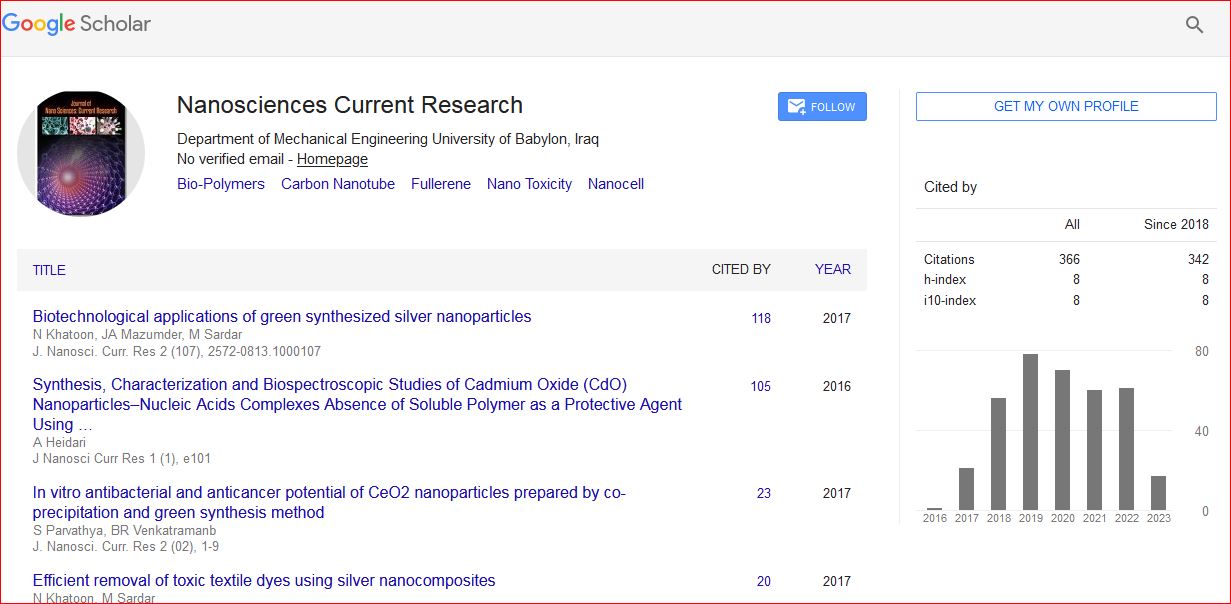
Journal of Nanosciences: Current Research received 387 citations as per Google Scholar report