Brief Report - (2025) Volume 9, Issue 5
Received: 01-Sep-2025, Manuscript No. hps-26-184491;
Editor assigned: 03-Sep-2025, Pre QC No. P-184491;
Reviewed: 17-Sep-2025, QC No. Q-184491;
Revised: 22-Sep-2025, Manuscript No. R-184491;
Published:
29-Sep-2025
, DOI: 10.37421/2573-4563.2025.9.371
Citation: Rios, Alejandro M.. ”Modulating Pancreatic Cancer’s Tumor Microenvironment: Key Strategies.” J Hepatol Pancreat Sci 09 (2025):371.
Copyright: © 2025 Rios M. Alejandro This is an open-access article distributed under the terms of the Creative Commons Attribution License, which permits unrestricted use, distribution and reproduction in any medium, provided the original author and source are credited.
The tumor microenvironment (TME) in pancreatic cancer presents a formidable obstacle to effective treatment due to its complex and multifaceted nature, characterized by dense stroma, immune suppression, and poor vascularization [1].
The intricate interplay of these stromal elements contributes significantly to drug resistance and facilitates metastatic spread, posing a major challenge for therapeutic interventions [1].
Emerging strategies are now focused on targeting these specific TME components, including stromal depletion, immune modulation, and normalization of the vasculature, aiming to improve patient outcomes [1].
Fibroblast activation is a defining characteristic of the pancreatic cancer TME, driving stromal desmoplasia and contributing to therapeutic resistance [2].
Pancreatic stellate cells (PSCs) are a primary source of cancer-associated fibroblasts (CAFs), and novel approaches are being investigated to target these cells [2].
Inhibiting specific signaling pathways within PSCs has shown promise in reducing matrix deposition and enhancing drug penetration, thereby overcoming stromal barriers [2].
Immune evasion is a critical hurdle in managing pancreatic cancer, with regulatory T cells (Tregs) and myeloid-derived suppressor cells (MDSCs) playing pivotal roles in fostering an immunosuppressive TME [3].
Research is exploring the efficacy of combining checkpoint inhibitors with agents designed to deplete or reprogram these suppressive immune cells [3].
Such combination therapies have demonstrated the potential to bolster anti-tumor immunity and improve treatment responses, offering renewed hope for more effective immunotherapeutic strategies [3].
Vascular abnormalities, including hypoperfusion and aberrant angiogenesis, are frequently observed in the pancreatic cancer TME, compromising drug delivery and promoting metastasis [4].
This study assesses the impact of vascular-disrupting agents (VDAs) and anti-angiogenic therapies on TME normalization [4].
Preliminary findings suggest that VDAs can temporarily reduce tumor burden and enhance drug penetration, potentially rendering the TME more receptive to other therapies [4].
The extracellular matrix (ECM) in pancreatic cancer undergoes significant remodeling, creating a physical barrier that hinders the infiltration of therapeutic agents and immune cells [5].
Investigations into the role of specific matrix-degrading enzymes and their inhibitors are crucial for modulating ECM density [5].
Targeting enzymes like hyaluronidase has shown potential in softening the stroma, thereby improving the efficacy of both chemotherapy and immunotherapy [5].
Hypoxia is a pervasive feature within the pancreatic cancer TME, contributing to tumor progression, therapeutic resistance, and genomic instability [6].
Strategies are being developed to target hypoxia-inducible factors (HIFs) and the downstream consequences of hypoxia [6].
Novel small molecules and combination therapies are being explored to reoxygenate the tumor and sensitize cancer cells to treatment, addressing this critical barrier [6].
Metabolic reprogramming in the pancreatic cancer TME supports tumor growth and survival, often leading to nutrient deprivation for immune cells, thus impairing anti-tumor responses [7].
This work examines how targeting specific metabolic pathways, such as glutamine metabolism and fatty acid synthesis, can disrupt tumor cell proliferation and enhance anti-tumor immunity [7].
The identification of promising metabolic inhibitors offers new avenues for therapeutic intervention [7].
The reciprocal interactions between cancer cells and stromal components, particularly CAFs, are central to pancreatic cancer progression and treatment resistance [8].
This study delves into the signaling pathways that mediate these interactions, including PDGF and TGF-β [8].
The findings suggest that disrupting these communication channels could reprogram CAFs and enhance the tumor's sensitivity to therapy [8].
Chemotherapy resistance in pancreatic cancer is frequently exacerbated by the TME, which establishes both a physical barrier and an immunosuppressive environment [9].
This research evaluates combination strategies designed to surmount these resistance mechanisms, focusing on integrating conventional chemotherapy with agents that target the stroma and immune checkpoints [9].
Such combined approaches have demonstrated improved therapeutic efficacy [9].
The pancreatic cancer TME is characterized by substantial recruitment and activation of myeloid-derived suppressor cells (MDSCs), which actively suppress anti-tumor immune responses [10].
This study investigates novel therapeutic agents capable of specifically targeting and depleting MDSCs or inhibiting their function [10].
The results indicate that targeting MDSCs can significantly potentiate the effectiveness of immunotherapy and conventional treatment modalities [10].
The tumor microenvironment (TME) of pancreatic cancer is a highly complex ecosystem defined by a dense stromal matrix, profound immune suppression, and insufficient vascularization, all of which collectively create significant impediments to effective therapeutic interventions [1].
These inherent characteristics of the TME are intrinsically linked to the development of drug resistance and the promotion of metastatic processes [1].
Consequently, a growing body of research is dedicated to exploring novel therapeutic strategies that specifically target these critical TME components, including approaches focused on stromal depletion, modulation of the immune milieu, and the normalization of tumor vasculature, thereby opening new avenues for enhancing patient survival and quality of life [1].
A hallmark feature of the pancreatic cancer TME is the prominent activation of fibroblasts, which leads to extensive stromal desmoplasia and contributes substantially to therapeutic resistance [2].
Pancreatic stellate cells (PSCs) are identified as a major cellular source of these cancer-associated fibroblasts (CAFs), and ongoing research is focused on developing novel approaches to target them effectively [2].
This investigation specifically examines the impact of inhibiting certain signaling pathways within PSCs, demonstrating that such interventions can significantly reduce extracellular matrix deposition and improve the penetration of therapeutic agents, presenting a promising strategy for overcoming the physical barriers imposed by the stroma [2].
Immune evasion represents a critical challenge in the management of pancreatic cancer, where specific immune cell populations, such as regulatory T cells (Tregs) and myeloid-derived suppressor cells (MDSCs), play a crucial role in establishing and maintaining an immunosuppressive TME [3].
Current research is actively investigating the therapeutic potential of combining immune checkpoint inhibitors with agents designed to deplete or reprogram these suppressive immune cells [3].
Preliminary findings from these studies indicate that such combination therapies can effectively enhance anti-tumor immune responses and lead to improved outcomes in patients, offering significant hope for the development of more potent and effective immunotherapeutic approaches [3].
Vascular abnormalities are a pervasive characteristic of the pancreatic cancer TME, manifesting as hypoperfusion and aberrant angiogenesis, both of which critically impair drug delivery to the tumor and promote its metastatic spread [4].
This study undertakes an evaluation of the effects of vascular-disrupting agents (VDAs) and anti-angiogenic therapies on achieving TME normalization [4].
The research demonstrates that VDAs can induce a transient reduction in tumor burden and concurrently enhance drug penetration into the tumor site, potentially making the TME more amenable to other therapeutic interventions, thus offering a dual therapeutic benefit [4].
The extracellular matrix (ECM) within the pancreatic cancer TME undergoes extensive remodeling, resulting in the formation of a dense physical barrier that significantly impedes the infiltration of both therapeutic agents and anti-tumor immune cells [5].
This work critically investigates the role of specific matrix-degrading enzymes and their corresponding inhibitors in the modulation of ECM density within the TME [5].
The experimental results indicate that interventions targeting enzymes such as hyaluronidase can effectively soften the tumor stroma, leading to a notable enhancement in the therapeutic efficacy of both conventional chemotherapy and advanced immunotherapy [5].
Hypoxia, a condition of low oxygen tension, is a pervasive and functionally significant feature of the pancreatic cancer TME, profoundly contributing to tumor progression, resistance to therapeutic treatments, and the induction of genomic instability [6].
This review comprehensively summarizes existing and emerging strategies aimed at targeting hypoxia-inducible factors (HIFs) and the diverse downstream consequences associated with hypoxic conditions [6].
The discussion includes an overview of novel small molecule inhibitors and innovative combination therapies specifically designed to reoxygenate the tumor microenvironment and thereby sensitize cancer cells to various treatment modalities [6].
Metabolic reprogramming within the pancreatic cancer TME is a critical process that actively supports tumor cell growth and survival, frequently leading to severe nutrient deprivation for the immune cells within the tumor microenvironment, thereby hindering anti-tumor immune responses [7].
This article critically explores the therapeutic potential of targeting key metabolic pathways, including glutamine metabolism and fatty acid synthesis, which are essential for tumor cell proliferation and survival [7].
The findings highlight the promise of specific metabolic inhibitors as potential therapeutic agents capable of disrupting tumor metabolism and bolstering anti-tumor immunity [7].
The complex reciprocal interactions between malignant cancer cells and the surrounding stromal components, particularly cancer-associated fibroblasts (CAFs), are integral to the progression of pancreatic cancer and the development of resistance to treatment [8].
This study meticulously investigates the specific signaling pathways that mediate these crucial interactions, with a particular focus on pathways such as platelet-derived growth factor (PDGF) and transforming growth factor-beta (TGF-β) [8].
The research proposes that the strategic blockade of these critical communication channels can effectively reprogram CAFs and significantly enhance the tumor's sensitivity to existing therapeutic regimens [8].
Chemotherapy resistance in pancreatic cancer is often significantly mediated by the characteristics of the TME, which not only presents a physical barrier to drug penetration but also establishes an immunosuppressive milieu that hinders treatment efficacy [9].
This research systematically evaluates the effectiveness of combination strategies designed to overcome these multifaceted resistance mechanisms [9].
The study specifically focuses on the synergistic effects of combining conventional chemotherapy with agents that target either the stromal compartment or immune checkpoints, demonstrating a marked improvement in overall therapeutic efficacy [9].
The pancreatic cancer TME is notably characterized by the significant recruitment and activation of myeloid-derived suppressor cells (MDSCs), which actively function to suppress anti-tumor immune responses, thereby contributing to immune evasion [10].
This study rigorously explores the potential of novel therapeutic agents that are specifically designed to target and deplete MDSCs or effectively inhibit their immunosuppressive functions [10].
The findings derived from this research strongly suggest that therapeutic interventions aimed at targeting MDSCs can significantly potentiate the efficacy of both immunotherapy and conventional treatment modalities in the context of pancreatic cancer [10].
Pancreatic cancer's tumor microenvironment (TME) is a complex barrier characterized by dense stroma, immune suppression, and poor vascularization, contributing to drug resistance and metastasis. Research is actively exploring strategies to overcome these challenges by targeting stromal components, modulating immune cells like Tregs and MDSCs, and normalizing tumor vasculature. Approaches include targeting pancreatic stellate cells, matrix-degrading enzymes, metabolic pathways, and signaling pathways between cancer cells and stromal components. Combination therapies involving chemotherapy with agents targeting the TME or immune checkpoints show promise. Strategies to address hypoxia and extracellular matrix remodeling are also being investigated. Targeting MDSCs is identified as a key approach for enhancing immunotherapy. Overall, a multi-pronged approach to TME modulation is crucial for improving treatment efficacy in pancreatic cancer.
None
None
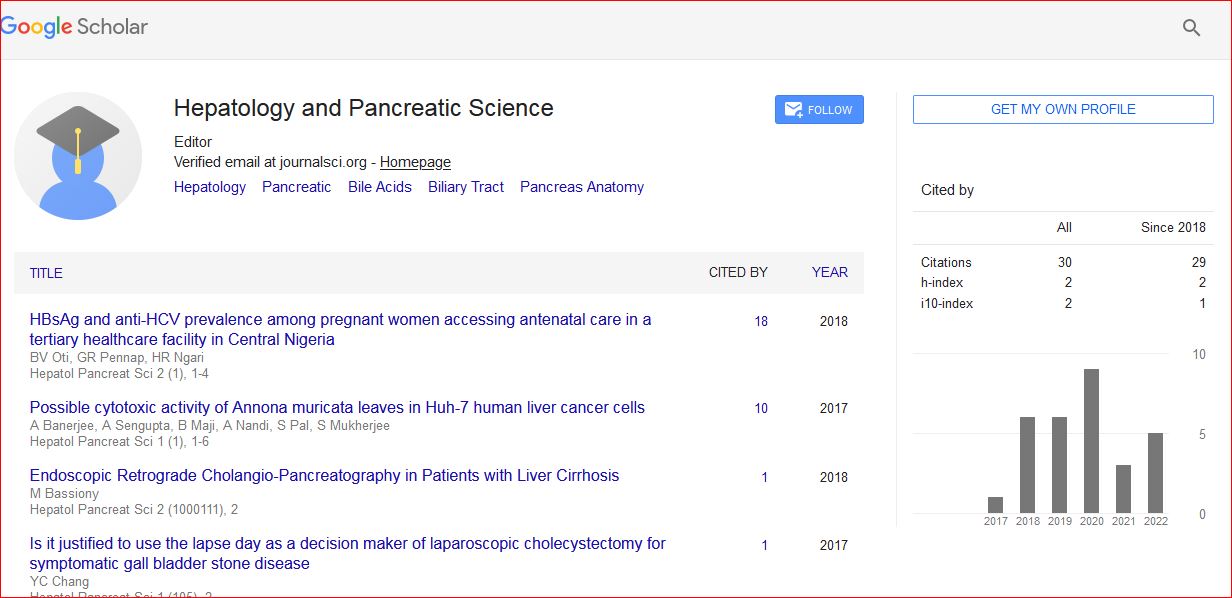
Hepatology and Pancreatic Science received 34 citations as per Google Scholar report