Opinion - (2025) Volume 14, Issue 2
Received: 01-Apr-2025, Manuscript No. jeom-26-188153;
Editor assigned: 03-Apr-2025, Pre QC No. P-188153;
Reviewed: 17-Apr-2025, QC No. Q-188153;
Revised: 22-Apr-2025, Manuscript No. R-188153;
Published:
29-Apr-2025
, DOI: 10.37421/2169-026X.2025.14.521
Citation: Dubois, Sophie. ”Modern Strategic Management: Agility, Digitalization, Sustainability, Innovation.” J Entrepren Organiz Manag 14(2025):521.
Copyright: © 2025 Dubois S. This is an open-access article distributed under the terms of the Creative Commons Attribution License, which permits unrestricted use, distribution and reproduction in any medium, provided the original author and source are credited.
Modern organizations operate within environments characterized by rapid change and increasing complexity, necessitating adaptive strategic management practices to maintain a competitive edge. Agile strategic management, for instance, emphasizes iterative planning, continuous feedback, and decentralized decision-making to foster resilience and allow swift adaptation to dynamic market conditions. This approach is crucial for navigating unforeseen challenges and capitalizing on emerging opportunities [1].
The pervasive influence of digital technologies has fundamentally reshaped the landscape of strategic management. Embracing digital transformation enables organizations to achieve enhanced operational efficiency, deepen customer engagement, and devise innovative business models, making it imperative for strategic frameworks to integrate these capabilities and data-driven insights for sustained growth in the digital era [2].
Furthermore, the integration of sustainability into strategic management is no longer a peripheral concern but a core imperative. Organizations that embed environmental and social considerations into their fundamental strategies can achieve long-term value creation alongside significant societal benefits, leading to enhanced reputation and improved resource efficiency [3].
Within this dynamic context, organizational ambidexterityâ??the capacity to simultaneously explore new opportunities while exploiting existing onesâ??becomes a critical strategic differentiator. Achieving effective ambidexterity requires specific organizational structures, leadership styles, and cultural elements to foster innovation and sustained competitive advantage in complex environments [4].
Strategic leadership plays a pivotal role in guiding organizations through periods of rapid technological change and disruption. Visionary leadership, combined with a strong capacity for strategic learning and adaptation, is essential for empowering employees, fostering innovation, and aligning organizational efforts towards strategic objectives in the face of disruptive shifts [5].
The successful implementation of strategic change is paramount for organizations aiming to evolve and adapt. Effective change management relies heavily on clear communication, robust stakeholder engagement, and proactive resistance management to ensure successful transitions and minimize disruptions during strategic shifts [6].
A fundamental strategic imperative for organizations seeking to maintain a competitive edge is the cultivation of a learning organization. Continuous learning, knowledge sharing, and adaptation are the cornerstones of developing and sustaining this capability, enabling greater strategic flexibility and fostering a culture of innovation [7].
The rise of innovation ecosystems presents a significant strategic opportunity for modern organizations. By actively engaging with external partners, startups, and research institutions, organizations can accelerate innovation, access new markets, and orchestrate complex networks for mutual benefit and sustained competitive advantage [8].
Customer-centricity has emerged as a critical strategic framework for value creation. Aligning strategies with a deep understanding of customer needs leads to enhanced loyalty, market differentiation, and improved profitability, emphasizing the integration of customer insights throughout the strategic planning and execution processes [9].
Finally, building organizational resilience is a crucial strategic imperative in an era of increasing volatility and uncertainty. A framework for anticipating, responding to, and recovering from disruptions, underpinned by adaptive capacity, robust systems, and effective leadership, is essential for navigating complex and unpredictable environments [10].
Agile strategic management practices are increasingly vital for modern organizations to effectively navigate dynamic market conditions. This approach is characterized by iterative planning, continuous feedback loops, and decentralized decision-making, all of which contribute to enhanced organizational resilience and the ability to maintain a competitive advantage in fluctuating environments. The core tenet of strategic agility lies not merely in speed but in the capacity for robust learning and effective adaptation derived from strategic initiatives [1].
Digital transformation is fundamentally reshaping the strategic management paradigm. Organizations that strategically embrace digital technologies can achieve significant improvements in operational efficiency, foster deeper customer engagement, and develop groundbreaking business models. Consequently, strategic management must evolve to incorporate digital capabilities and leverage data-driven insights for informed decision-making, thereby ensuring sustained growth in the digital age [2].
The integration of sustainability principles into strategic management practices is becoming a critical factor for long-term success. Organizations that embed environmental and social considerations into their core strategies are better positioned to achieve dual goals of value creation and positive societal impact. Proactive sustainability integration can lead to a stronger reputation, improved resource efficiency, and a greater capacity for innovation, marking it as an essential component of contemporary strategic management [3].
Organizational ambidexterity, defined as the capability to simultaneously explore new opportunities and exploit existing ones, presents significant strategic implications. To achieve effective ambidextrous strategies, organizations must cultivate specific structures, leadership styles, and cultural norms. Those that excel in ambidexterity are demonstrably better equipped to drive innovation and secure sustained competitive advantage within complex and uncertain market landscapes [4].
Strategic leadership is instrumental in guiding organizations through the challenges posed by rapid technological change. Visionary leadership, coupled with a pronounced ability for strategic learning and adaptation, is crucial for navigating disruptive shifts. Key leadership behaviors that foster innovation, empower employees, and effectively align organizational efforts toward strategic objectives are essential for success [5].
The effective implementation of strategic change is a complex undertaking that requires careful management. This paper highlights the critical roles of clear communication, extensive stakeholder engagement, and proactive resistance management in ensuring successful strategic transitions. A well-planned and executed change process, strongly supported by effective leadership, is fundamental to achieving desired strategic outcomes and mitigating potential disruptions [6].
Fostering a learning organization is identified as a strategic imperative for organizations aiming to gain and maintain a competitive edge. Continuous learning, effective knowledge sharing, and a consistent capacity for adaptation are foundational to this objective. The research identifies key organizational mechanisms and cultural attributes that support a learning orientation, ultimately leading to enhanced strategic flexibility and innovation [7].
Innovation ecosystems are recognized for their strategic importance in contemporary business environments. By actively collaborating with external partners, startups, and research institutions, organizations can significantly accelerate their innovation processes and gain access to new markets. Strategic management must adeptly orchestrate these complex networks to ensure mutual benefit and drive sustained competitive advantage [8].
Customer-centricity represents a strategic framework with profound implications for organizational success. Aligning strategies with a deep understanding of customer needs and preferences is shown to enhance customer loyalty, create market differentiation, and improve profitability. This approach necessitates the integration of customer insights across all facets of strategic planning and execution [9].
Organizational resilience is presented as a crucial strategic imperative in today's volatile and uncertain world. The proposed framework for building resilient organizations focuses on their capacity to anticipate, respond to, and recover from disruptions. Adaptive capacity, robust systems, and effective leadership are emphasized as critical elements for successfully navigating complex and unpredictable environments [10].
This collection of research explores critical aspects of modern strategic management. It highlights the importance of agile practices for adapting to dynamic markets, the transformative impact of digital technologies, and the integration of sustainability for long-term value and societal benefit. The studies also delve into organizational ambidexterity for innovation, the role of strategic leadership in technological disruption, and effective change management for strategic implementation. Furthermore, the research emphasizes the strategic imperative of fostering learning organizations, leveraging innovation ecosystems, adopting customer-centric frameworks for value creation, and building organizational resilience in volatile times. Together, these papers underscore the multifaceted and evolving nature of strategic management in achieving sustained competitive advantage.
None
None
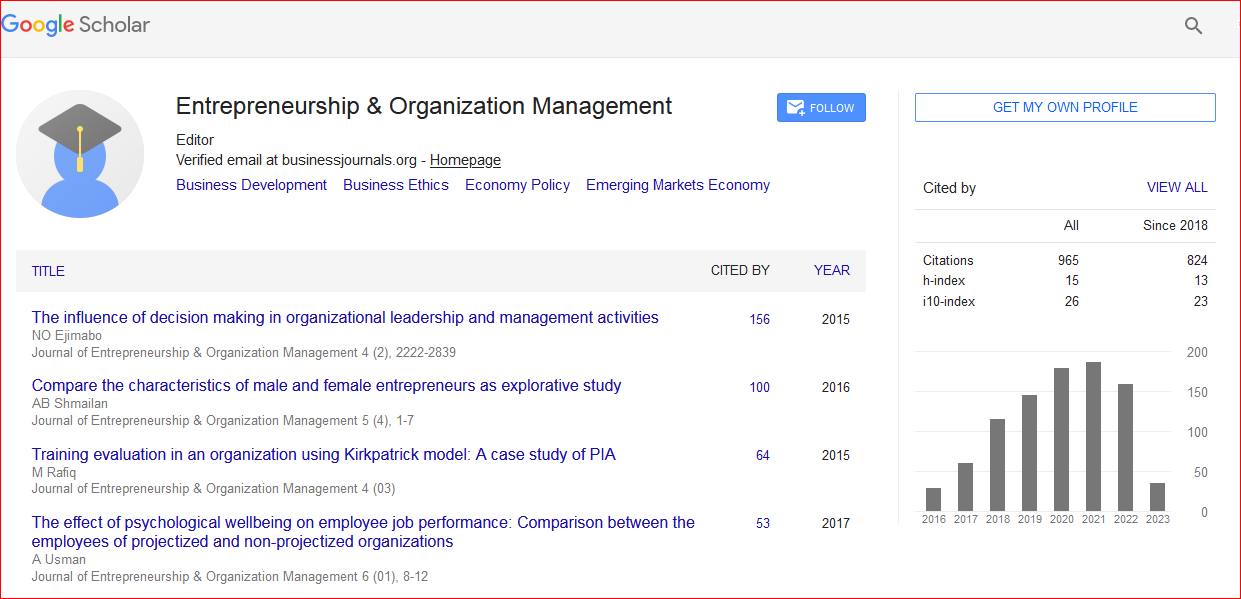
Entrepreneurship & Organization Management received 1115 citations as per Google Scholar report