Opinion - (2025) Volume 16, Issue 3
Received: 29-May-2025, Manuscript No. gjto-25-175445;
Editor assigned: 02-Jun-2025, Pre QC No. P-175445;
Reviewed: 16-Jun-2025, QC No. QC-175445;
Revised: 23-Jun-2025, Manuscript No. R-175445;
Published:
30-Jun-2025
, DOI: 10.37421/2229-8711.2025.16.450
Citation: Kovačević, Victor. ”Modern Medicine’s Tech Revolution: Smarter, Faster Care.” Global J Technol Optim 16 (2025):450.
Copyright: © 2025 Kovačević V. This is an open-access article distributed under the terms of the Creative Commons Attribution License, which permits unrestricted use,
distribution and reproduction in any medium, provided the original author and source are credited.
Artificial intelligence is proving to be a game-changer in medical diagnostics, particularly in the complex task of identifying prostate cancer. Recent studies highlight AI's capacity to enhance the interpretation of multiparametric MRI, leading to more accurate and earlier detection, which fundamentally improves patient outcomes. The technology streamlines diagnostic pathways, making advanced screening more accessible and efficient for healthcare providers.[1] Wearable technologies are transforming how we approach health monitoring, moving from episodic check-ups to continuous, real-time data collection. These devices offer unprecedented insights into cardiac and respiratory activities, providing early warning signs for potential health issues. This shift empowers individuals to take a more proactive role in managing their health, and enables clinicians to deliver personalized and timely interventions.[2] CRISPR-Cas9 gene editing represents a monumental leap in biotechnology, offering precision tools to modify DNA with incredible accuracy. Its application in human pluripotent stem cells holds immense promise for developing new therapeutic strategies for genetic diseases. While challenges remain in clinical translation, the technology is rapidly advancing, paving the way for personalized medicine and regenerative therapies.[3] Robotic-assisted surgery is changing the landscape of complex procedures, especially in areas like liver cancer treatment. The enhanced precision, improved visualization, and greater dexterity offered by robotic systems enable surgeons to perform minimally invasive operations with better outcomes. This technology reduces patient recovery times and complications, signaling a new era for surgical interventions.[4] Nanotechnology is opening up new avenues for targeted drug delivery, fundamentally reshaping cancer therapy. By engineering nanoparticles to specifically deliver therapeutic agents to tumor sites, this approach minimizes systemic toxicity while maximizing drug efficacy. It represents a significant advancement in precision medicine, offering the potential for more effective and less harmful cancer treatments.[5] 3D printing technology is revolutionizing the creation of medical implants and devices, moving beyond standard designs to highly customized solutions. This application allows for the fabrication of complex geometries tailored to individual patient anatomy, enhancing biocompatibility and functional integration. The ability to rapidly prototype and produce bespoke medical instruments is significantly improving patient care and surgical precision.[6] Telemedicine has emerged as a crucial applied technology, especially for remote monitoring of patients with chronic diseases.
It provides a means for continuous oversight and timely intervention without the need for frequent in-person visits. This approach not only enhances convenience for patients but also reduces healthcare burdens, demonstrating its effectiveness in maintaining patient health and managing long-term conditions.[7] Electrochemical biosensors are at the forefront of point-of-care diagnostics, offering rapid and accurate detection of infectious diseases outside traditional laboratory settings. Their ability to provide immediate results facilitates quicker diagnosis and treatment decisions, which is critical for managing outbreaks and preventing disease spread. This technology is making advanced diagnostics more accessible and efficient.[8] Deep learning algorithms are fundamentally changing medical image segmentation, a critical step in many diagnostic and therapeutic procedures. By precisely delineating anatomical structures and abnormalities, these algorithms significantly improve the accuracy and speed of medical image analysis. This allows for more precise diagnoses, better treatment planning, and enhanced understanding of disease progression, marking a substantial step forward in radiology and pathology.[9] Artificial intelligence is a powerful accelerator in drug discovery and development, automating and optimizing various stages from target identification to lead optimization. This computational approach drastically reduces the time and cost associated with bringing new medicines to market. While challenges exist, AI's capacity to analyze vast datasets and predict molecular interactions is ushering in an era of more efficient and targeted therapeutic innovation.[10]
The healthcare landscape is undergoing a significant transformation, with advanced technologies playing a pivotal role in redefining diagnostics, treatment, and patient care. Artificial Intelligence (AI) stands out as a central force, offering remarkable capabilities across multiple domains. In medical diagnostics, AI has emerged as a game-changer, particularly in identifying complex conditions like prostate cancer by enhancing the interpretation of multiparametric MRI, leading to earlier and more accurate detection [1]. Beyond specific disease identification, deep learning algorithms, a subset of AI, are fundamentally improving medical image segmentation, a critical step that precisely delineates anatomical structures and abnormalities. This advancement significantly boosts the accuracy and speed of image analysis, enabling more precise diagnoses and treatment planning in fields like radiology and pathology [9]. Furthermore, AI acts as a powerful accelerator in drug discovery and development, optimizing stages from target identification to lead optimization. This computational approach dramatically reduces the time and cost involved in bringing new medicines to market, ushering in an era of more efficient and targeted therapeutic innovation [10].
Patient monitoring and accessible diagnostics are also seeing revolutionary changes. Wearable technologies are shifting health monitoring from intermittent check-ups to continuous, real-time data collection. These devices provide unparalleled insights into cardiac and respiratory activities, offering early warning signs for potential health issues. This change empowers individuals to proactively manage their health and allows clinicians to provide personalized, timely interventions [2]. Complementing this, telemedicine has become a crucial technology for remotely monitoring patients with chronic diseases. It ensures continuous oversight and timely intervention without the need for frequent in-person visits, improving patient convenience and reducing healthcare burdens [7]. For rapid, on-the-spot assessments, electrochemical biosensors are at the forefront of point-of-care diagnostics. They offer quick and accurate detection of infectious diseases outside traditional labs, facilitating faster diagnosis and treatment decisions vital for managing outbreaks [8].
Surgical procedures and genetic therapies are witnessing substantial advancements through technology. Robotic-assisted surgery is redefining complex operations, such as liver cancer treatment. The enhanced precision, improved visualization, and greater dexterity provided by robotic systems enable surgeons to perform minimally invasive operations with superior outcomes. This technology demonstrably reduces patient recovery times and complications, heralding a new era for surgical interventions [4]. Simultaneously, CRISPR-Cas9 gene editing represents a monumental leap in biotechnology. It provides precise tools to modify DNA with incredible accuracy, and its application in human pluripotent stem cells holds immense promise for developing new therapeutic strategies for genetic diseases. Despite ongoing challenges in clinical translation, this technology is rapidly progressing towards personalized medicine and regenerative therapies [3].
Innovations in material science and drug delivery are reshaping treatment efficacy and patient-specific solutions. Nanotechnology is opening new avenues for targeted drug delivery, fundamentally transforming cancer therapy. By engineering nanoparticles to specifically deliver therapeutic agents to tumor sites, this approach minimizes systemic toxicity while maximizing drug efficacy. It signifies a major advancement in precision medicine, offering the potential for more effective and less harmful cancer treatments [5]. Moreover, 3D printing technology is revolutionizing the creation of medical implants and devices. It moves beyond standard designs to highly customized solutions, allowing for the fabrication of complex geometries tailored to individual patient anatomy. This enhances biocompatibility and functional integration, with the ability to rapidly prototype and produce bespoke medical instruments significantly improving patient care and surgical precision [6].
These technological strides collectively emphasize a future where healthcare is more precise, preventive, and patient-centered. The integration of these diverse innovations promises to continue improving diagnostic accuracy, therapeutic outcomes, and overall accessibility to advanced medical care.
Modern medicine is experiencing a profound transformation, driven by an array of sophisticated technologies that are fundamentally reshaping patient care and diagnostic pathways. Artificial Intelligence (AI) stands out as a critical tool, significantly improving the accuracy and speed of medical diagnostics, exemplified by its role in identifying prostate cancer through multiparametric MRI and refining medical image segmentation. AI also drastically streamlines drug discovery and development processes, cutting down on time and cost. Wearable technologies are shifting health monitoring from sporadic check-ups to continuous, real-time data collection, offering early warnings for health issues.
Telemedicine complements this by providing remote oversight for chronic disease patients, enhancing convenience and reducing healthcare burdens. Similarly, electrochemical biosensors deliver rapid, accurate point-of-care diagnostics for infectious diseases, making advanced testing more accessible. In surgical interventions, robotic-assisted systems offer enhanced precision and visualization, leading to better outcomes and quicker patient recovery for complex procedures like liver cancer treatment. Gene editing, particularly with CRISPR-Cas9, provides precise tools to modify DNA, holding immense promise for genetic disease therapies and regenerative medicine. Nanotechnology is advancing targeted drug delivery in cancer therapy, minimizing toxicity while maximizing efficacy. Finally, 3D printing technology enables the creation of highly customized medical implants and devices, tailored to individual patient anatomy, significantly improving surgical precision and patient outcomes. These innovations are paving the way for a more personalized, efficient, and effective healthcare future.
None
None
Haifeng M, Jie G, Ruize W. "Artificial intelligence for diagnosis of prostate cancer in multiparametric MRI: A systematic review and meta-analysis".Front Oncol 12 (2022):1082103.
Indexed at, Google Scholar, Crossref
Omar AA, Khadijah MA, Yaser A. "Wearable Devices for Continuous Monitoring of Cardiac and Respiratory Activities: A Systematic Review and Meta-Analysis".Healthcare (Basel) 11 (2023):618.
Indexed at, Google Scholar, Crossref
Li X, Ping P, Peitao L. "CRISPR-Cas9-mediated gene editing in human pluripotent stem cells for therapeutic applications: Advances and challenges".Stem Cell Res Ther 13 (2022):377.
Indexed at, Google Scholar, Crossref
Zhaoxiang P, Xiaokun T, Hongbing H. "Robotic-assisted surgery for liver cancer: Current status and future perspectives".Front Oncol 13 (2023):1099684.
Indexed at, Google Scholar, Crossref
Bhumika P, Ramanjaneyulu P, Dhirendra J. "Recent advances in nanotechnology for targeted drug delivery in cancer therapy".J Drug Target 31 (2023):1152-1175.
Indexed at, Google Scholar, Crossref
Shilpa S, Ankita G, Neha S. "Recent Advances in 3D Printing Technology for Medical Implants and Devices".J Nanomaterials 2023 (2023):5590928.
Indexed at, Google Scholar, Crossref
Mohammad A, Rubel C, Mahmudul A. "Effectiveness of Telemedicine for Remote Monitoring in Patients with Chronic Diseases: A Systematic Review and Meta-Analysis".Healthcare (Basel) 11 (2023):1387.
Indexed at, Google Scholar, Crossref
Zhijie Y, Ping L, Chao D. "Recent advances in electrochemical biosensors for point-of-care diagnosis of infectious diseases".J Anal Test 7 (2023):16.
Indexed at, Google Scholar, Crossref
Jinqiu L, Yunlu W, Xin X. "Deep Learning for Medical Image Segmentation: A Comprehensive Review and Future Prospects".J Imaging 9 (2023):71.
Indexed at, Google Scholar, Crossref
Debashis P, Jyotirmayee P, Basant P. "Artificial intelligence in drug discovery and development: Recent advances, challenges, and future perspectives".Comput Struct Biotechnol J 21 (2023):1942-1954.
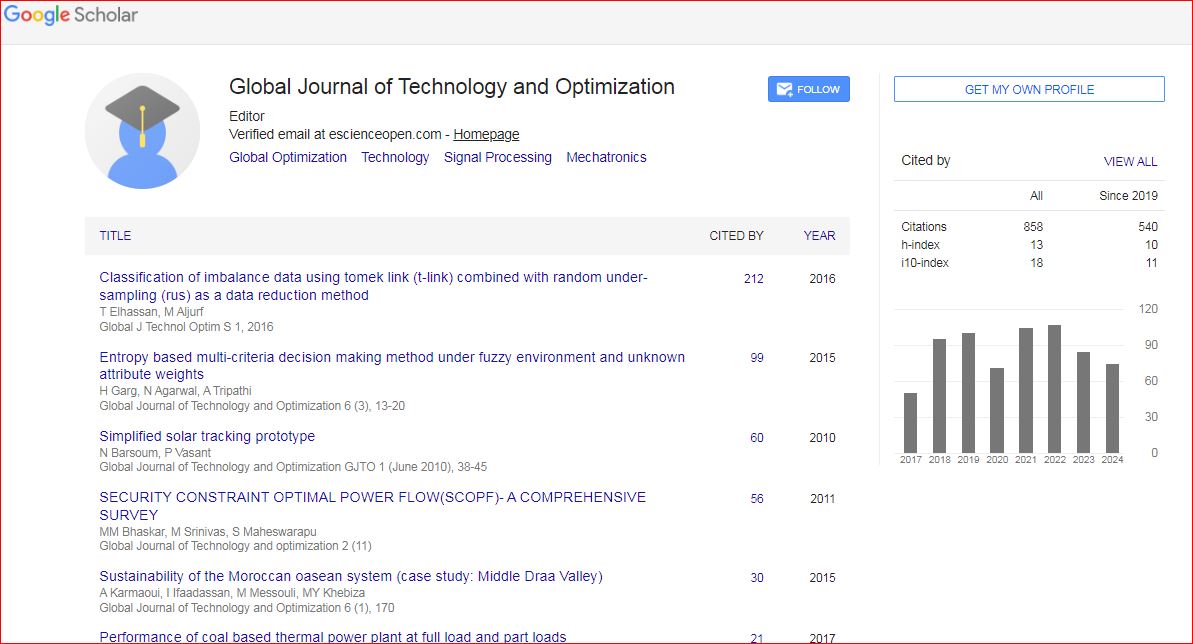
Global Journal of Technology and Optimization received 847 citations as per Google Scholar report