Perspective - (2025) Volume 16, Issue 4
Received: 01-Aug-2025, Manuscript No. jfr-26-184116;
Editor assigned: 04-Aug-2025, Pre QC No. P-184116;
Reviewed: 18-Aug-2025, QC No. Q-184116;
Revised: 22-Aug-2025, Manuscript No. R-184116;
Published:
29-Aug-2025
, DOI: 10.37421/2157-7145.2025.16.677
Citation: Steiner, Jakob. ”Modern Forensics: Unlocking Cold
Case Mysteries.” J Forensic Res 16 (2025):677.
Copyright: © 2025 Steiner J. This is an open-access article distributed under the terms of the Creative Commons Attribution License, which permits unrestricted use,
distribution and reproduction in any medium, provided the original author and source are credited.
Modern forensic techniques are significantly transforming the investigation of cold cases, offering renewed hope for their resolution by revisiting them with advanced scientific methods. The application of sophisticated DNA analysis tools, such as low-template DNA profiling and familial DNA searching, has proven instrumental in identifying suspects or establishing links between evidence in cases where traditional investigative avenues were exhausted or proved unsuccessful. These advanced molecular techniques are expanding the scope of forensic analysis, particularly in cases where DNA samples may be degraded or present in very low quantities, posing significant challenges but yielding valuable genetic profiles through innovative sample enrichment and sensitive PCR-based methods.
The recovery and characterization of such degraded DNA are crucial for optimizing investigative efforts and understanding degradation patterns to facilitate successful analysis. Digital forensics has emerged as a critical discipline in contemporary investigations, including those of cold cases, by enabling the extraction and analysis of data from older electronic devices, dormant systems, and cloud storage, thereby uncovering fresh leads and contextual information. The ability to meticulously analyze data from digital sources, including social media platforms, can provide crucial timelines, communication records, and other contextual details that might have been overlooked or inaccessible during the original investigation, offering new perspectives. Isotope ratio mass spectrometry (IRMS) provides a powerful capability for tracing the geographical origin and historical environmental exposure of materials, which can be vital in cold cases for linking individuals or evidence to specific locations. Advanced imaging techniques, including X-ray fluorescence (XRF) and infrared (IR) spectroscopy, are adept at revealing hidden details on latent evidence by identifying elemental compositions or visualizing alterations, thereby offering new insights into previously examined materials. The integration of artificial intelligence (AI) and machine learning (ML) is starting to influence cold case investigations by facilitating the analysis of extensive datasets, thereby identifying subtle patterns and potential connections between seemingly disparate cases. Revisiting historical crime scenes with contemporary forensic tools, such as advanced latent print development and touch DNA analysis, can yield critical evidence that was previously missed or unobtainable, potentially leading to suspect or victim identification. The application of advanced molecular techniques for microbial DNA analysis is also expanding in forensic science, allowing for the identification of microbial signatures in various samples to provide geographical information or link individuals to specific environments or events, thus offering a novel investigative pathway. The development and widespread adoption of high-throughput sequencing (HTS) technologies have dramatically improved the capabilities of forensic genomics, enabling the analysis of complex DNA mixtures and degraded samples, and facilitating ancestry estimation and phenotypic prediction, all of which are invaluable for re-examining cold cases [1].Familial DNA searching has emerged as a potent strategy in cold case investigations, allowing investigators to identify potential relatives of an unknown offender within a DNA database, thereby significantly narrowing the suspect pool and providing crucial links to resolve long-standing mysteries. The ethical considerations and legal frameworks governing familial searching are paramount aspects that necessitate careful navigation to ensure responsible and effective implementation of this technique. Advances in DNA analysis, such as low-template DNA profiling and familial DNA searching, have offered new hope for the resolution of cold cases, identifying suspects or linking evidence in scenarios where traditional methods previously failed [1].
The recovery and analysis of degraded or low-quantity DNA samples continue to present ongoing challenges in cold case investigations. Innovations in sample enrichment techniques and the development of more sensitive PCR-based methods are crucial for obtaining valuable genetic profiles from these difficult samples, and understanding DNA degradation patterns is key to optimizing recovery efforts [3].
Digital forensics plays an increasingly vital role in modern investigations, including cold cases. The ability to extract and analyze data from dormant or damaged digital devices, cloud storage, and social media platforms can provide timelines, communications, and other crucial contextual information that may have been overlooked or inaccessible at the time of the original investigation [4].
Advanced imaging techniques, such as X-ray fluorescence (XRF) and infrared (IR) spectroscopy, are proving invaluable in revealing hidden details on latent evidence. These methods can identify the elemental composition of trace materials or visualize alterations and additions to documents, offering new perspectives on evidence previously considered exhausted [5].
Isotope ratio mass spectrometry (IRMS) offers a sophisticated method for tracing the geographical origin and environmental history of materials, including biological samples and manufactured goods. In cold cases, IRMS can help link a suspect or victim to a specific location or establish the provenance of illicit materials, providing context that might otherwise be missing [6].
The integration of artificial intelligence (AI) and machine learning (ML) is beginning to impact cold case investigations by enabling the analysis of vast datasets. AI can assist in identifying patterns, predicting potential connections between seemingly unrelated cases, and optimizing resource allocation for investigative efforts [7].
Revisiting old crime scenes with modern forensic techniques can yield new evidence. Technologies like advanced latent print development, touch DNA analysis, and even entomological studies can provide critical insights that were missed or impossible to obtain during the initial investigation, potentially leading to the identification of suspects or victims [8].
The application of advanced molecular techniques for microbial DNA analysis in forensic contexts is expanding. In cold cases, identifying microbial signatures in soil, on clothing, or within biological samples can provide geographical information or link individuals to specific environments or events, offering a novel avenue for investigation [9].
The development of high-throughput sequencing (HTS) technologies has significantly enhanced the power of forensic genomics. HTS allows for the analysis of complex mixtures of DNA, degraded samples, and the identification of single nucleotide polymorphisms (SNPs) for ancestry estimation and phenotypic prediction, all of which can be instrumental in re-examining cold cases [10].
Modern forensic science is actively revolutionizing the approach to cold cases by employing cutting-edge technologies that provide new avenues for investigation and resolution. The utilization of advanced DNA analysis techniques, such as low-template DNA profiling and familial DNA searching, has proven to be a powerful tool in identifying previously elusive suspects or establishing critical links between evidence when traditional methods have reached their limits. These sophisticated molecular methods are expanding the potential for uncovering genetic information even from degraded or trace amounts of DNA, which were once considered unanalyzable, through innovative sample processing and highly sensitive detection systems.
The critical challenge of recovering and characterizing degraded DNA samples is being addressed by ongoing research into improved sample enrichment protocols and the development of more sensitive amplification methods, crucial for obtaining valuable genetic profiles from these difficult specimens, while a deeper understanding of DNA degradation patterns is essential for maximizing recovery success. In parallel, digital forensics has become an indispensable component of modern investigations, particularly for cold cases, by enabling the recovery and analysis of data from a wide array of digital sources, including aging electronic devices, cloud-based storage, and communication platforms, thereby uncovering overlooked information and providing crucial contextual data. The extraction and interpretation of digital evidence from various sources can furnish detailed timelines, communication logs, and other contextual elements that might have been missed or were otherwise inaccessible during the initial investigation, offering a fresh perspective on the events. Isotope ratio mass spectrometry (IRMS) offers a highly refined method for determining the geographical origin and historical environmental exposure of diverse materials, which is exceptionally beneficial in cold cases for establishing connections between individuals or evidence and specific locations. Furthermore, advanced imaging technologies, such as X-ray fluorescence (XRF) and infrared (IR) spectroscopy, are proving to be invaluable in the detection of subtle details on latent evidence by precisely identifying the elemental composition of trace materials or visualizing alterations and additions, thereby providing new insights from evidence that might have been considered fully analyzed. The integration of artificial intelligence (AI) and machine learning (ML) is increasingly influencing cold case investigations through their capacity to process and analyze vast and complex datasets, identifying subtle patterns and potential interconnections between cases that might otherwise remain undetected. The strategic revisiting of historical crime scenes using contemporary forensic techniques, including advanced latent print development and touch DNA analysis, can uncover critical evidence that was either missed or technically unrecoverable at the time of the original investigation, thereby potentially leading to the identification of suspects or victims. The application of advanced molecular methodologies for microbial DNA analysis is also gaining traction in forensic science, where the identification of microbial signatures in environmental samples or on physical evidence can offer vital geographical clues or link individuals to particular locations or events, presenting a novel investigative strategy. The development and widespread implementation of high-throughput sequencing (HTS) technologies have substantially augmented the capabilities of forensic genomics, enabling the analysis of complex DNA mixtures and degraded samples, as well as facilitating advancements in ancestry estimation and phenotypic prediction, all of which are instrumental in the re-examination of cold cases [1].Familial DNA searching has emerged as a powerful tool for cold case investigations, allowing investigators to identify potential relatives of an unknown offender in a DNA database. This technique significantly narrows down suspect pools and can provide the crucial link needed to solve long-standing mysteries. Ethical considerations and legal frameworks surrounding familial searching are critical aspects that require careful navigation [2].
The recovery and analysis of degraded or low-quantity DNA samples present ongoing challenges in cold case investigations. Innovations in sample enrichment techniques and the development of more sensitive PCR-based methods are crucial for obtaining valuable genetic profiles from these challenging samples. Understanding the degradation patterns of DNA is also key to optimizing recovery efforts [3].
Digital forensics plays an increasingly vital role in modern investigations, including cold cases. The ability to extract and analyze data from dormant or damaged digital devices, cloud storage, and social media platforms can provide timelines, communications, and other crucial contextual information that may have been overlooked or inaccessible at the time of the original investigation [4].
Advanced imaging techniques, such as X-ray fluorescence (XRF) and infrared (IR) spectroscopy, are proving invaluable in revealing hidden details on latent evidence. These methods can identify the elemental composition of trace materials or visualize alterations and additions to documents, offering new perspectives on evidence previously considered exhausted [5].
Isotope ratio mass spectrometry (IRMS) offers a sophisticated method for tracing the geographical origin and environmental history of materials, including biological samples and manufactured goods. In cold cases, IRMS can help link a suspect or victim to a specific location or establish the provenance of illicit materials, providing context that might otherwise be missing [6].
The integration of artificial intelligence (AI) and machine learning (ML) is beginning to impact cold case investigations by enabling the analysis of vast datasets. AI can assist in identifying patterns, predicting potential connections between seemingly unrelated cases, and optimizing resource allocation for investigative efforts [7].
Revisiting old crime scenes with modern forensic techniques can yield new evidence. Technologies like advanced latent print development, touch DNA analysis, and even entomological studies can provide critical insights that were missed or impossible to obtain during the initial investigation, potentially leading to the identification of suspects or victims [8].
The application of advanced molecular techniques for microbial DNA analysis in forensic contexts is expanding. In cold cases, identifying microbial signatures in soil, on clothing, or within biological samples can provide geographical information or link individuals to specific environments or events, offering a novel avenue for investigation [9].
The development of high-throughput sequencing (HTS) technologies has significantly enhanced the power of forensic genomics. HTS allows for the analysis of complex mixtures of DNA, degraded samples, and the identification of single nucleotide polymorphisms (SNPs) for ancestry estimation and phenotypic prediction, all of which can be instrumental in re-examining cold cases [10].
Modern forensic science is significantly enhancing cold case investigations through advanced DNA analysis, including low-template profiling and familial searching, alongside digital forensics for data recovery from old devices and social media. Isotope ratio mass spectrometry (IRMS) and advanced imaging techniques like X-ray fluorescence help trace origins and reveal hidden evidence on items. Innovations in microbial DNA analysis and high-throughput sequencing (HTS) offer further investigative avenues. AI and machine learning are being applied to analyze large datasets and identify patterns. Revisiting old crime scenes with new technologies can yield critical evidence. Addressing challenges with degraded DNA through sample enrichment and sensitive methods is crucial for uncovering genetic profiles.
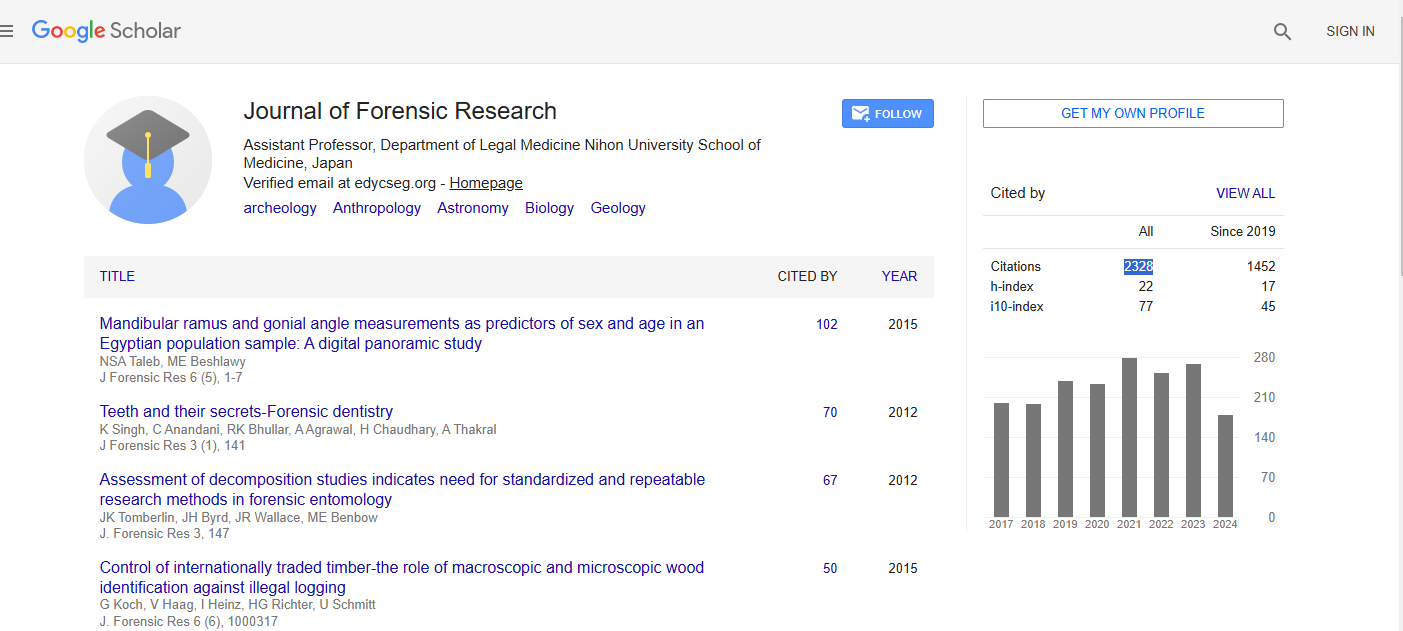
Journal of Forensic Research received 2328 citations as per Google Scholar report