Short Communication - (2025) Volume 14, Issue 2
Received: 02-Jun-2025, Manuscript No. ara-25-175581;
Editor assigned: 04-Jun-2025, Pre QC No. P-175581;
Reviewed: 18-Jun-2025, QC No. Q-175581;
Revised: 23-Jun-2025, Manuscript No. R-175581;
Published:
30-Jun-2025
, DOI: 10.37421/2168-9695.2025.14.331
Citation: Ferreira, Lucas. ”ML Advancements Driving Intelligent Autonomous Robotics.” Adv Robot Autom 14 (2025):331.
Copyright: © 2025 Ferreira L. This is an open-access article distributed under the terms of the Creative Commons Attribution License, which permits unrestricted use, distribution and reproduction in any medium, provided the original author and source are credited.
The field of robotics is advancing quickly, largely thanks to Machine Learning (ML), which gives autonomous systems more capabilities and adaptability. One core research area uses reinforcement learning with deep Q-networks to teach robots complex manipulation tasks. This work addresses the sim-to-real transfer challenge, developing methods to bridge the gap. This allows robots to learn efficiently in virtual environments before applying skills in the physical world, a crucial step for autonomous industrial and service robots [1].
Beyond individual learning, there's a focus on privacy-preserving collaborative learning among multiple robots. Federated learning lets robots share models without centralizing sensitive raw data. This is vital for applications like healthcare or smart cities where data privacy is paramount, requiring careful architectural and practical planning [2].
For robots to operate reliably in unpredictable environments, robust perception is essential. Deep learning techniques improve object detection and scene understanding. Novel architectures enhance accuracy and efficiency under varying lighting and occlusions, which is foundational for safe navigation and interaction in real-world settings [3].
Understanding human intent is critical for collaborative robotics. Research explores various ML methods, from probabilistic graphical models to deep neural networks, to predict human actions. This allows robots to adapt their behavior, aiming for more intuitive and effective interaction in shared workspaces, ultimately improving safety and productivity [4].
To accelerate skill acquisition across different robot platforms or tasks, transfer learning offers a powerful solution. By leveraging pre-trained models from source tasks, robots can learn new, complex skills with significantly less training data and time. This directly tackles a major bottleneck in robot deployment and adaptability [5].
A growing area explores the integration of Large Language Models (LLMs) with robotics. This work shows how LLMs can facilitate natural language instruction and high-level task planning for robots. Robots interpret complex human commands, generate sequential actions, and even explain their reasoning, moving towards more intuitive and versatile interfaces [6].
Further advancements detail robot locomotion using deep reinforcement learning for quadrupedal robots. Policies learned in simulation transfer effectively to real hardware, enabling agile and robust movement over challenging terrain without extensive hand-tuned control. This is transformative for deploying robots in dynamic, unstructured environments [7].
A key concern in deploying Machine Learning-based control systems for robots involves safety and interpretability. Methods for verifiable Artificial Intelligence (AI) are proposed to ensure robot behaviors are not only efficient but also predictable and safe. This is crucial in human-robot collaboration and mission-critical applications [8].
To improve the generalization capabilities of robotic learning algorithms, causal inference techniques are being explored. By identifying underlying causal relationships rather than mere correlations, robots adapt more effectively to novel situations and environments, leading to more intelligent and robust autonomous systems [9].
Finally, embodied AI integrates Machine Learning models directly with physical robot bodies, allowing real-time interaction and adaptation. This research highlights challenges and opportunities in closing the perception-action loop with advanced neural networks, especially for dexterous manipulation and navigation in complex, dynamic scenes [10].
The contemporary landscape of robotics is largely defined by its intricate convergence with Machine Learning (ML), yielding unprecedented capabilities in autonomous systems. Deep reinforcement learning, particularly through deep Q-networks, is fundamental for teaching robots complex manipulation tasks. This approach directly confronts the challenge of sim-to-real transfer, developing innovative methods to allow robots to efficiently learn skills in virtual environments before practical application in the physical world. This is critical for the next generation of autonomous industrial and service robots [1]. Similarly, advancements in deep reinforcement learning are transforming robot locomotion, notably for quadrupedal robots. Research demonstrates the successful transfer of complex movement policies learned in simulation to real hardware, resulting in agile and robust movement across challenging terrains without extensive manual calibration. This marks a significant leap for robots operating in dynamic environments [7].
Beyond individual robot learning, federated learning is applied to multi-robot systems for privacy-preserving collaborative learning. This allows robots to share learned models without centralizing sensitive raw data. Such an approach is indispensable for applications in highly sensitive sectors like healthcare or smart cities, where strict data privacy is non-negotiable [2]. Alongside collaborative learning, robust perception is vital for robots navigating unpredictable environments. Deep learning algorithms are refined for superior object detection and scene understanding. Researchers propose novel architectures that significantly improve accuracy and efficiency under adverse conditions, including varied lighting and partial occlusions. These capabilities are foundational for safe navigation and intelligent interaction in diverse real-world scenarios [3].
The sophistication of human-robot interaction is another rapidly evolving domain. Research rigorously explores various Machine Learning techniques, from probabilistic graphical models to advanced deep neural networks, to accurately predict human actions and intentions. The core objective is to empower robots to intelligently adapt their behavior in real-time responses to human cues. This leads to more intuitive, safer, and ultimately more effective interactions within shared human-robot workspaces, considerably boosting both overall safety and productivity levels [4]. In a parallel development, the integration of Large Language Models (LLMs) with robotics is opening new avenues for natural language instruction and high-level task planning. This work showcases the remarkable ability of robots to interpret complex human commands, translate them into sequential actions, and even provide explanations for their decision-making processes. This marks a profound shift towards creating far more intuitive and versatile human-robot interfaces [6].
To overcome the persistent challenge of lengthy skill acquisition, transfer learning offers an efficient solution across different robot platforms or diverse tasks. By leveraging knowledge embedded within pre-trained models from source tasks, robots can acquire new, often complex skills with dramatically reduced training data and significantly less time. This methodology directly addresses a major impediment to widespread robot deployment, substantially enhancing their inherent adaptability [5]. Critical to the broader acceptance and deployment of ML-based control systems for robots is the assurance of safety and interpretability. Pioneering research proposes innovative methods for verifiable Artificial Intelligence (AI), specifically designed to guarantee that robot behaviors are not only highly efficient but also entirely predictable, transparent, and inherently safe. This concept is particularly vital in scenarios involving human-robot collaboration and mission-critical applications where system failure carries severe consequences [8].
Furthermore, to fundamentally improve the generalization capabilities of robotic learning algorithms, researchers actively investigate advanced causal inference techniques. By meticulously identifying and understanding underlying causal relationships, rather than merely observing surface-level correlations, robots gain the ability to adapt far more effectively to novel situations and previously unseen environments. This deeper causal understanding leads directly to the development of intrinsically more intelligent and robust autonomous systems capable of handling unexpected conditions [9]. Finally, embodied AI explores the direct and seamless integration of Machine Learning models with physical robot bodies. This enables real-time interaction with the environment and continuous adaptation. This comprehensive research highlights both challenges and opportunities inherent in effectively closing the perception-action loop through advanced neural networks, particularly for achieving highly dexterous manipulation and sophisticated navigation within complex, dynamic scenes [10].
Recent advancements in robotics are heavily influenced by a range of Machine Learning techniques, pushing the boundaries of autonomous systems. From deep reinforcement learning enabling robots to learn complex manipulation tasks and robust locomotion in challenging environments [1, 7], to innovative approaches that bridge the sim-to-real gap, allowing for efficient skill acquisition in virtual settings before physical deployment. The field also explores federated learning for privacy-preserving collaborative learning among multiple robots, critical for sensitive applications like healthcare or smart cities by sharing models without centralizing raw data [2]. Perception capabilities are being enhanced through deep learning for object detection and scene understanding, crucial for safe navigation in unpredictable environments [3]. Human-robot interaction is becoming more intuitive as robots learn to predict human intent using various ML methods, improving safety and productivity in shared workspaces [4]. Efficiency in robot deployment is boosted by transfer learning, which allows robots to acquire new skills with significantly less data by leveraging pre-trained models [5]. A burgeoning area involves integrating Large Language Models (LLMs) with robotics, enabling robots to interpret natural language instructions, plan high-level tasks, and explain their reasoning, leading to more versatile interfaces [6]. Ensuring the safety and interpretability of ML-based control systems is also paramount, with verifiable Artificial Intelligence (AI) methods proposed to make robot behaviors predictable and safe in critical applications [8]. Moreover, causal inference techniques are being explored to improve generalization by identifying underlying causal relationships, fostering more intelligent and robust autonomous systems [9]. The concept of embodied AI, integrating ML models directly with robot bodies for real-time interaction and adaptation, highlights future challenges and opportunities in dexterous manipulation and navigation in dynamic scenes [10]. These developments collectively pave the way for a new generation of intelligent, adaptable, and autonomous robots.
None
None
Sergey L, Marvin T, Anusha N. "Learning Robotic Manipulation Skills via Deep Reinforcement Learning".Science Robotics 5 (2020):eaay6844.
Indexed at, Google Scholar, Crossref
Jong-Hoon K, Hyun-Joon K, Se-Hoon K. "Federated Learning for Multi-Robot Systems: A Privacy-Preserving Collaborative Learning Approach".IEEE Transactions on Robotics 37 (2021):1378-1392.
Indexed at, Google Scholar, Crossref
Bin F, Kai W, Min T. "Robust Perception for Autonomous Robots Using Deep Learning".IEEE Transactions on Industrial Electronics 68 (2021):12839-12848.
Indexed at, Google Scholar, Crossref
Yixin Z, Xiang L, Haizhou L. "Human Intent Prediction for Collaborative Robots: A Machine Learning Approach".ACM Transactions on Human-Robot Interaction 11 (2022):1-20.
Indexed at, Google Scholar, Crossref
Yi S, Zheng Z, Fuchun S. "Transfer Learning for Robot Skill Acquisition: A Survey".Robotics and Autonomous Systems 157 (2022):104240.
Indexed at, Google Scholar, Crossref
Yifan P, Yixin Z, Chien-Ming H. "Large Language Models in Robotics: A Survey".arXiv preprint N/A (2023):1-20.
Indexed at, Google Scholar, Crossref
Gabriel M, Xichen S, Matthew RO. "Rapid Learning of Dexterous Manipulation Policies with Guided Policy Search".Science Robotics 8 (2023):eade6245.
Indexed at, Google Scholar, Crossref
Huimin L, Hongtao L, Changchun W. "Verifiable Machine Learning for Safe Robot Control".IEEE Transactions on Control Systems Technology 32 (2024):1-14.
Indexed at, Google Scholar, Crossref
Bing S, Yejin K, Inseok H. "Causal Inference for Robust Robot Learning".Journal of Machine Learning Research 25 (2024):1-30.
Indexed at, Google Scholar, Crossref
Julian KRH, Patrick S, Kristian K. "Embodied AI: A Survey of the Convergence of Robotics and Machine Learning".Annual Review of Control, Robotics, and Autonomous Systems 7 (2024):1-20.
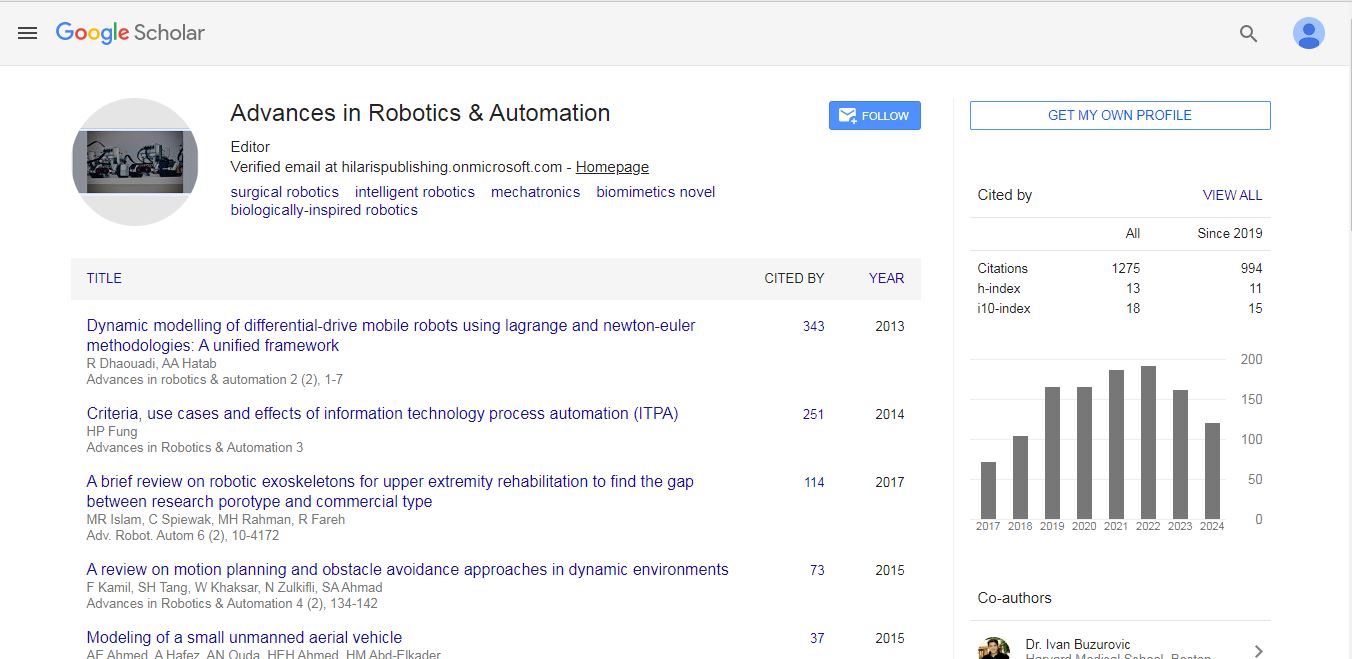
Advances in Robotics & Automation received 1275 citations as per Google Scholar report