Short Communication - (2025) Volume 11, Issue 3
Received: 01-Aug-2025, Manuscript No. jmt-25-175197;
Editor assigned: 04-Aug-2025, Pre QC No. P-175197;
Reviewed: 18-Aug-2025, QC No. Q-175197;
Revised: 22-Aug-2025, Manuscript No. R-175197;
Published:
29-Aug-2025
, DOI: 10.37421/2471-271X.2025.11.356
Citation: Rachid, Fatima. ”Mindfulness: Effective, Versatile for Health and Well-being.” J Ment Disord Treat 11 (2025):356.
Copyright: © 2025 Rachid F. This is an open-access article distributed under the terms of the Creative Commons Attribution License, which permits unrestricted use, distribution and reproduction in any medium, provided the original author and source are credited.
This article re-evaluates Mindfulness-Based Cognitive Therapy (MBCT) for depression, positioning it as a distinct clinical paradigm beyond relapse prevention. It emphasizes MBCT's role in fostering metacognitive awareness and changing one's relationship with depressive thoughts, offering a different approach to managing recurrent depression [1].
This systematic review and meta-analysis consolidates evidence on mindfulness-based interventions for chronic pain. It highlights their effectiveness in reducing pain intensity, improving functional ability, and alleviating psychological distress associated with long-term pain conditions, suggesting these therapies are a valuable addition to pain management strategies [2].
This review traces the evolution of mindfulness-based therapy from ancient practices to contemporary clinical applications. It discusses how these interventions impact mental health by fostering self-regulation, reducing reactivity to stress, and promoting psychological flexibility, offering a comprehensive view on their mechanisms and efficacy [3].
This pilot study explores the feasibility and efficacy of Mindfulness-Based Stress Reduction (MBSR) for adolescents experiencing anxiety. Findings suggest that MBSR can significantly reduce anxiety symptoms and improve emotional regulation in this population, pointing to its potential as an accessible intervention for youth mental health [4].
This article delves into the neurobiological underpinnings of mindfulness practice. It describes how mindfulness-based interventions induce measurable changes in brain structure and function, affecting areas involved in attention, emotion regulation, and self-awareness, providing a scientific basis for its therapeutic effects [5].
This systematic review and meta-analysis examines the application of mindfulness-based therapy in individuals with psychosis. It reveals that such interventions can effectively reduce distress associated with psychotic symptoms, improve functioning, and enhance overall well-being, suggesting a promising adjunctive treatment for this complex condition [6].
This comprehensive review and meta-analysis assesses the effectiveness of Mindfulness-Based Relapse Prevention (MBRP) for substance use disorders. It indicates that MBRP helps individuals develop greater awareness of craving and triggers, fostering healthier responses and reducing the likelihood of relapse, thus supporting its integration into addiction treatment [7].
This systematic review and meta-analysis investigates the impact of mindfulness-based interventions on burnout among healthcare professionals. It demonstrates that these therapies significantly reduce emotional exhaustion and depersonalization, while increasing personal accomplishment, highlighting their potential to support the well-being and resilience of frontline workers [8].
This article explores the neurobiological mechanisms through which Mindfulness-Based Stress Reduction (MBSR) influences chronic pain. It emphasizes how MBSR targets central nervous system processes, including attention, emotion regulation, and pain perception pathways, offering insights into how mindful awareness can modulate the experience of pain [9].
This systematic review synthesizes research on mindfulness-based interventions' role in improving emotion regulation. It highlights how these practices cultivate awareness of emotional experiences without judgment, fostering a more adaptive and flexible response to challenging feelings, crucial for mental well-being across various clinical populations [10].
Mindfulness-Based Cognitive Therapy (MBCT) is recognized as a distinct clinical paradigm for depression, extending beyond mere relapse prevention. It specifically aids in cultivating metacognitive awareness, allowing individuals to alter their relationship with depressive thoughts, thereby offering a novel approach to managing recurrent depression [1]. This therapeutic evolution from ancient wisdom to modern clinical applications underscores how mindfulness fosters self-regulation, reduces stress reactivity, and promotes psychological flexibility, providing a comprehensive understanding of its mechanisms and effectiveness in mental health [3].
Several studies highlight the broad applicability of mindfulness-based interventions across various conditions. For instance, MBSR has shown significant promise for adolescents experiencing anxiety, reducing symptoms and improving emotional regulation, suggesting it is a viable intervention for youth mental health challenges [4]. Furthermore, in the realm of chronic pain, systematic reviews and meta-analyses affirm the effectiveness of mindfulness-based interventions in diminishing pain intensity, enhancing functional ability, and alleviating psychological distress tied to long-term pain conditions [2]. The neurobiological aspect of MBSR in chronic pain reveals its impact on central nervous system processes, including attention, emotion regulation, and pain perception, illustrating how mindful awareness can directly influence the experience of pain [9].
Beyond individual conditions, mindfulness interventions demonstrate efficacy in complex areas like psychosis. A systematic review and meta-analysis confirmed that these therapies reduce distress from psychotic symptoms, improve overall functioning, and boost well-being, positioning them as a valuable adjunctive treatment [6]. Similarly, for substance use disorders, Mindfulness-Based Relapse Prevention (MBRP) has proven instrumental. It helps individuals develop heightened awareness of cravings and triggers, fostering healthier responses and significantly lowering the risk of relapse, thereby supporting its integration into addiction treatment protocols [7].
The scientific basis for mindfulnessâ??s therapeutic effects is further strengthened by neurobiological research. Studies reveal that mindfulness-based interventions induce measurable changes in brain structure and function, impacting regions vital for attention, emotion regulation, and self-awareness [5]. This deep dive into the neuroscience of mindfulness illustrates how consistent practice can profoundly alter the brain and body. Moreover, a systematic review on emotion regulation consolidates how these practices cultivate non-judgmental awareness of emotional experiences, leading to more adaptive and flexible responses to challenging feelings, which is crucial for mental well-being across diverse clinical populations [10]. Even healthcare professionals benefit, with mindfulness-based interventions effectively reducing emotional exhaustion and depersonalization while increasing personal accomplishment, thereby supporting their well-being and resilience [8].
Mindfulness-based interventions are a versatile and effective approach to various mental and physical health challenges. These therapies, including Mindfulness-Based Cognitive Therapy (MBCT) and Mindfulness-Based Stress Reduction (MBSR), are increasingly recognized for their ability to foster metacognitive awareness and alter one's relationship with difficult thoughts and sensations. They have shown significant success in managing recurrent depression by promoting psychological flexibility and self-regulation. Beyond mental health, mindfulness is effective in reducing pain intensity and improving functional ability for individuals with chronic pain, with neurobiological studies illustrating how these practices modify brain structure and function related to attention and emotion regulation. Specific applications include reducing anxiety in adolescents, managing distress and improving functioning in psychosis, and preventing relapse in substance use disorders. Furthermore, mindfulness helps healthcare professionals combat burnout by reducing emotional exhaustion and increasing personal accomplishment, highlighting its broad benefits for well-being across diverse populations and conditions.
None
None
Zindel VS, Sona D, Aaron TB. "Mindfulness-Based Cognitive Therapy for Depression: A New Clinical Paradigm".Cognitive and Behavioral Practice 30 (2023):415-427.
Indexed at, Google Scholar, Crossref
Karen R, Bianca B, Lukas T. "Mindfulness-Based Interventions for Chronic Pain: A Systematic Review and Meta-Analysis of Randomized Controlled Trials".The Journal of Pain 23 (2022):1629-1643.
Indexed at, Google Scholar, Crossref
Eric LG, Anne WH, Brennan LR. "Mindfulness-Based Therapy for Mental Health: A Modern Perspective on Ancient Wisdom".Annual Review of Clinical Psychology 19 (2023):261-285.
Indexed at, Google Scholar, Crossref
Heather LR, Sarah R, Jeffery AD. "Mindfulness-Based Stress Reduction for Adolescents with Anxiety: A Pilot Randomized Controlled Trial".Mindfulness 11 (2020):2634-2646.
Indexed at, Google Scholar, Crossref
Britta KH, Sara WL, Taren G. "The Neuroscience of Mindfulness: How Practice Changes the Brain and Body".Annual Review of Neuroscience 44 (2021):1-21.
Indexed at, Google Scholar, Crossref
Peter C, Gillian H, Alice MJ. "Mindfulness-Based Therapy for Psychosis: An Updated Systematic Review and Meta-Analysis".Clinical Psychology Review 77 (2020):101839.
Indexed at, Google Scholar, Crossref
Sarah B, Neharika C, Susan EC. "Mindfulness-Based Relapse Prevention for Substance Use Disorders: A Systematic Review and Meta-Analysis".Addiction 117 (2022):1279-1293.
Indexed at, Google Scholar, Crossref
Kavita G, Shalini S, Ruchika G. "Effectiveness of Mindfulness-Based Interventions on Burnout in Healthcare Professionals: A Systematic Review and Meta-Analysis".Journal of Clinical Psychology in Medical Settings 30 (2023):856-871.
Indexed at, Google Scholar, Crossref
Zev S, Marisha T, David RV. "The Mind-Body Connection in Pain: Mindfulness-Based Stress Reduction and the Neuroscience of Chronic Pain".Current Pain and Headache Reports 24 (2020):57.
Indexed at, Google Scholar, Crossref
Philippe RG, Moria Z, Amishi PJ. "Mindfulness-based interventions for emotion regulation: A systematic review".Current Opinion in Psychology 48 (2022):101460.
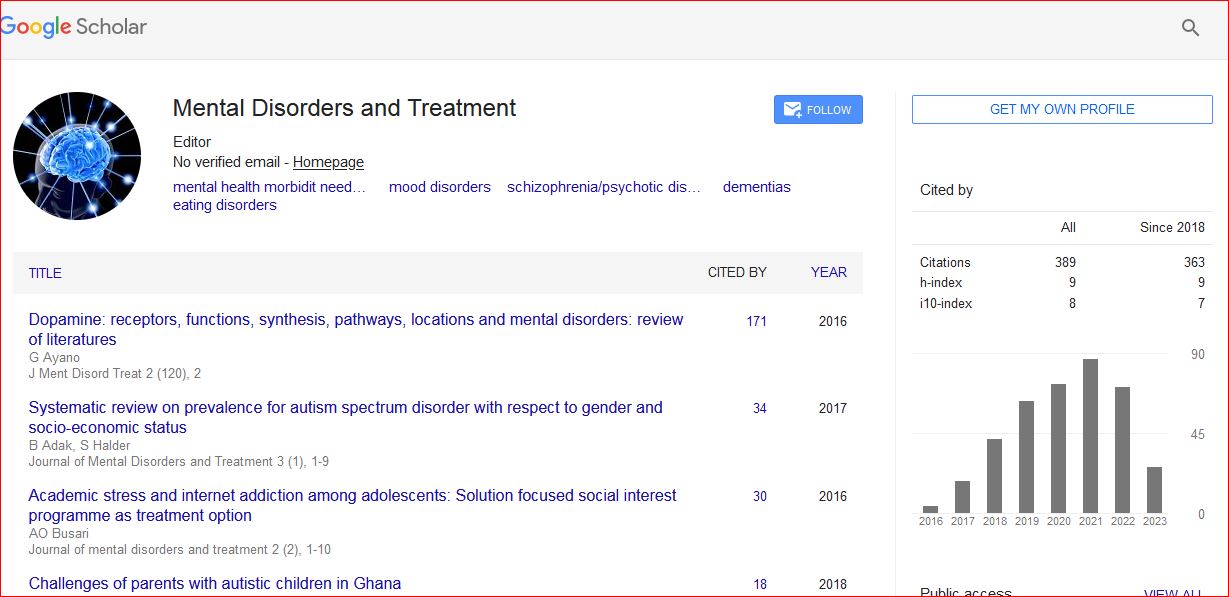
Mental Disorders and Treatment received 556 citations as per Google Scholar report