Perspective - (2025) Volume 11, Issue 4
Received: 03-Aug-2025, Manuscript No. abp-25-173834;
Editor assigned: 05-Aug-2025, Pre QC No. P-173834;
Reviewed: 19-Aug-2025, QC No. Q-173834;
Revised: 25-Aug-2025, Manuscript No. R-173834;
Published:
30-Aug-2025
, DOI: 10.37421/2472-0496.2025.11.335
Citation: Petrova, Anna. ”Mindfulness: Broad Benefits for Health and Life.” Abnorm Behav Psychol 11 (2025):335.
Copyright: © 2025 Petrova A. This is an open-access article distributed under the terms of the Creative Commons Attribution License, which permits unrestricted use, distribution and reproduction in any medium, provided the original author and source are credited.
Mindfulness-based interventions (MBIs) have emerged as a significant area of research, with a growing body of evidence supporting their diverse applications and benefits across various populations and conditions. Recent systematic reviews and meta-analyses extensively explore their efficacy and mechanisms. For instance, a systematic review examines MBIs' efficacy in psychiatric disorders through randomized controlled trials. It highlights MBIs as valuable complements to standard treatments, demonstrating benefits across various conditions like depression, anxiety, and stress-related disorders. They often improve emotional regulation and reduce symptom severity [1].
In high-stress professional environments, a meta-analysis investigates the impact of MBIs on burnout and overall well-being in healthcare professionals. It concludes that such interventions significantly reduce burnout symptoms and improve well-being, suggesting their utility as a coping strategy for professionals facing demanding environments [2].
Regarding physical health, particularly chronic pain management, a systematic review focuses on the latest evidence. It emphasizes MBIs' capacity to reduce pain intensity, improve functional ability, and enhance the quality of life for individuals suffering from various chronic pain conditions, often by fostering a different relationship with pain [3].
Beyond adult populations, MBIs are also effectively integrated into educational settings. A systematic review and meta-analysis evaluates their effectiveness for adolescents in school settings. It suggests these programs can positively influence mental health outcomes, reduce stress, and improve emotional regulation skills among young people, contributing to better overall well-being and academic functioning [4].
Exploring the underlying mechanisms, a systematic review synthesizes findings from neuroimaging studies. It identifies consistent alterations in brain regions associated with attention, emotion regulation, and self-awareness, suggesting that mindfulness training fosters specific neural changes that support its therapeutic effects [5].
The workplace also benefits. A systematic review and meta-analysis evaluates how MBIs impact employee well-being and performance. Findings indicate these interventions are effective in enhancing employee mental health, reducing stress, and potentially improving work-related performance and satisfaction [6].
For individuals with eating disorders and disordered eating patterns, MBIs offer a valuable complementary approach. A systematic review and meta-analysis concludes that these interventions show promise in reducing symptoms of disordered eating, improving body image, and enhancing mindful eating behaviors [7].
The accessibility of mindfulness is evolving with technology. A systematic review and meta-analysis evaluates the efficacy of digital MBIs on mental health outcomes. It suggests that app-based or online mindfulness programs can be effective in improving various mental health indicators, offering accessible and scalable solutions for managing psychological distress [8].
Furthermore, the broader societal implications of MBIs include cultivating compassion and empathy. A systematic review and meta-analysis suggests these practices can significantly enhance prosocial emotions and behaviors, contributing to improved interpersonal relationships and a greater sense of connection with others [9].
Finally, for those experiencing sleep disturbances, MBIs offer a non-pharmacological pathway. A systematic review and meta-analysis on insomnia indicates that these interventions significantly improve sleep quality and reduce insomnia severity by fostering a more relaxed and present state of mind [10].
Mindfulness-based interventions (MBIs) are widely recognized for their diverse therapeutic applications across various health and social domains. A substantial body of evidence from systematic reviews and meta-analyses consistently supports their efficacy, highlighting MBIs not just as alternative therapies but as crucial complements to established treatments. This evidence base demonstrates significant improvements in mental, physical, and emotional well-being.
In the critical area of mental health, MBIs have proven particularly impactful. Research shows their effectiveness in managing psychiatric disorders, notably reducing symptom severity for conditions like depression, anxiety, and stress-related disorders by enhancing emotional regulation [1]. Beyond clinical settings, MBIs offer substantial benefits to healthcare professionals, effectively mitigating burnout symptoms and boosting overall well-being in highly demanding environments [2]. The accessibility of MBIs has also expanded through digital platforms; online and app-based programs are effective in improving various mental health indicators, providing scalable solutions for psychological distress for a broader population [8].
MBIs also play a vital role in addressing physical ailments, particularly chronic pain. They significantly reduce pain intensity, improve functional abilities, and substantially enhance the quality of life for individuals with various chronic pain [3]. This often stems from fostering a profoundly different relationship with the experience of pain. Furthermore, individuals experiencing sleep disturbances like insomnia find relief, as MBIs improve sleep quality and reduce insomnia severity by cultivating a more relaxed and present state of mind [10]. For those grappling with eating disorders, MBIs present a valuable complementary approach, showing promise in reducing symptoms, fostering healthier body image, and promoting mindful eating behaviors [7].
The influence of MBIs extends to broader societal and developmental contexts. For adolescents in school settings, these programs positively impact mental health outcomes, reduce stress, and improve emotional regulation skills, contributing to better overall well-being and academic functioning [4]. In the workplace, MBIs enhance employee mental health, significantly reduce work-related stress, and can even improve work-related performance and overall job satisfaction [6]. Moreover, the practice of mindfulness is instrumental in cultivating vital prosocial emotions. It significantly enhances compassion and empathy, leading to improved interpersonal relationships and fostering a greater sense of connection with others [9].
Crucially, understanding the neurobiological underpinnings of these benefits is a key area of study. Neuroimaging studies reveal consistent alterations in specific brain regions critical for attention, emotion regulation, and self-awareness [5]. These findings suggest that mindfulness training induces distinct neural changes that directly support its wide-ranging therapeutic effects. Collectively, this extensive research underscores the remarkable versatility and profound positive impact of mindfulness-based interventions across the human experience, from individual mental and physical health to professional performance and interpersonal well-being.
Mindfulness-based interventions (MBIs) are increasingly recognized for their diverse therapeutic benefits across a wide range of conditions and populations. Extensive systematic reviews and meta-analyses highlight their efficacy in managing psychiatric disorders like depression, anxiety, and stress, by improving emotional regulation and reducing symptom severity. MBIs are also effective in alleviating burnout and enhancing well-being among healthcare professionals in high-stress environments. For chronic pain, these interventions reduce intensity, improve function, and enhance quality of life by fostering a different relationship with pain. In school settings, MBIs positively impact adolescent mental health, stress reduction, and emotional regulation, contributing to overall well-being and academic performance. Neuroimaging studies reveal that mindfulness training leads to consistent alterations in brain regions associated with attention, emotion regulation, and self-awareness, supporting its therapeutic effects. In the workplace, MBIs enhance employee mental health, reduce stress, and improve performance and satisfaction. They also show promise in reducing symptoms of eating disorders, improving body image, and promoting mindful eating. Digital MBIs offer accessible solutions for mental health improvement. Furthermore, these interventions cultivate compassion and empathy, enhancing interpersonal relationships, and effectively improve sleep quality and reduce insomnia severity. This collective evidence underscores the versatile and profound positive impact of MBIs across individual well-being, professional performance, and societal connections.
None
None
1. Carlo G, Claudio S, Alessandro B. "Mindfulness-based interventions in psychiatry: a systematic review of randomized controlled trials.".Psychother Psychosom 91 (2022):367-377.
Indexed at, Google Scholar, Crossref
2. MarÃa XP, Marco M, Alexander G. "Effectiveness of Mindfulness-Based Interventions on Burnout and Well-Being among Healthcare Professionals: A Systematic Review and Meta-Analysis.".J Clin Med 12 (2023):1109.
Indexed at, Google Scholar, Crossref
3. Keren R, Liron T, Carmel L. "The effectiveness of mindfulness-based interventions for chronic pain management: A systematic review of recent developments.".Clin Psychol Rev 101 (2023):102264.
Indexed at, Google Scholar, Crossref
4. Berber JV, Leonore WM, Theo WdV. "Mindfulness-based interventions in schools for adolescents: A systematic review and meta-analysis.".J Consult Clin Psychol 91 (2023):387-400.
Indexed at, Google Scholar, Crossref
5. Britta KH, Sara WL, Taren G. "Neurobiological mechanisms of mindfulness-based interventions: A systematic review of structural and functional neuroimaging studies.".Neurosci Biobehav Rev 132 (2022):104443.
Indexed at, Google Scholar, Crossref
6. Tim L, Itai I, Kathryn CW. "The effectiveness of mindfulness-based interventions on employee well-being and performance: A systematic review and meta-analysis.".J Posit Psychol 16 (2021):507-526.
Indexed at, Google Scholar, Crossref
7. Bassam K, Tineke L, Thomas P. "Mindfulness-based interventions for eating disorders and disordered eating: A systematic review and meta-analysis.".Clin Psychol Rev 97 (2022):102195.
Indexed at, Google Scholar, Crossref
8. Yonghong T, Hao D, Shiyao W. "Effectiveness of Digital Mindfulness-Based Interventions on Mental Health: A Systematic Review and Meta-Analysis of Randomized Controlled Trials.".J Med Internet Res 24 (2022):e34907.
Indexed at, Google Scholar, Crossref
9. Julieta G, Miranda G, Sophie K. "Mindfulness-based interventions to foster compassion and empathy: A systematic review and meta-analysis.".Clin Psychol Rev 89 (2021):102072.
Indexed at, Google Scholar, Crossref
10. Jing L, Hui W, Fengqin X. "Mindfulness-Based Interventions for Insomnia: A Systematic Review and Meta-Analysis.".Mindfulness 14 (2023):111-125.
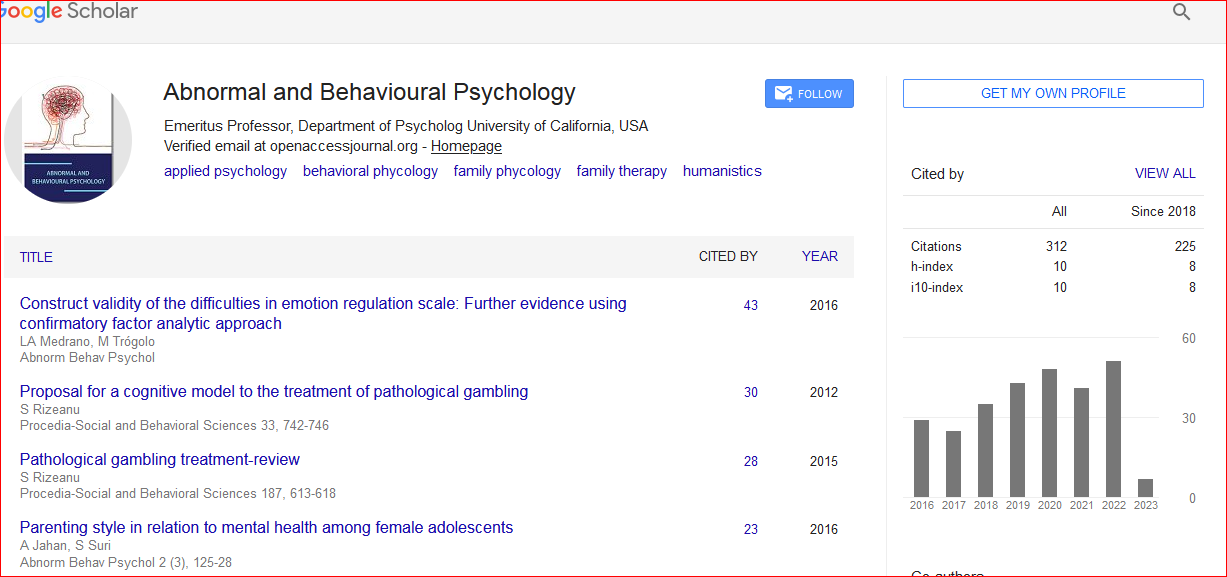
Abnormal and Behavioural Psychology received 361 citations as per Google Scholar report