Brief Report - (2025) Volume 14, Issue 6
Received: 03-Nov-2025, Manuscript No. aim-25-178058;
Editor assigned: 05-Nov-2025, Pre QC No. P-178058;
Reviewed: 19-Nov-2025, QC No. Q-178058;
Revised: 24-Nov-2025, Manuscript No. R-178058;
Published:
29-Nov-2025
, DOI: 10.37421/2427-5162.2025.14.601
Citation: Kapoor, Maya R.. ”Mindfulness: a Versatile and Essential Mental Health Tool.” Alt Integr Med 14 (2025):601.
Copyright: © 2025 Kapoor R. Maya This is an open-access article distributed under the terms of the Creative Commons Attribution License, which permits unrestricted use, distribution and reproduction in any medium, provided the original author and source are credited.
Research has consistently explored the therapeutic potential of mindfulness-based interventions (MBIs) across diverse clinical applications. One foundational systematic review and meta-analysis unequivocally affirmed the widespread efficacy of these interventions in mitigating symptoms associated with depression, anxiety, and stress. This broad applicability extends across a spectrum of populations, firmly establishing MBIs as a promising core component within contemporary mental health care paradigms. [1].
Further reinforcing the extensive evidence base, another comprehensive systematic review and meta-analysis meticulously evaluated mindfulness-based interventions, revealing robust support for their capacity to significantly enhance overall health and well-being. This significant finding corroborates the consistent effectiveness of MBIs across a variety of demographic groups and clinical conditions, solidifying their role in promoting holistic wellness. [2].
Beyond broad reviews, targeted clinical trials have provided specific insights into the utility of MBIs. A pivotal randomized controlled trial specifically investigated Mindfulness-Based Cognitive Therapy (MBCT) and conclusively demonstrated its effectiveness in addressing residual depressive symptoms. This outcome is particularly crucial as it underscores MBCT's potential not only for symptom reduction but also for preventing relapse and fostering improved long-term mental health trajectories, offering a vital preventative strategy. [3].
Innovative applications of mindfulness are also being explored in specialized high-pressure environments. A randomized controlled pilot study conducted among medical students showcased the feasibility and initial efficacy of a hybrid Mindfulness-Based Stress Reduction (MBSR) program. This pioneering work suggested a significant potential for such tailored interventions to effectively mitigate stress and substantially enhance well-being within demanding academic settings, thereby supporting student resilience. [4].
Understanding the mechanisms underpinning the observed benefits of MBIs is crucial for refining their application. A systematic review dedicated to this aspect meticulously explored the various pathways through which mindfulness-based interventions alleviate depression and anxiety. Key findings emphasized significant changes in cognitive reactivity, improved emotion regulation, and enhanced self-compassion as central mechanisms driving the therapeutic effects, offering a deeper theoretical understanding. [5].
The accessibility and scalability of mental health interventions are critical considerations, especially in modern healthcare. A recent systematic review and meta-analysis specifically focused on mobile mindfulness-based interventions, confirming their substantial effectiveness in improving mental health and overall well-being outcomes. This highlights a significant potential for these digital platforms to deliver widespread, accessible, and scalable care, reaching a broader population. [6].
Early intervention and prevention are vital for youth mental health. A dedicated meta-analysis focused on school-based mindfulness interventions for adolescents, demonstrating their clear effectiveness in fostering positive mental health outcomes. Specifically, these programs were shown to reduce stress and anxiety while significantly enhancing emotional regulation capabilities in young individuals, supporting their developmental well-being. [7].
The application of MBIs extends to specialized and vulnerable populations. A systematic review and meta-analysis specifically addressed the efficacy of mindfulness-based interventions in alleviating psychological distress among cancer patients. The findings confirmed significant benefits, underscoring the role of MBIs as a valuable adjunctive treatment within comprehensive oncology care, supporting patients' emotional well-being during difficult times. [8].
Healthcare professionals, often exposed to high levels of stress, can also benefit significantly from MBIs. A systematic review and meta-analysis meticulously examined the efficacy of mindfulness-based interventions in reducing burnout and concurrently enhancing well-being among this critical workforce. The study provided compelling evidence for their role in offering essential support to professionals in high-stress clinical environments. [9].
Addressing substance use disorders remains a significant public health challenge, where MBIs show promise. A systematic review and meta-analysis rigorously evaluated mindfulness-based interventions for substance use disorders, clearly demonstrating their effectiveness in reducing cravings and preventing relapse. These findings strongly support the strategic integration of MBIs into existing addiction treatment protocols, offering a non-pharmacological therapeutic avenue. [10].
Mindfulness-based interventions (MBIs) have garnered considerable attention in mental health research due to their broad applicability and confirmed efficacy. A comprehensive systematic review and meta-analysis highlighted their substantial role in ameliorating symptoms of depression, anxiety, and stress across diverse populations, affirming their potential as an integral component within various mental health care frameworks. These findings provide a strong empirical basis for their widespread adoption. [1]. Further evidence concerning the broad benefits of mindfulness-based approaches was elucidated in an extensive systematic review and meta-analysis. This work specifically underscored the robust empirical support for MBIs in promoting overall health and well-being. The review meticulously documented their effectiveness across numerous populations and under various health conditions, confirming their pervasive positive impact on human welfare. [2]. Focusing on specific clinical challenges, a randomized controlled trial meticulously evaluated Mindfulness-Based Cognitive Therapy (MBCT) as an intervention for individuals experiencing residual depressive symptoms. The study successfully demonstrated MBCTâ??s capacity to address these persistent symptoms, concurrently suggesting its significant utility in relapse prevention and the enhancement of long-term mental health outcomes, thereby offering a proactive therapeutic strategy. [3]. The exploration of mindfulness applications has extended into demanding professional contexts, such as medical education. A pilot study, conducted as a randomized controlled trial, investigated the feasibility and initial efficacy of a hybrid Mindfulness-Based Stress Reduction (MBSR) program specifically designed for medical students. The results indicated a promising capacity for this intervention to effectively alleviate stress and improve well-being within intensely pressurized academic settings. [4]. To fully leverage MBIs, understanding their underlying mechanisms is paramount. A dedicated systematic review meticulously investigated how these interventions exert their therapeutic effects on depression and anxiety. The analysis revealed that MBIs operate through critical changes in cognitive reactivity, enhanced emotion regulation, and the cultivation of self-compassion, providing valuable insights into the psychobiological pathways involved. [5]. In an era demanding greater accessibility to mental health support, mobile mindfulness-based interventions represent a significant advancement. A systematic review and meta-analysis examined these digital modalities, confirming their substantial effectiveness in improving a range of mental health and well-being outcomes. This research firmly establishes the immense potential of such technologies for delivering scalable and widely accessible care to a diverse global population. [6]. Mindfulness training has also been specifically tailored for younger demographics within educational settings. A comprehensive meta-analysis focused on school-based mindfulness interventions for adolescents, definitively showcasing their positive impact on mental health. The findings included significant reductions in stress and anxiety levels, alongside marked improvements in emotional regulation skills among youth participants, supporting crucial developmental milestones. [7]. The profound challenges faced by cancer patients necessitate multifaceted support strategies. A systematic review and meta-analysis specifically highlighted the significant benefits of integrating mindfulness-based interventions for mitigating psychological distress within this vulnerable group. These findings firmly position MBIs as a valuable adjunctive treatment option, complementing conventional oncology care and enhancing patient coping mechanisms. [8]. Addressing the pervasive issue of burnout among healthcare professionals is critical for maintaining robust health systems. A systematic review and meta-analysis rigorously assessed the efficacy of mindfulness-based interventions in reducing professional burnout while simultaneously enhancing overall well-being within this high-stress workforce. The compelling evidence advocates for their broader implementation as an essential support mechanism. [9]. The landscape of addiction treatment is continually evolving, with MBIs emerging as a potent therapeutic tool. A systematic review and meta-analysis thoroughly evaluated mindfulness-based interventions for individuals struggling with substance use disorders. The results clearly demonstrated their effectiveness in diminishing cravings and significantly aiding in the prevention of relapse, thereby supporting their valuable integration into comprehensive addiction recovery protocols. [10].
Mindfulness-based interventions (MBIs) demonstrate broad and robust efficacy across a wide range of mental health conditions and populations. Systematic reviews and meta-analyses consistently confirm their effectiveness in reducing symptoms of depression, anxiety, and stress, and enhancing overall health and well-being. Specific applications highlight their utility in preventing depressive relapse, mitigating stress in high-pressure academic environments, and addressing psychological distress in cancer patients. Furthermore, MBIs have shown significant potential in improving mental health outcomes for adolescents through school-based programs and reducing burnout among healthcare professionals. Digital and mobile mindfulness interventions offer scalable and accessible care, while studies on underlying mechanisms reveal improvements in cognitive reactivity, emotion regulation, and self-compassion. Importantly, MBIs have also proven effective in reducing cravings and preventing relapse in individuals with substance use disorders, supporting their integration into addiction treatment. Collectively, the evidence positions mindfulness-based approaches as valuable, versatile, and increasingly essential components of contemporary mental health and wellness strategies.
None
None
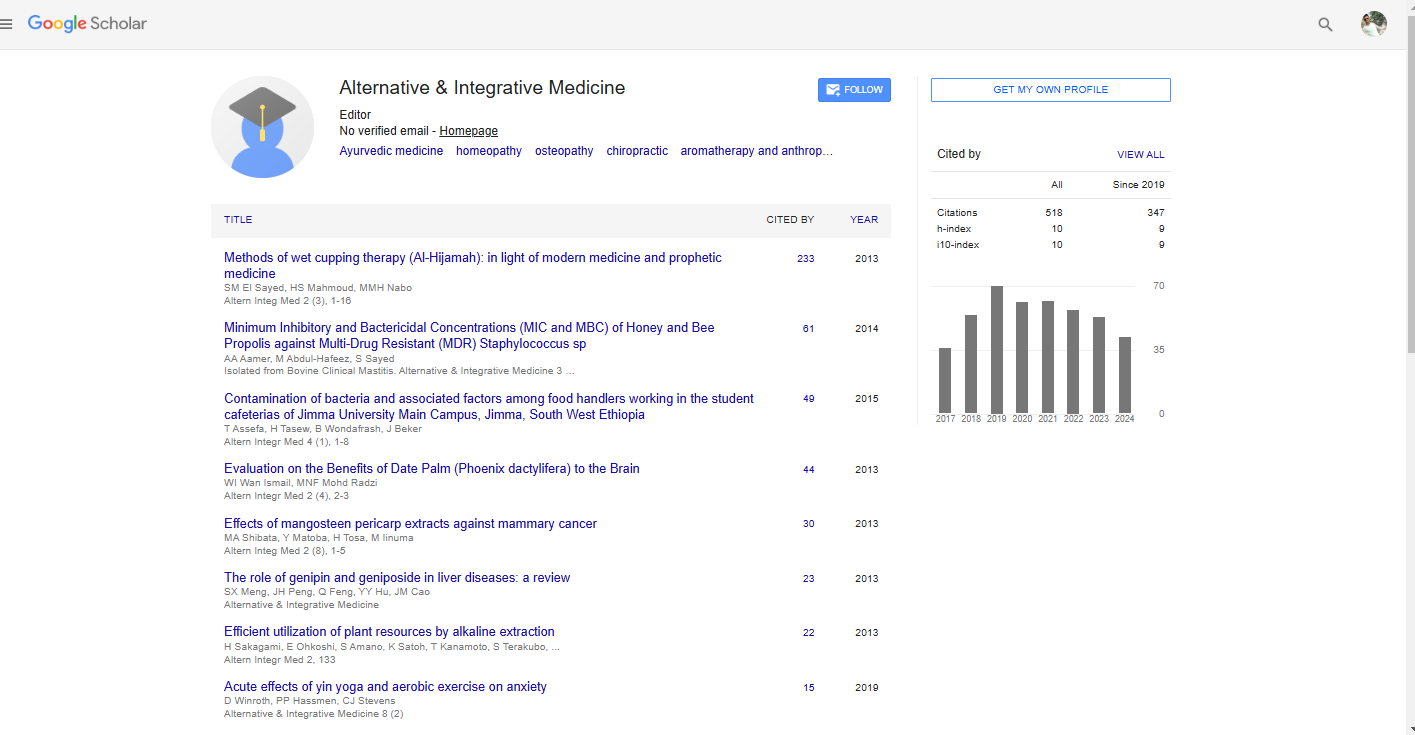
Alternative & Integrative Medicine received 476 citations as per Google Scholar report