Brief Report - (2025) Volume 14, Issue 5
Received: 01-Oct-2025, Manuscript No. jbfa-25-176825;
Editor assigned: 03-Oct-2025, Pre QC No. P-176825;
Reviewed: 17-Oct-2025, QC No. Q-176825;
Revised: 22-Oct-2025, Manuscript No. R-176825;
Published:
29-Oct-2025
, DOI: 10.37421/2161-0673.2025.14.550
Citation: Deluca, Marco. ”Microfinance: Impact, Challenges, Digital Transformation, Sustainability.” J Bus Fin Aff 14 (2025):550.
Copyright: © 2025 Deluca M. This is an open-access article distributed under the terms of the Creative Commons Attribution License, which permits unrestricted use, distribution and reproduction in any medium, provided the original author and source are credited.
Microfinance stands as a crucial tool in global development, with various studies dissecting its multifaceted impacts and operational aspects. A comprehensive meta-analysis reveals that while microfinance positively, albeit modestly, impacts poverty alleviation, its effectiveness relies heavily on contextual factors such as institutional quality, client targeting, and the integration of non-financial services. This underscores the need for tailored strategies to maximize developmental outcomes[1].
The evolving landscape of microfinance now includes significant digitalization, exploring its implications for financial inclusion. Key digital innovations, including mobile banking and digital payment platforms, demonstrably enhance outreach, reduce transaction costs, and improve service delivery for marginalized populations. However, this progress is not without challenges, necessitating attention to digital literacy, data privacy, and adaptive regulatory frameworks[2].
Empirical research from Nigeria highlights microfinance institutions' vital role in fostering women's empowerment. Findings indicate a significant positive relationship between access to microfinance services and enhanced economic decision-making, social status, and political participation among women. Such targeted programs prove effective in promoting gender equality and improving socio-economic conditions in developing economies[3].
Operational challenges and future prospects of microfinance institutions are also a subject of scrutiny, as seen in a case study from Ethiopia focusing on the Oromia Credit and Saving Institution SC. Critical hurdles identified include inadequate capital, high default rates, intense competition, and limited outreach to rural areas. Despite these obstacles, opportunities exist for growth through technological adoption, improved regulatory frameworks, and diversified product offerings to enhance financial inclusion and sustainability[4].
Beyond social empowerment, microfinance critically contributes to agricultural and rural development in many developing countries. Systematic reviews show that services like credit, savings, and insurance empower smallholder farmers to invest in productive assets, adopt modern farming techniques, and manage risks. This, in turn, boosts food security, improves livelihoods, and stimulates economic growth in rural areas, although product tailoring to the agricultural cycle remains important[5].
A common challenge for Microfinance Institutions (MFIs) in Africa involves balancing dual objectives: social outreach and financial sustainability. Research using data from various African countries explores the trade-offs and synergies, noting that while some MFIs achieve both, there is often pressure to prioritize financial viability, potentially limiting social impact. Strategic interventions and regulatory support are therefore advocated to help MFIs achieve broader social goals without compromising financial health[6].
The multifaceted contributions of microfinance extend to achieving the United Nations' Sustainable Development Goals (SDGs). A comprehensive review demonstrates how microfinance services contribute not only to poverty reduction (SDG 1) but also to zero hunger (SDG 2), good health and well-being (SDG 3), quality education (SDG 4), gender equality (SDG 5), and decent work and economic growth (SDG 8). Integrating microfinance strategies within broader development policies is crucial for maximizing their synergistic impact on the SDGs[7].
Risk management is another critical area within microfinance, as systematic literature reviews investigate the various risks faced by MFIs, including credit, operational, liquidity, and strategic risks. Exploring global mitigation strategies, studies emphasize the need for robust risk management frameworks. These frameworks are vital for ensuring the financial stability and long-term sustainability of MFIs, particularly given their exposure to vulnerable client segments and volatile operating environments[8].
Empirical evidence from Vietnam further illuminates the indirect impact of microfinance on crucial social indicators, specifically household health expenditure and child education. Findings suggest that access to microfinance significantly enhances a household's capacity to invest in healthcare and education for their children. By providing income stability and financial resources, microfinance promotes better health outcomes and increased educational attainment, thereby fostering long-term human capital development in rural communities[9].
Finally, the critical aspect of client protection within the microfinance industry is explored through systematic reviews, examining ethical considerations and best practices. Key principles identified include transparent pricing, responsible lending, and fair and respectful treatment. The importance of robust regulatory frameworks and self-regulation is underscored to prevent over-indebtedness, predatory lending, and other practices that could undermine the fundamental developmental goals of microfinance[10].
Microfinance operates as a dynamic sector, continually adapting to global challenges and opportunities. At its core, it aims to reduce poverty, though studies show this impact is often modest and highly depends on factors like institutional quality, targeted clientele, and the inclusion of non-financial services. To truly make a difference, strategies must be carefully tailored to specific contexts [1]. The sector is also undergoing a significant transformation through digitalization. Innovations like mobile banking and digital payment platforms are expanding outreach and lowering transaction costs, thereby improving service access for marginalized groups. Yet, this digital shift brings its own hurdles, including the need for increased digital literacy and robust data privacy measures, alongside responsive regulatory frameworks [2].
A key contribution of microfinance lies in fostering women's empowerment. Research from Nigeria, for instance, demonstrates a strong positive correlation between women's access to microfinance services and improvements in their economic decision-making, social standing, and political engagement. This indicates that carefully designed microfinance programs can be potent tools for advancing gender equality and uplifting socio-economic conditions for women in developing nations [3]. Beyond individual empowerment, microfinance also plays a pivotal role in agricultural and rural development in many parts of the world. Systematic reviews highlight how services such as credit, savings, and insurance enable smallholder farmers to invest in productive assets, adopt modern farming techniques, and effectively manage risks. These services are instrumental in boosting food security, improving livelihoods, and stimulating economic growth in rural areas, emphasizing the need for financial products that align with agricultural cycles [5].
However, the operational environment for Microfinance Institutions (MFIs) is not without its difficulties. A case study from Ethiopia, focusing on the Oromia Credit and Saving Institution SC, points to persistent challenges like insufficient capital, elevated default rates, intense market competition, and limited reach into remote rural communities. Despite these formidable obstacles, there are clear pathways for growth, notably through embracing new technologies, strengthening regulatory frameworks, and diversifying product offerings to enhance both financial inclusion and institutional sustainability [4]. Another significant aspect is the inherent tension between MFIs' social mission and their need for financial viability, particularly observed in African countries. While some institutions manage to achieve both social outreach and financial sustainability, thereâ??s often an implicit pressure to prioritize financial health, which can, at times, inadvertently limit their social impact. This suggests a need for strategic interventions and supportive regulatory environments to help MFIs better balance these dual objectives [6].
The broader impact of microfinance extends directly to the achievement of the United Nations' Sustainable Development Goals (SDGs). Comprehensive reviews illustrate that microfinance services contribute significantly not only to poverty eradication (SDG 1) but also to reducing hunger (SDG 2), promoting good health and well-being (SDG 3), ensuring quality education (SDG 4), advancing gender equality (SDG 5), and fostering decent work and economic growth (SDG 8). Integrating microfinance strategies into wider development policies is crucial to maximize these synergistic contributions [7]. Furthermore, the indirect effects are notable, with evidence from Vietnam showing how microfinance access can improve household capacity to invest in healthcare and child education. By enhancing income stability, microfinance supports better health outcomes and increased educational attainment, fostering long-term human capital development in rural areas [9].
Ensuring the long-term stability and ethical operation of MFIs requires careful attention to two critical areas: risk management and client protection. Systematic literature reviews identify various risks, including credit, operational, liquidity, and strategic risks, underscoring the necessity of robust mitigation strategies globally. Effective risk management frameworks are paramount for MFIs, especially given their exposure to vulnerable client segments and often volatile operating environments [8]. Concurrently, the ethical treatment of clients is explored through reviews that highlight key principles such as transparent pricing, responsible lending, and fair treatment. The industry needs strong regulatory oversight and self-regulation to prevent issues like over-indebtedness and predatory lending, thereby safeguarding the developmental mission of microfinance [10].
Microfinance generally demonstrates a positive, yet modest, impact on poverty alleviation, though its effectiveness is highly contingent on factors like institutional quality and client targeting. Digitalization is transforming the microfinance landscape by enhancing outreach and reducing transaction costs through innovations such as mobile banking, yet it also introduces challenges related to digital literacy and data privacy. These institutions play a vital role in fostering women's empowerment, showing a significant link between microfinance access and improved economic decision-making and social status. Furthermore, microfinance contributes substantially to agricultural and rural development by enabling smallholder farmers to invest in productive assets and adopt modern techniques, thereby enhancing food security and livelihoods. Despite these benefits, Microfinance Institutions (MFIs) face considerable operational challenges, including inadequate capital, high default rates, and intense competition, especially evident in regions like Ethiopia. A critical aspect for MFIs in Africa and beyond is balancing their dual objectives of social outreach and financial sustainability; while some succeed, prioritizing financial viability can sometimes limit social impact. Microfinance broadly supports the United Nations' Sustainable Development Goals, extending its influence beyond poverty reduction to areas like zero hunger, health, education, gender equality, and economic growth. Given their exposure to vulnerable client segments, robust risk management frameworks addressing credit, operational, liquidity, and strategic risks are essential for MFI stability. Moreover, ensuring client protection through transparent pricing and responsible lending practices is paramount to prevent over-indebtedness and uphold the developmental goals of microfinance. Its indirect impact also extends to improving household health expenditure and child education in rural communities, as evidenced in Vietnam.
None
None
Indexed at, Google Scholar, Crossref
Indexed at, Google Scholar, Crossref
Indexed at, Google Scholar, Crossref
Indexed at, Google Scholar, Crossref
Indexed at, Google Scholar, Crossref
Indexed at, Google Scholar, Crossref
Indexed at, Google Scholar, Crossref
Indexed at, Google Scholar, Crossref
Indexed at, Google Scholar, Crossref
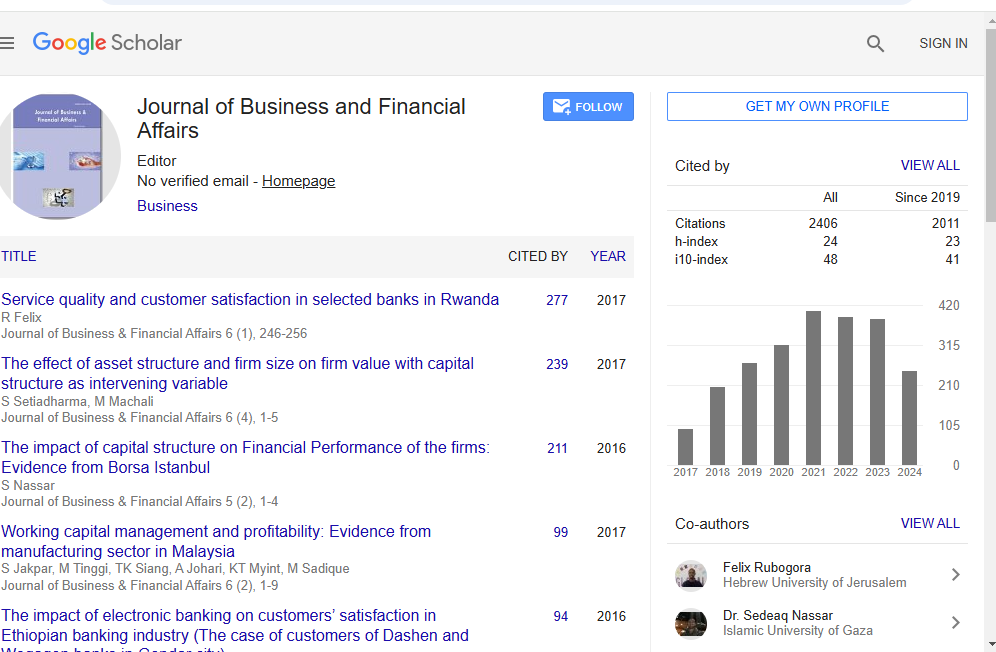
Journal of Business & Financial Affairs received 1726 citations as per Google Scholar report