Brief Report - (2025) Volume 14, Issue 5
Received: 01-Oct-2025, Manuscript No. jbfa-25-176824;
Editor assigned: 03-Oct-2025, Pre QC No. P-176824;
Reviewed: 17-Oct-2025, QC No. Q-176824;
Revised: 22-Oct-2025, Manuscript No. R-176824;
Published:
29-Oct-2025
, DOI: 10.37421/2161-0673.2025.14.549
Citation: Radovic, Elena. ”Microfinance: Health, Empowerment, Poverty, Food Security.” J Bus Fin Aff 14 (2025):549.
Copyright: © 2025 Radovic E. This is an open-access article distributed under the terms of the Creative Commons Attribution License, which permits unrestricted use, distribution and reproduction in any medium, provided the original author and source are credited.
Microfinance interventions are increasingly recognized for their diverse and profound impacts on health outcomes in low-income settings, offering critical support for vulnerable populations. There is substantial, growing evidence demonstrating improvements in crucial areas such as maternal and child health, overall nutrition, and even mental well-being for participants [1].
Building on this, the existing literature consistently indicates a positive association between engagement with microfinance programs and a range of favorable health outcomes. This connection is particularly evident concerning increased access to essential healthcare services and the adoption of more beneficial health behaviors among microfinance beneficiaries, suggesting a holistic improvement in their health-seeking capacities and habits [7].
A comprehensive review of current research specifically outlines how microfinance is connected to various health outcomes across numerous developing nations. This body of work frequently highlights critical impact zones including enhanced nutrition for families, improvements in sanitation practices within communities, and more effective strategies for disease prevention. While these positive linkages are clear, the review concurrently suggests that further rigorous and focused evaluation is essential to fully understand and precisely quantify these complex and multifaceted relationships, ensuring that interventions are optimally designed [4].
Beyond direct health benefits, financial inclusion, and microfinance specifically, prove to be instrumental in fostering significant women's empowerment. This robust, positive relationship is consistently observed, manifesting through increased decision-making power within households and greater economic autonomy for women beneficiaries, enabling them to exert more control over their lives and resources [3].
Microfinance distinctly contributes to the socioeconomic empowerment of women in developing countries, providing concrete evidence of enhanced financial independence, more active and meaningful participation in household decision-making processes, and an overall rise in their social status among their communities. This reflects a shift in gender dynamics and recognition of women's contributions [10].
Moreover, a detailed systematic review and meta-analysis indicates that microfinance programs significantly boost women's economic, social, and psychological empowerment across various contexts. However, the study also underscores the crucial role played by context-specific factors, which means the success and extent of empowerment can vary significantly depending on local socio-economic and cultural environments [8].
A broader exploration of the impact of microfinance on women's empowerment in developing countries confirms enhancements across economic, social, and even political spheres, illustrating its potential as a transformative tool. Despite these gains, this same research thoughtfully brings to light inherent challenges related to loan usage and the potential for increased dependence on microfinance institutions, suggesting a nuanced rather than universally positive outcome that requires careful management [6].
The influence of microfinance also extends significantly into improving household stability, particularly concerning the critical issue of food security. Programs consistently demonstrate a positive effect on food security for women by directly contributing to improved household food security. This is achieved through increased income generation capabilities, which in turn leads to better and more reliable access to essential food resources, reducing hunger and malnutrition [5].
Furthermore, microfinance is widely acknowledged for its crucial role in poverty reduction within developing countries. It is frequently identified as an effective tool for elevating household income levels and substantially improving consumption patterns, thereby lifting families out of extreme poverty. Yet, it is vital to acknowledge that its ultimate impact is subject to considerable variation. Success often depends heavily on specific program design elements, the target group, and the prevailing local economic conditions, which can either amplify or diminish the intended benefits [9].
However, the landscape of microfinance impact is complex and not without its potential downsides and challenges. Research specifically exploring microfinance's influence on the mental health of women entrepreneurs, conducted across several countries, offers an important caveat to the overwhelmingly positive narratives. While these programs undeniably offer tangible economic benefits, the inherent pressure associated with timely loan repayment can, in some instances, contribute to heightened levels of stress and debilitating anxiety among participants. This critical finding highlights the pressing need for a more holistic approach to microfinance that considers not only economic upliftment but also the vital psychological well-being of beneficiaries, ensuring sustainable and healthy outcomes [2].
Recent systematic reviews consistently highlight the multifaceted and predominantly positive influence of microfinance on health outcomes in low-income settings. Evidence indicates that microfinance interventions contribute to substantial improvements in critical public health areas, including enhanced maternal and child health, improved nutritional statuses, and better overall mental well-being [1]. Furthermore, a comprehensive scoping review affirms this profound connection, specifically pointing to areas such as enhanced sanitation practices and more effective disease prevention strategies as key zones where microfinance exerts its beneficial impact. This review also underscores the ongoing necessity for more robust and methodologically sound evaluations to deepen our understanding of these intricate relationships [4]. The broader existing literature unequivocally confirms a positive association between active microfinance engagement and various health outcomes, particularly noting increased access to essential healthcare services and the sustained adoption of improved health behaviors among beneficiaries [7]. These findings collectively suggest that microfinance acts as a crucial catalyst for better health, not merely through direct medical access, but significantly by empowering individuals and communities to adopt healthier lifestyles and proactively seek health resources.
A core and recurring theme throughout the collected literature is the pivotal and significant role of microfinance in fostering substantial women's empowerment. Financial inclusion, of which microfinance is a foundational component, consistently demonstrates a strong correlation with increased decision-making power within households and significantly enhanced economic autonomy for women beneficiaries [3]. This empowerment extends across multiple dimensions, demonstrably boosting women's economic participation, social standing, and psychological resilience. It is crucial, however, to recognize that the mediating effect of context-specific factors can greatly influence the degree and form of this empowerment [8]. Further evidence from systematic reviews robustly underscores how microfinance directly contributes to socioeconomic empowerment through tangible benefits such as enhanced financial independence, more active and meaningful participation in household decisions, and an elevated social status within their respective communities [10]. These compelling findings collectively paint a vivid picture of microfinance as a potent and transformative tool for advancing gender equity and catalyzing broader social change.
While the general outlook on microfinance's impact on women's empowerment is broadly positive, the literature also presents important nuances and highlights inherent challenges that warrant careful consideration. One systematic review, while acknowledging that microfinance significantly enhances economic, social, and political empowerment, simultaneously brings to light potential pitfalls related to the dynamics of loan usage and the risk of increased dependence on microfinance institutions [6]. This crucial complexity is further underscored by compelling findings regarding mental health outcomes. Research specifically exploring microfinance's influence on the mental health of women entrepreneurs across diverse countries suggests that, despite the undeniable economic benefits these programs provide, the inherent and persistent pressure of timely loan repayment can, in specific instances, contribute to heightened levels of stress and debilitating anxiety among participants [2]. This critical insight emphasizes a pressing need for microfinance programs to integrate robust mental health support systems and comprehensive financial literacy training alongside their core offerings. Such an integrated approach would aim to mitigate potential negative psychological impacts, thereby ensuring a more holistic and genuinely sustainable path to empowerment for all beneficiaries.
Another highly significant area of positive impact identified within the research is the improvement of food security, particularly among women beneficiaries and their households. A systematic review and meta-analysis conclusively demonstrates that microfinance programs make a positive and substantial contribution to improved household food security [5]. This vital improvement is primarily driven by the enhanced income generation capabilities that microfinance provides to women. This increased financial capacity, in turn, translates directly into better and more consistent access to essential food resources, significantly reducing instances of hunger, improving dietary diversity, and mitigating malnutrition within families. This clear and direct link between participation in microfinance initiatives and enhanced food security highlights its foundational role in building economic resilience and substantially improving the overall quality of life at the crucial household level.
Finally, the broader economic impact of microfinance on poverty reduction in developing countries is a recurrent and well-documented subject within the academic discourse. Systematic reviews consistently highlight microfinance as an effective and strategic instrument for achieving significant improvements in household income and consumption levels, thereby directly contributing to widespread poverty alleviation [9]. However, it is critically important to acknowledge that the ultimate success and the precise scale of this impact are far from uniform; they vary significantly based on a confluence of factors. These include the specific design and implementation strategies of the microfinance program itself, the target population, and the unique local economic conditions in which the program operates [9]. Therefore, for optimal effectiveness, tailored approaches and careful consideration of these intricate local contexts are absolutely essential for maximizing the profound poverty reduction potential of microfinance initiatives, ensuring they are truly impactful and sustainable.
Microfinance interventions are a pivotal mechanism for positive change, significantly impacting health, women's empowerment, food security, and poverty reduction across developing countries. These programs have demonstrated remarkable success in improving various health outcomes, including crucial advancements in maternal and child health, overall nutrition, and mental well-being in low-income settings [1]. Furthermore, they are instrumental in increasing access to essential healthcare services and fostering the adoption of healthier behaviors among beneficiaries [4, 7]. For women, microfinance acts as a powerful catalyst for empowerment, enhancing economic autonomy, boosting their decision-making power within households, and elevating their social status. This leads to a multidimensional increase in socioeconomic and psychological empowerment [3, 6, 8, 10]. Moreover, microfinance programs contribute positively to household food security by facilitating increased income generation, which in turn leads to better and more consistent access to essential food resources [5]. On a broader economic scale, microfinance is an effective tool for improving household income and consumption levels, directly contributing to poverty alleviation. However, it is crucial to note that its ultimate impact can vary considerably based on specific program design and prevailing local economic conditions [9]. Despite these widespread positive effects, the literature also reveals potential downsides; for example, the pressure associated with loan repayment can sometimes contribute to stress and anxiety among women entrepreneurs, even as they experience economic gains [2]. This highlights the imperative for microfinance initiatives to adopt more holistic approaches that carefully balance economic benefits with crucial psychological well-being and are sensitive to diverse context-specific considerations for sustainable development.
None
None
Indexed at, Google Scholar, Crossref
Indexed at, Google Scholar, Crossref
Indexed at, Google Scholar, Crossref
Indexed at, Google Scholar, Crossref
Indexed at, Google Scholar, Crossref
Indexed at, Google Scholar, Crossref
Indexed at, Google Scholar, Crossref
Indexed at, Google Scholar, Crossref
Indexed at, Google Scholar, Crossref
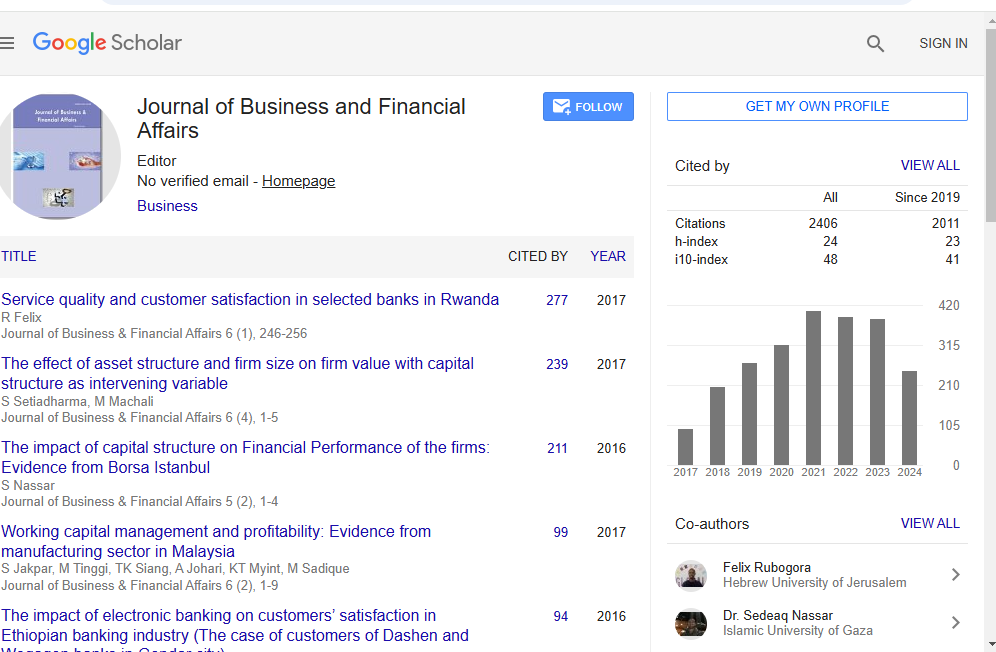
Journal of Business & Financial Affairs received 1726 citations as per Google Scholar report