Perspective - (2025) Volume 13, Issue 5
Received: 01-Sep-2025, Manuscript No. economics-26-186072;
Editor assigned: 03-Sep-2025, Pre QC No. P-186072;
Reviewed: 17-Sep-2025, QC No. Q-186072;
Revised: 22-Sep-2025, Manuscript No. R-186072;
Published:
29-Sep-2025
, DOI: 10.37421/2375-4389.2025.13.547
Citation: Youssef, Mohamed Ben. ”Microfinance And Integrated
Poverty Reduction Strategies.” J Glob Econ 13 (2025):547.
Copyright: © 2025 Youssef B. Mohamed This is an open-access article distributed under the terms of the Creative Commons Attribution License, which permits unrestricted
use, distribution and reproduction in any medium, provided the original author and source are credited.
The multifaceted role of microfinance initiatives in poverty reduction has been extensively examined, highlighting how accessible financial services can empower marginalized communities by providing pathways for income generation and asset accumulation [1].
This approach delves into the fundamental mechanisms through which microcredit, savings, and insurance products contribute to improved living standards, offering a tangible means for individuals to escape persistent poverty. The study also meticulously addresses the inherent challenges and limitations associated with microfinance, such as the pervasive issue of over-indebtedness and the critical need for complementary support services to truly maximize its impact and ensure sustainable outcomes [1].
Targeted poverty reduction policies, particularly conditional cash transfer programs, have been a significant focus of research aimed at understanding their effectiveness in influencing household consumption, education, and health outcomes among the poor [2].
These programs are designed with specific conditions to foster human capital development and, in doing so, aim to break the intergenerational cycles of poverty that afflict many developing regions. However, the administrative costs associated with implementing and monitoring these initiatives, alongside the potential for exclusion of the most vulnerable populations, remain critical considerations that warrant careful analysis and policy adaptation [2].
The synergistic effects of combining microfinance with entrepreneurship training represent a promising avenue for poverty alleviation, arguing that while financial access is undeniably crucial, equipping individuals with essential business management skills and market access significantly enhances their capacity to generate sustainable incomes [3].
This integrated approach seeks to move beyond simple financial provision, aiming instead to foster self-sufficiency and long-term economic viability for micro-enterprises. Evidence presented in studies indicates higher success rates for micro-enterprises that benefit from this comprehensive, integrated support model, demonstrating the value of a holistic strategy [3].
A comparative analysis of different national poverty reduction strategies, with a specific emphasis on the integration of microfinance, offers valuable insights into effective policy frameworks and regulatory environments [4].
This research examines the crucial role of government in fostering inclusive financial sectors that can support the poor. The findings from such analyses highlight best practices and provide policy recommendations for nations striving to scale up their poverty reduction interventions, emphasizing the importance of coherence and strategic alignment across various governmental efforts [4].
The gendered impact of microfinance on poverty reduction is a vital area of study, with a particular emphasis on how women's access to financial services can catalyze improvements in household well-being and foster their personal empowerment [5].
This research explores the profound social and economic transformations experienced by women who access microfinance, while also candidly addressing the persistent barriers they encounter. The findings consistently underscore the indispensable importance of designing microfinance programs with a keen awareness of gender dynamics and specific needs [5].
The transformative potential of digital financial services in rural areas for poverty reduction is increasingly recognized, with a focus on how mobile banking and digital payment systems can substantially increase financial inclusion and reduce transaction costs for underserved populations [6].
These technological advancements offer unprecedented access to credit and other financial products, thereby broadening the reach of microfinance initiatives. The research highlights how technology can serve as a powerful catalyst for scaling up microfinance efforts and ensuring their accessibility to those who have historically been excluded from formal financial systems [6].
The role of social capital in the success of microfinance initiatives for poverty reduction offers a unique perspective, positing that strong social networks and community trust can significantly enhance repayment rates, facilitate essential information sharing, and promote collective action among borrowers [7].
By leveraging existing social structures and fostering a sense of mutual support, microfinance programs can achieve greater efficacy. The research provides valuable insights into designing programs that effectively harness the power of community bonds to drive sustainable poverty reduction [7].
The impact of financial literacy programs on the effectiveness of microfinance initiatives is a critical factor for achieving lasting poverty reduction, emphasizing that borrowers' comprehension of financial products, risk management strategies, and savings principles is paramount [8].
While access to finance is a necessary first step, it is insufficient on its own to guarantee long-term improvements in financial well-being. The study offers important recommendations for seamlessly integrating comprehensive financial education into the delivery mechanisms of microfinance programs, thereby empowering borrowers with the knowledge to make informed financial decisions [8].
The evolving landscape of poverty reduction strategies is increasingly characterized by a shift towards multidimensional approaches that extend beyond mere income metrics, recognizing that poverty encompasses various forms of deprivation [9].
This perspective analyzes how microfinance, when strategically combined with interventions in social protection, health, and education, can more effectively address the complex and interconnected deprivations faced by the poor. The paper strongly advocates for the development and implementation of integrated policy frameworks that acknowledge and tackle the multifaceted nature of poverty [9].
A critical review of the long-term sustainability of microfinance institutions (MFIs) is essential to ensure their continued contribution to lasting poverty reduction, examining critical issues such as mission drift, operational efficiency, and the necessity of appropriate regulatory oversight [10].
This scrutiny is vital to guarantee that these institutions remain dedicated to serving the poor effectively without compromising their core objectives. The study proposes pathways for strengthening the resilience and enhancing the overall impact of the microfinance sector, ensuring its enduring relevance and effectiveness in the fight against poverty [10].
Microfinance initiatives play a crucial role in poverty reduction by enhancing access to financial services for marginalized communities, thereby empowering them to generate income and accumulate assets [1].
The core mechanisms involve microcredit, savings, and insurance products, which collectively contribute to improved living standards. Despite their benefits, challenges such as over-indebtedness and the need for complementary support services persist, necessitating careful program design and implementation [1].
Conditional cash transfer programs represent a significant component of targeted poverty reduction strategies, influencing household consumption, educational attainment, and health outcomes among the poor [2].
The effectiveness of these programs hinges on well-designed conditionalities that promote human capital development and aim to break intergenerational poverty cycles. However, the administrative burden and the risk of excluding vulnerable groups are persistent concerns that require ongoing attention [2].
The integration of microfinance with entrepreneurship training offers a powerful synergy for poverty alleviation [3].
Beyond merely providing financial access, this approach equips individuals with vital business management skills and market insights, significantly boosting their ability to establish and sustain profitable enterprises. Studies indicate that such integrated support models lead to higher success rates for micro-enterprises, demonstrating a more robust pathway to economic independence [3].
National strategies for poverty reduction increasingly incorporate microfinance, necessitating a comparative analysis of policy frameworks and regulatory environments to foster inclusive financial sectors [4].
Governments play a pivotal role in establishing conducive conditions for microfinance to thrive. Research in this area identifies best practices and informs policy recommendations for countries aiming to amplify the effectiveness and reach of their poverty reduction efforts through integrated financial inclusion [4].
Microfinance's impact on poverty reduction is often gendered, with women's access to financial services leading to enhanced household well-being and personal empowerment [5].
Research meticulously examines the social and economic transformations women undergo through microfinance, while also identifying the obstacles they face. This analysis underscores the critical importance of designing gender-sensitive programs that address the unique needs and contexts of female borrowers [5].
Digital financial services are revolutionizing poverty reduction in rural areas by increasing financial inclusion and reducing transaction costs through mobile banking and digital payment systems [6].
These technological advancements provide essential access to credit and other financial products for previously underserved populations. The potential for technology to scale microfinance and extend its reach to remote communities is a key finding, offering new avenues for poverty alleviation efforts [6].
Social capital acts as a significant facilitator for the success of microfinance initiatives in poverty reduction [7].
Strong social networks and community trust contribute to higher repayment rates, improved information exchange, and enhanced collective action among microfinance clients. Understanding and leveraging these existing social structures is crucial for designing effective and sustainable microfinance programs that foster community development [7].
Financial literacy programs are instrumental in maximizing the impact of microfinance on poverty reduction [8].
Beyond mere access to financial products, a borrower's understanding of financial concepts, risk management, and savings strategies is vital for achieving long-term financial stability. Integrating financial education into microfinance delivery is recommended to empower individuals with the knowledge necessary for sustained economic improvement [8].
Contemporary poverty reduction strategies are increasingly adopting multidimensional approaches that extend beyond income-based measures [9].
These strategies recognize that poverty encompasses various deprivations, and microfinance, when integrated with social protection, health, and education initiatives, offers a more holistic solution. The advocacy for integrated policy frameworks highlights the need for comprehensive interventions that address the complex nature of poverty [9].
The long-term sustainability and effectiveness of microfinance institutions (MFIs) are critical for enduring poverty reduction [10].
This involves addressing issues such as mission drift, operational efficiency, and regulatory oversight to ensure MFIs consistently serve their target populations. The study suggests pathways to enhance the resilience and amplify the impact of MFIs, ensuring their continued contribution to poverty alleviation efforts [10].
This collection of research explores multifaceted approaches to poverty reduction, with a strong emphasis on the role and impact of microfinance. Studies highlight how microcredit, savings, and insurance can empower marginalized communities by fostering income generation and improving living standards. The research also examines the effectiveness of targeted policies like conditional cash transfers, the benefits of integrating microfinance with entrepreneurship training, and the influence of digital financial services in expanding financial inclusion, particularly in rural areas. Furthermore, the importance of gender-sensitive programs, the role of social capital, and the critical need for financial literacy are underscored. National poverty reduction strategies are analyzed for their integration of microfinance, and a critical review of microfinance institution sustainability is presented. The overarching theme is the need for integrated, multidimensional approaches to poverty reduction that address various deprivations effectively.
None
None
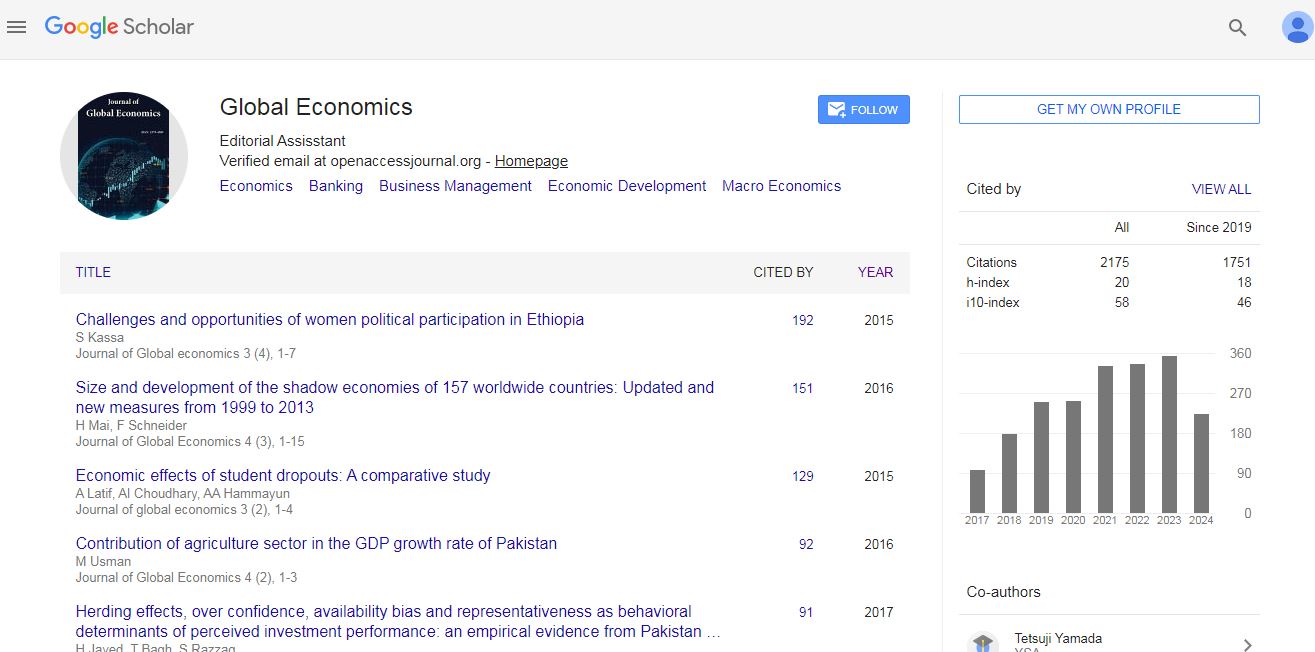
Journal of Global Economics received 2175 citations as per Google Scholar report