Brief Report - (2025) Volume 9, Issue 3
Received: 01-Aug-2025, Manuscript No. jmbp-25-175100;
Editor assigned: 04-Aug-2025, Pre QC No. P-175100;
Reviewed: 18-Aug-2025, QC No. Q-175100;
Revised: 22-Aug-2025, Manuscript No. R-175100;
Published:
29-Aug-2025
, DOI: 10.37421/2684-4931.2025.9.263
Citation: Benton, Chloe. ”Microbiome Research: Tech, Health, Precision Therapies.” J Microbiol Patho 09 (2025):263.
Copyright: © 2025 Benton C. This is an open-access article distributed under the terms of the Creative Commons Attribution License, which permits unrestricted use, distribution and reproduction in any medium, provided the original author and source are credited.
This review provides an overview of advanced computational tools and bioinformatics pipelines vital for microbiome analysis. It highlights how these methods help decipher complex microbial communities, understand their functional roles, and process the vast amounts of data generated by modern sequencing technologies, making sense of the microbial world [1].
This article explores the latest understanding of how the gut microbiome influences human health and disease. It delves into the intricate roles microbes play in various conditions and discusses emerging therapeutic strategies that target these microbial communities to improve health outcomes [2].
Here's the thing: this review unpacks the complex interplay between the microbiome and cancer. It examines how microbial communities contribute to the development and progression of cancer and, importantly, how they can influence the effectiveness of various anti-cancer treatments [3].
This article highlights the increasing use of single-cell technologies in microbiome research. What this really means is researchers can now look at microbial heterogeneity, understand host-microbe interactions at a very detailed level, and pinpoint new therapeutic targets with much greater precision [4].
This paper explores how microbiome analysis is becoming a key part of precision medicine. It discusses how understanding an individual's unique microbial profile can inform personalized diagnostics and lead to more targeted and effective treatment strategies, moving us closer to truly personalized healthcare [5].
This perspective piece sheds light on the crucial role of the oral microbiome, extending beyond just local infections. It emphasizes its significant systemic impact on various diseases, including heart conditions and metabolic disorders, underscoring the need for more comprehensive, integrated research in this area [6].
This review offers a clear picture of the bioinformatics tools and pipelines essential for analyzing human microbiome data. It helps researchers navigate the options for processing and interpreting complex sequencing information, making it easier to select the right tools for their studies [7].
This article gives a thorough review of our current understanding of the skin microbiome. It describes its makeup, its role in maintaining healthy skin, and how imbalances contribute to various skin conditions, offering new ideas for potential treatments [8].
This review tackles the intricate communication between a host and its resident microbial communities. It explores how these interactions shape the host's immune system, metabolism, and overall body functions, and what that means for health and disease [9].
This article reviews the current state of microbiome-based therapeutics, from early concepts to their emergence in clinical practice. It addresses the challenges and exciting opportunities involved in harnessing the microbiome to treat a wide range of human diseases [10].
The complex microbial communities inhabiting the human body, collectively known as the microbiome, are increasingly recognized for their profound impact on human health and disease. Unpacking this complexity demands advanced computational tools and sophisticated bioinformatics pipelines [1]. These crucial methods allow researchers to effectively decipher the composition of microbial communities, understand their intricate functional roles, and efficiently process the vast amounts of data generated by modern sequencing technologies, ultimately making coherent sense of the microbial world [1]. Here's the thing: a clear understanding of the available bioinformatics tools is essential for researchers to navigate the options for processing and interpreting complex human microbiome data, ensuring they select the right tools for their specific studies and research questions [7].
The influence of the microbiome extends across various anatomical sites and plays a critical role in systemic health. The gut microbiome, for instance, is a major area of focus, with recent advances shedding light on its intricate roles in a wide range of human health conditions and disease pathologies. This evolving understanding is instrumental in developing and discussing emerging therapeutic strategies that specifically target these microbial communities to improve overall health outcomes [2]. Beyond the gastrointestinal tract, the oral microbiome also holds a surprisingly crucial role, extending far past localized infections. It's now recognized for its significant systemic impact on various diseases, including serious heart conditions and metabolic disorders, underscoring the urgent need for more comprehensive and integrated research in this specific area [6]. Similarly, thorough reviews of the skin microbiome highlight its unique makeup, its vital role in maintaining healthy skin, and critically, how imbalances within this community contribute to the onset and progression of various skin conditions, offering new ideas for potential treatments and interventions [8].
Moreover, the interplay between the microbiome and specific diseases, such as cancer, represents a highly complex and crucial area of investigation. Here's the thing: research meticulously examines how microbial communities actively contribute to both the development and progression of cancer. Importantly, these studies also explore how the microbiome can significantly influence the effectiveness of various anti-cancer treatments, suggesting new avenues for combination therapies [3]. Underlying these disease-specific observations are the intricate dynamics of host-microbe interactions. This involves a sophisticated communication between a host and its resident microbial communities, which profoundly shapes the host's immune system, metabolism, and overall body functions. Deciphering this complex "language" of the microbiota is absolutely key to understanding the full spectrum of health and disease states [9].
Advancements in technology are fundamentally revolutionizing the scope and precision of microbiome research. Single-cell technologies, for example, are increasingly being adopted to highlight and explore microbial heterogeneity, allowing researchers to understand host-microbe interactions at an unprecedented, very detailed level. What this really means is a much greater precision in pinpointing new therapeutic targets, which was previously unattainable [4]. These detailed insights are absolutely fundamental to the rapidly growing field of precision medicine, where microbiome analysis is becoming an indispensable component. Understanding an individual's unique microbial profile can inform highly personalized diagnostics and lead to more targeted and effective treatment strategies, ultimately moving us significantly closer to truly personalized healthcare solutions [5].
Ultimately, the overarching goal is to effectively translate this deep and expanding knowledge of the microbiome into tangible clinical applications. Microbiome-based therapeutics are steadily progressing from early conceptual stages to their emergence and validation in clinical practice. This exciting frontier addresses both the challenges and vast opportunities involved in harnessing the therapeutic potential of the microbiome to treat a wide range of human diseases, offering new hope and innovative solutions [10]. This holistic approach to understanding and manipulating microbial communities holds immense promise for the future of medicine, reshaping how we approach disease prevention and treatment.
The field of microbiome research is rapidly advancing, driven by sophisticated computational tools and bioinformatics pipelines that enable the deciphering of complex microbial communities and their functional roles from vast sequencing data. Researchers are keenly exploring how these microbial ecosystems influence human health and disease across different body sites. For instance, the gut microbiome plays an intricate role in various conditions, with emerging therapeutic strategies aiming to target these communities for better health outcomes. The microbiome also has a complex interplay with cancer, affecting its development, progression, and even the effectiveness of treatments. What this really means is that advanced technologies, such as single-cell approaches, are improving our understanding of microbial heterogeneity and host-microbe interactions at a highly detailed level, helping pinpoint new therapeutic targets with greater precision. This deep understanding is propelling microbiome analysis into precision medicine, allowing for personalized diagnostics and targeted treatment strategies based on an individual's unique microbial profile. Beyond the gut, the oral microbiome is recognized for its significant systemic impact on diseases like heart conditions and metabolic disorders, highlighting the need for integrated research. Similarly, thorough reviews of the skin microbiome describe its composition, its role in healthy skin, and how imbalances contribute to various skin conditions, offering new ideas for treatments. Overall, understanding the intricate communication between a host and its resident microbial communities, and how these interactions shape immune systems, metabolism, and body functions, is crucial for both health and disease. This comprehensive research landscape supports the development of microbiome-based therapeutics, moving from early concepts towards clinical reality for treating a wide range of human diseases.
None
None
Edoardo P, Stefano T, Curtis H. "Computational methods for microbiome analysis".Nat Commun 11 (2020):3828.
Indexed at, Google Scholar, Crossref
Yuanyuan F, Qi Z, Zhiwen Z. "The gut microbiome in health and disease: Recent advances and therapeutic opportunities".Nat Rev Gastroenterol Hepatol 20 (2023):709-728.
Indexed at, Google Scholar, Crossref
Sangashini R, Michael DVdH, Giorgio T. "The microbiome in cancer etiology and therapy".Nat Rev Cancer 22 (2022):271-292.
Indexed at, Google Scholar, Crossref
Caitlin MB, Jeffrey JR, Erick RVE. "Single-cell technologies in microbiome research".Nat Rev Microbiol 20 (2022):366-381.
Indexed at, Google Scholar, Crossref
Zichen W, Jun X, Qian S. "Precision medicine and the microbiome: Moving towards personalized diagnostics and therapies".Trends Microbiol 32 (2024):225-236.
Indexed at, Google Scholar, Crossref
George H, Panagiotis NS, Slobodan E. "The oral microbiome: A new frontier in systemic health".Cell Host Microbe 28 (2020):641-650.
Indexed at, Google Scholar, Crossref
Ofir M, Jonathan RI, Yaniv IO. "Bioinformatics tools for human microbiome analysis".Brief Bioinform 21 (2020):1475-1487.
Indexed at, Google Scholar, Crossref
Elizabeth AG, Hana C, Julia LF. "The skin microbiome in health and disease".Nat Rev Microbiol 20 (2022):295-309.
Indexed at, Google Scholar, Crossref
Nobuhiko K, Gabriel N, Kenya H. "Host-microbe interactions: Deciphering the language of the microbiota".Cell 185 (2022):765-779.
Indexed at, Google Scholar, Crossref
Jun X, Qian S, Zichen W. "Microbiome-based therapeutics: From concept to clinical reality".Cell Host Microbe 31 (2023):1391-1406.
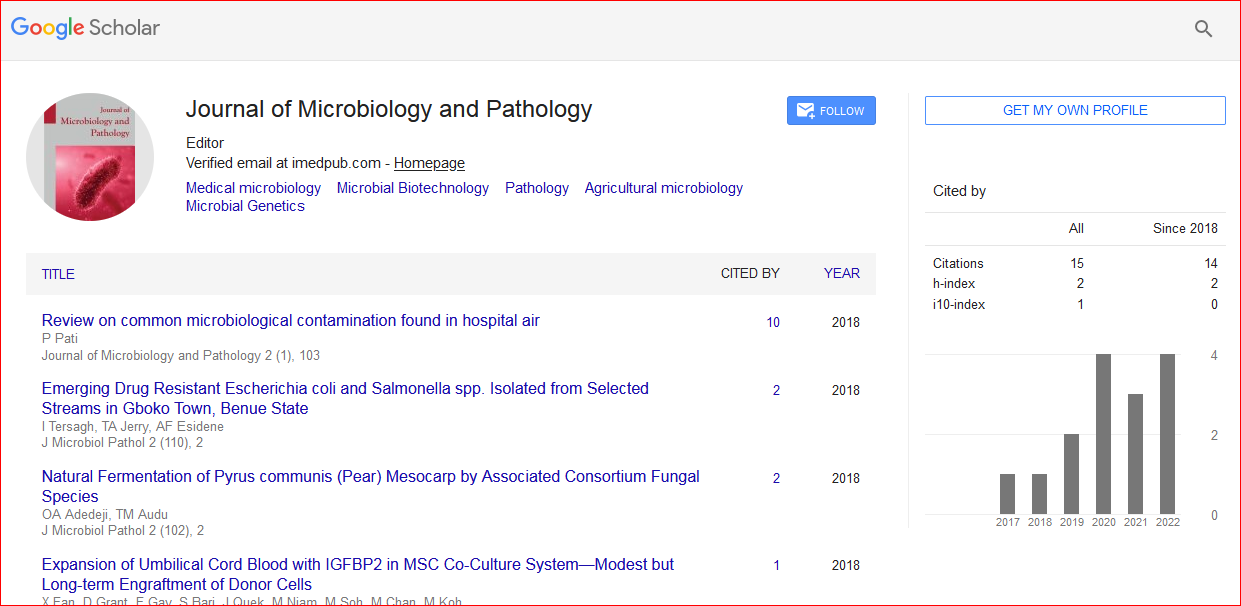
Journal of Microbiology and Pathology received 18 citations as per Google Scholar report