Commentary - (2025) Volume 12, Issue 3
Received: 01-Jun-2025, Manuscript No. jreac-26-185787;
Editor assigned: 03-Jun-2025, Pre QC No. P-185787;
Reviewed: 17-Jun-2025, QC No. Q-185787;
Revised: 23-Jun-2025, Manuscript No. R-185787;
Published:
30-Jun-2025
, DOI: 10.37421/2380-2391.2025.12.432
Citation: Ji-hoon. ”Method Validation: Essential for Environmental Data Reliability.” J Environ Anal Chem 12 (2025):432.
Copyright: © 2025 Park J. This is an open-access article distributed under the terms of the Creative Commons Attribution License, which permits unrestricted use, distribution and reproduction in any medium, provided the original author and source are credited.
The critical importance of method validation in environmental analytical chemistry cannot be overstated, serving as the bedrock for generating reliable and accurate data that informs crucial decisions in risk assessment and regulatory compliance. This foundational step ensures that the analytical tools employed are fit for their intended purpose, providing a high degree of confidence in the results obtained [1].
The validation of analytical methods is particularly vital when dealing with trace organic pollutants, a category of substances often present in complex environmental matrices at very low concentrations. The challenges associated with their detection and quantification necessitate rigorous validation procedures to overcome matrix effects and ensure the sensitivity and specificity of the methods used [2].
In the realm of heavy metal determination, method validation plays an equally significant role. Ensuring the accuracy and precision of analyses in environmental samples like water and soil requires careful consideration of factors such as sample preparation, potential interferences, and the robust estimation of uncertainty, all of which are addressed through thorough validation [3].
Complementing internal validation efforts, proficiency testing schemes offer an external and independent evaluation of laboratory performance. Participation in these quality assessment programs provides invaluable insights into the overall competence of environmental laboratories and the reliability of their validated methods [4].
As analytical technologies advance, the validation of rapid analytical methods, often employed in environmental monitoring, presents unique challenges. These methods, frequently based on sensor technologies, require specific validation approaches that account for their distinct characteristics, such as response time and selectivity, to ensure their suitability for field applications [5].
Statistical approaches are indispensable in the process of method validation for environmental analysis. A deep understanding and proper application of statistical tools are necessary to confidently evaluate method performance metrics like linearity, accuracy, and precision, including the interpretation of confidence intervals and hypothesis testing [6].
The emergence of new contaminants, often termed emerging contaminants, in water and wastewater streams poses ongoing validation challenges. Their diverse nature and frequently low concentrations demand sensitive and selective analytical techniques, necessitating continuous refinement and improvement of validation practices to ensure their reliable detection and quantification [7].
Method validation for particulate matter in air is another area demanding meticulous attention. The inherent complexities of sampling and analyzing heterogeneous atmospheric samples, coupled with the need for robustness against varying environmental conditions, underscore the importance of standardized validation protocols to ensure data comparability [8].
Measurement uncertainty is an integral component of method validation in environmental chemistry. Evaluating and expressing this uncertainty is paramount for the correct interpretation of analytical results, particularly when comparing them against regulatory limits or during risk assessments, providing a quantitative measure of the confidence in the reported values [9].
Adherence to current guidelines and best practices for method validation in environmental analytical chemistry is crucial for ensuring data quality and international comparability. Harmonizing validation procedures across different organizations and adopting a risk-based approach are essential for demonstrating method fitness for purpose and advancing the field [10].
Method validation in environmental analytical chemistry is a multifaceted process, critically important for ensuring the reliability and accuracy of data used in environmental monitoring and regulatory decision-making. It encompasses a systematic evaluation of analytical procedures to confirm their suitability for the intended application, guaranteeing that the results obtained are trustworthy and defensible. Key performance characteristics such as linearity, accuracy, precision, detection limits, and robustness are rigorously assessed to establish the overall quality of the analytical method [1].
When analyzing trace organic pollutants within complex environmental matrices, the validation process faces significant hurdles. The low concentrations at which these pollutants are often found, coupled with the presence of interfering substances in the matrix, demand highly sensitive and selective methods. Rigorous validation, often involving sophisticated statistical tools, is essential to overcome these challenges and ensure that the analytical results accurately reflect the presence and levels of these contaminants [2].
For the analysis of heavy metals in environmental samples, such as water, soil, and sediment, method validation is equally critical. The intricacies of sample preparation, potential for chemical interferences, and the necessity for accurate estimation of measurement uncertainty all contribute to the complexity of this process. Practical guidance on selecting appropriate validation parameters and interpreting the outcomes is vital for the successful implementation of environmental monitoring programs [3].
The integration of proficiency testing schemes represents a valuable addition to internal method validation procedures. These external quality assessment programs provide an independent benchmark against which laboratories can measure their performance, helping to identify systemic issues and enhance overall laboratory competence. This process ensures that validated methods perform consistently and reliably in a real-world setting [4].
The validation of rapid analytical methods, often employed for near real-time environmental monitoring, requires a distinct approach. These methods, which may differ significantly from traditional laboratory techniques, necessitate specific validation criteria. Aspects like response time, selectivity, and operational stability must be thoroughly evaluated to confirm their suitability for deployment in field applications, enabling quicker decision-making [5].
Statistical methodologies form the backbone of effective method validation in environmental analysis. The appropriate application of statistical tests and calculations is essential for quantifying method performance, including assessing linearity, determining accuracy and precision, and establishing confidence intervals. This statistical rigor allows analytical chemists to confidently assert the validity of their methods [6].
The analysis of emerging contaminants in water and wastewater presents a dynamic challenge for method validation. The ever-evolving nature of these pollutants, their diverse chemical structures, and their typically low concentrations necessitate the development and validation of analytical techniques that are both sensitive and selective. Continuous improvement of validation practices is key to ensuring the reliable detection and quantification of these substances [7].
Method validation for the analysis of particulate matter in air involves specific considerations related to the sampling and analytical procedures. The heterogeneous nature of airborne particles and the potential variability in environmental conditions demand methods that are robust and reliable. Standardized validation protocols are crucial for ensuring that data generated from different studies and locations are comparable and meaningful [8].
Measurement uncertainty is an indispensable element of method validation in environmental chemistry. Its evaluation and expression provide a quantitative measure of the reliability of analytical results, which is crucial for their interpretation in the context of regulatory compliance and risk assessment. Understanding uncertainty budgets helps in making informed decisions based on the analytical data [9].
Following established guidelines and best practices for method validation is paramount in environmental analytical chemistry. International standards and recommendations promote harmonization of validation procedures, ensuring that methods are demonstrably fit for their intended purpose. A risk-based approach to validation further optimizes resource allocation and focuses on the critical aspects of method performance [10].
This collection of research highlights the critical importance of method validation across various facets of environmental analytical chemistry. Studies emphasize its role in ensuring data reliability for pollutants like trace organics, heavy metals, and emerging contaminants in diverse matrices such as water, soil, and air. Key aspects covered include the application of statistical tools, the significance of measurement uncertainty, and the role of proficiency testing in external quality assessment. The validation of rapid analytical methods and adherence to international guidelines are also discussed. Overall, the research underscores that robust method validation is fundamental for accurate environmental monitoring, risk assessment, and regulatory compliance.
None
None
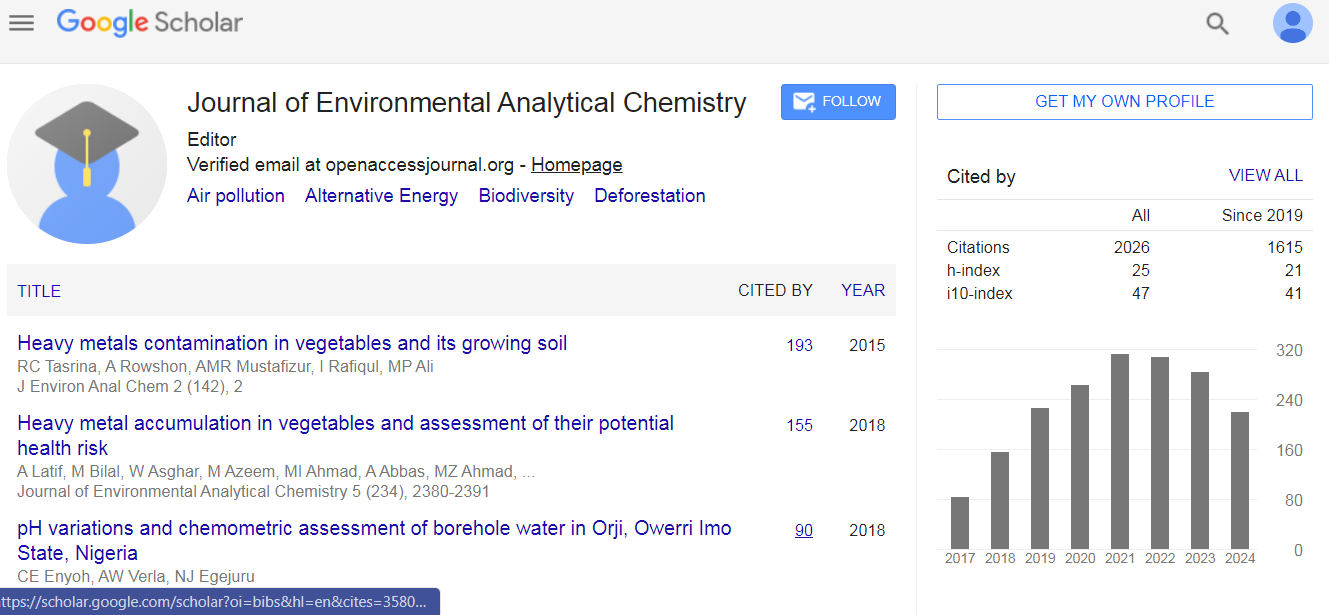
Journal of Environmental Analytical Chemistry received 1781 citations as per Google Scholar report