Brief Report - (2025) Volume 12, Issue 5
Received: 01-Oct-2025, Manuscript No. jreac-26-185817;
Editor assigned: 03-Oct-2025, Pre QC No. P-185817;
Reviewed: 17-Oct-2025, QC No. Q-185817;
Revised: 22-Oct-2025, Manuscript No. R-185817;
Published:
29-Oct-2025
, DOI: 10.37421/2380-2391.2025.12.456
Citation: Silva, Ricardo. ”MEPS: Efficient Environmental Pollutant Preconcentration.” J Environ Anal Chem 12 (2025):456.
Copyright: © 2025 Silva R. This is an open-access article distributed under the terms of the Creative Commons Attribution License, which permits unrestricted use, distribution and reproduction in any medium, provided the original author and source are credited.
Microextraction by Packed Sorbent (MEPS) has emerged as a powerful and versatile technique for the analysis of environmental pollutants, offering a miniaturized and efficient approach to sample preparation. This technique, which involves using a small packed sorbent within a syringe for analyte isolation and concentration, has found significant applications in various environmental matrices. Its inherent advantages, such as reduced solvent consumption and shortened preparation times, align with the growing demand for greener and more cost-effective analytical methods in routine environmental monitoring. Recent advances have further refined MEPS, enhancing its sensitivity and applicability for complex samples such as seawater and marine biota, enabling the detection of a wide range of contaminants including pesticides, polycyclic aromatic hydrocarbons (PAHs), and heavy metals [1].
The optimization of MEPS protocols has been a key focus for researchers aiming to improve the determination of emerging contaminants in challenging aquatic environments. Studies have explored different sorbent materials and elution solvents to maximize the extraction efficiency for both polar and non-polar analytes. The adaptability of MEPS for simultaneous analysis of multiple contaminants has been demonstrated, leading to improved detection limits and reduced sample throughput times, which are critical for real-time environmental surveillance of complex water bodies [2].
Furthermore, the effectiveness of MEPS has been extensively investigated for the analysis of persistent organic pollutants (POPs) in marine sediment samples. The development of robust MEPS methods for POP extraction has shown superior performance when compared to traditional liquid-liquid extraction techniques. The ability of MEPS to handle larger sample volumes and achieve lower detection limits is particularly emphasized, making it a valuable tool for accurate ecological risk assessment of contaminated sediments [3].
The application of MEPS extends to the sensitive determination of microplastics and their associated contaminants in marine water. The technique's capability to preconcentrate analytes from large volumes of water is crucial for detecting low concentrations of these pollutants. When coupled with advanced analytical instruments, MEPS provides valuable insights into the environmental fate and impact of microplastic pollution in marine ecosystems [4].
Novel MEPS sorbents have also been developed for the selective extraction of specific classes of pollutants, such as pharmaceuticals and personal care products (PPCPs) from coastal waters. Research in this area emphasizes the efficiency and selectivity of these novel sorbents, leading to improved recovery rates and reduced matrix effects. These advancements are vital for monitoring the prevalence and impact of PPCPs on fragile marine ecosystems [5].
In ecotoxicology, MEPS has proven to be a valuable tool for the analysis of heavy metals in marine organisms. The method's ability to preconcentrate trace metal ions from complex biological matrices, when followed by determination using techniques like ICP-MS, allows for accurate assessment of bioaccumulation. This capability is essential for understanding metal contamination pathways within marine food webs [6].
A comprehensive review of MEPS advancements highlights its versatility across various sample matrices and analyte classes for environmental analysis. The paper elaborates on the inherent benefits of MEPS, including miniaturization, reduced solvent usage, and the potential for automation, positioning it as an attractive technique for high-throughput screening of environmental pollutants. Specific examples relevant to marine pollution further underscore its significance [7].
The development of MEPS methods for the simultaneous determination of pesticides and their metabolites in coastal waters has been a significant area of research. These studies highlight the crucial role of sorbent selection and elution conditions in achieving efficient extraction of both polar and non-polar compounds. The validated MEPS methods offer a rapid and sensitive tool for monitoring pesticide contamination in marine environments [8].
Innovative applications of MEPS have also emerged for the analysis of volatile organic compounds (VOCs) in air samples collected from marine environments. The research demonstrates the effectiveness of MEPS in capturing and concentrating VOCs, enabling their sensitive detection using gas chromatography. This is particularly relevant for assessing air quality in coastal regions and understanding the atmospheric transport of pollutants [9].
Finally, the integration of MEPS with various chromatographic techniques for the analysis of emerging contaminants in diverse environmental matrices, including marine samples, has been thoroughly discussed. The authors emphasize the advantages of MEPS in terms of sample throughput, cost-effectiveness, and reduced environmental impact, underscoring its importance in modern environmental analytical chemistry through a comprehensive overview of its applications [10].
Microextraction by Packed Sorbent (MEPS) is a highly sensitive and efficient technique for preconcentrating trace contaminants, particularly in environmental samples. This method miniaturizes solid-phase extraction, employing a small packed sorbent within a syringe to facilitate rapid analyte isolation and concentration. Its application within the Department of Marine Ecology and Biotechnology showcases its utility for analyzing complex matrices such as seawater and marine biota, allowing for the detection of a broad spectrum of pollutants including pesticides, polycyclic aromatic hydrocarbons (PAHs), and heavy metals. MEPS stands out for its ability to significantly reduce solvent consumption and sample preparation time, positioning it as an environmentally friendly and cost-effective alternative for routine environmental monitoring [1].
Researchers have dedicated efforts to optimizing MEPS for the accurate determination of emerging contaminants found in complex aquatic environments. This optimization involves exploring various sorbent materials and elution solvents to enhance the extraction efficiency for both polar and non-polar analytes. The adaptability of MEPS for the simultaneous analysis of multiple contaminants has been successfully demonstrated, resulting in improved detection limits and reduced sample preparation turnaround times, which are essential for effective real-time environmental surveillance [2].
Significant work has been conducted to investigate the effectiveness of MEPS for the analysis of persistent organic pollutants (POPs) within marine sediment samples. The development of robust MEPS methodologies for the extraction of POPs has consistently demonstrated superior performance when contrasted with conventional liquid-liquid extraction techniques. The capacity of MEPS to process larger sample volumes and achieve lower detection limits is a key advantage, vital for conducting accurate ecological risk assessments [3].
This publication explores the practical application of MEPS in the sensitive determination of microplastics and the contaminants they carry within marine water samples. The technique's inherent ability to preconcentrate analytes from substantial volumes of water is critical for the detection of even trace concentrations. The authors underscore how MEPS, when combined with sophisticated analytical instrumentation, can yield invaluable insights into the environmental behavior and ecological impact of microplastic pollution [4].
The development of novel MEPS sorbents has been a focus for the selective extraction of specific contaminants like pharmaceuticals and personal care products (PPCPs) from coastal waters. This research highlights the enhanced efficiency and selectivity offered by these new sorbents, which translate to improved recovery rates and a reduction in matrix effects. Such advancements are crucial for accurately monitoring the presence and ecological consequences of PPCPs in marine ecosystems [5].
In the field of ecotoxicology, MEPS has emerged as a crucial method for analyzing heavy metals in marine organisms. The technique's ability to effectively preconcentrate trace metal ions from intricate biological matrices, followed by determination via methods like ICP-MS, enables precise assessment of bioaccumulation. This capability is fundamental to understanding the pathways of metal contamination within marine food webs [6].
A review article examines the recent advancements in MEPS specifically for environmental analysis, detailing its broad applicability across diverse sample types and pollutant categories. The paper elaborates on MEPS's inherent advantages, including its miniaturized format, reduced solvent requirements, and potential for automation, making it highly suitable for high-throughput screening of environmental pollutants. The inclusion of specific examples related to marine pollution further solidifies its relevance [7].
Research has focused on developing MEPS methods capable of simultaneously determining pesticides and their corresponding metabolites in coastal water samples. These studies emphasize the critical importance of selecting appropriate sorbents and optimizing elution conditions to ensure efficient extraction of both polar and non-polar compounds. The validated MEPS methods provide a swift and sensitive analytical tool for monitoring pesticide contamination in marine environments [8].
This study presents an innovative application of MEPS for the analysis of volatile organic compounds (VOCs) present in air samples collected from marine environments. The research demonstrates MEPS's effectiveness in capturing and concentrating VOCs, facilitating their sensitive detection through gas chromatography. This capability is particularly relevant for assessing air quality in coastal regions and for understanding the atmospheric dispersion of pollutants [9].
This paper reviews the integration of MEPS with various chromatographic techniques for analyzing emerging contaminants across different environmental matrices, including marine samples. The authors emphasize the benefits MEPS offers, such as increased sample throughput, cost-effectiveness, and a reduced environmental footprint. The review provides a comprehensive overview of the MEPS technique and its wide-ranging applications, highlighting its significance in contemporary environmental analytical chemistry [10].
Microextraction by Packed Sorbent (MEPS) is a highly efficient and sensitive technique for preconcentrating trace contaminants in environmental samples, offering miniaturization, reduced solvent use, and faster sample preparation. It is effectively applied to complex matrices like seawater and marine biota for analyzing pollutants such as pesticides, PAHs, and heavy metals. MEPS has been optimized for determining emerging contaminants in aquatic environments and has shown superior performance for persistent organic pollutants in marine sediments compared to traditional methods. The technique is also utilized for sensitive determination of microplastics and associated contaminants, as well as for analyzing heavy metals in marine organisms and volatile organic compounds in air. Novel MEPS sorbents have been developed for selective extraction of pharmaceuticals and personal care products. MEPS, when coupled with chromatographic techniques, offers a cost-effective and environmentally friendly approach for high-throughput screening of a wide range of environmental pollutants.
None
None
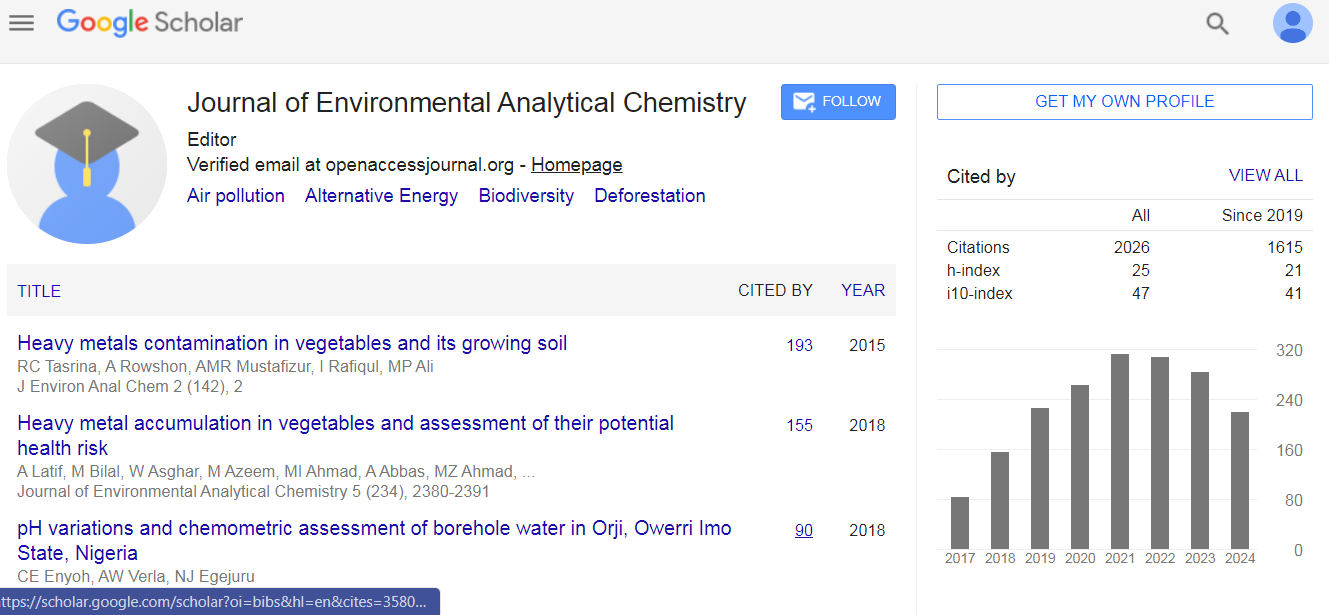
Journal of Environmental Analytical Chemistry received 1781 citations as per Google Scholar report