Perspective - (2025) Volume 15, Issue 6
Received: 01-Dec-2025, Manuscript No. mccr-25-178205;
Editor assigned: 03-Dec-2025, Pre QC No. P-178205;
Reviewed: 17-Dec-2025, QC No. Q-178205;
Revised: 22-Dec-2025, Manuscript No. R-178205;
Published:
29-Dec-2025
, DOI: 10.37421/2161-0444.2025.15.814
Citation: Martinez, Sofia. ”Medicinal Chemistry for Antiviral Drug Discovery.” Med Chem 15 (2025):814.
Copyright: © 2025 Martinez S. This is an open-access article distributed under the terms of the Creative Commons Attribution License, which permits unrestricted use, distribution and reproduction in any medium, provided the original author and source are credited.
The advancement of novel antiviral agents is fundamentally reliant on a comprehensive understanding of viral replication cycles and the precise identification of druggable targets within these processes. Medicinal chemistry stands as a crucial discipline, spearheading the design, synthesis, and meticulous optimization of chemical compounds that exhibit enhanced efficacy, improved selectivity against viral targets, and superior pharmacokinetic profiles for effective in vivo delivery. This intricate process often involves the application of sophisticated methodologies such as structure-based drug design, fragment-based approaches, and the strategic chemical modification of existing molecular scaffolds to surmount the formidable challenge of viral resistance mechanisms, with particular emphasis on inhibitors targeting viral proteases, polymerases, and entry mechanisms, alongside the exploration of host-directed therapies [1].
Central to the development of broad-spectrum antiviral drugs is the strategic targeting of the highly conserved RNA-dependent RNA polymerase (RdRp), an enzyme critical for viral RNA replication across a wide range of viruses. Medicinal chemists are actively engaged in exploring diverse chemical landscapes to discover and develop potent and selective inhibitors of RdRp. This ongoing research encompasses the optimization of existing nucleoside analogs and the design of novel non-nucleoside inhibitors, with a significant focus on mitigating the development of drug resistance and improving the overall bioavailability of these therapeutic agents [2].
The relentless emergence of drug-resistant viral strains presents a continuous and escalating challenge to public health, necessitating unwavering innovation in the field of antiviral drug discovery. Medicinal chemistry employs a multifaceted array of strategies to combat this resistance, including the development of agents designed to target multiple essential viral proteins simultaneously, the judicious use of combination therapies to prevent the emergence of resistance, and the design of compounds that operate through novel mechanisms of action, thereby rendering them less susceptible to resistance development [3].
Host-directed antivirals represent a promising and increasingly important new paradigm in the fight against viral infections, offering a strategic advantage by targeting fundamental cellular pathways that are essential for viral replication, rather than directly targeting viral components themselves. Medicinal chemistry plays an indispensable role in the identification and subsequent optimization of small molecules capable of effectively modulating these host factors, with the overarching aim of achieving broad-spectrum antiviral activity and significantly reducing the susceptibility of these agents to the development of viral resistance [4].
Structure-based drug design (SBDD) has emerged as an exceptionally powerful and indispensable tool in the systematic development of antiviral agents, enabling the rational and iterative design of molecules that demonstrate high binding affinity and exquisite specificity for their intended viral targets. Medicinal chemists expertly leverage the detailed structural information available for viral proteins to computationally or experimentally design and refine lead compounds, ultimately leading to the development of antiviral agents that are both more effective and possess improved safety profiles [5].
Fragment-based drug discovery (FBDD) provides a complementary and valuable alternative approach for the identification of novel antiviral lead compounds. This method involves the screening of libraries of small molecular fragments for their ability to bind weakly to specific viral targets. Subsequently, medicinal chemistry plays a critical and transformative role in the process of growing and linking these initial fragments, thereby generating potent and drug-like molecules that possess significant antiviral activity [6].
The meticulous optimization of pharmacokinetic (PK) and pharmacodynamic (PD) properties is an absolutely essential step in the challenging process of transforming promising antiviral drug candidates from the laboratory bench to clinically viable therapies. Medicinal chemists employ a diverse range of sophisticated strategies, including carefully modifying parameters such as lipophilicity, metabolic stability, and oral bioavailability, to ensure that adequate drug concentrations are achieved and maintained at the site of infection, thereby guaranteeing the desired therapeutic outcomes [7].
The formidable challenge of developing broad-spectrum antiviral agents, capable of effectively targeting multiple and diverse viral families, continues to drive significant research efforts. Medicinal chemistry research is actively exploring conserved viral targets and is leveraging a deeper understanding of viral evolution to design novel compounds with broader applicability, with the ultimate goal of reducing the reliance on developing highly specific drugs for each newly emerging virus [8].
The pressing need for rapid responses to emerging viral threats, particularly in the context of global pandemics, underscores the critical importance of developing adaptable and agile antiviral drug discovery platforms. Medicinal chemistry, when synergistically integrated with advanced techniques such as high-throughput screening and artificial intelligence, proves instrumental in significantly accelerating the identification and subsequent optimization of antiviral candidates against novel and rapidly evolving pathogens [9].
The successful design and development of highly effective antiviral therapies are critically dependent on the synergistic intersection of medicinal chemistry with the disciplines of virology and pharmacology. This collaborative effort involves a deep understanding of intricate viral entry mechanisms, complex replication machinery, and essential assembly processes to precisely identify novel and viable drug targets. Medicinal chemists are then tasked with the crucial responsibility of synthesizing and optimizing molecules that can selectively and effectively inhibit these specific viral processes, while minimizing any adverse impact on host cells [10].
The development of novel antiviral agents is fundamentally reliant on a comprehensive understanding of viral replication cycles and the precise identification of druggable targets within these processes. Medicinal chemistry stands as a crucial discipline, spearheading the design, synthesis, and meticulous optimization of chemical compounds that exhibit enhanced efficacy, improved selectivity against viral targets, and superior pharmacokinetic profiles for effective in vivo delivery. This intricate process often involves the application of sophisticated methodologies such as structure-based drug design, fragment-based approaches, and the strategic chemical modification of existing molecular scaffolds to surmount the formidable challenge of viral resistance mechanisms, with particular emphasis on inhibitors targeting viral proteases, polymerases, and entry mechanisms, alongside the exploration of host-directed therapies [1].
Central to the development of broad-spectrum antiviral drugs is the strategic targeting of the highly conserved RNA-dependent RNA polymerase (RdRp), an enzyme critical for viral RNA replication across a wide range of viruses. Medicinal chemists are actively engaged in exploring diverse chemical landscapes to discover and develop potent and selective inhibitors of RdRp. This ongoing research encompasses the optimization of existing nucleoside analogs and the design of novel non-nucleoside inhibitors, with a significant focus on mitigating the development of drug resistance and improving the overall bioavailability of these therapeutic agents [2].
The relentless emergence of drug-resistant viral strains presents a continuous and escalating challenge to public health, necessitating unwavering innovation in the field of antiviral drug discovery. Medicinal chemistry employs a multifaceted array of strategies to combat this resistance, including the development of agents designed to target multiple essential viral proteins simultaneously, the judicious use of combination therapies to prevent the emergence of resistance, and the design of compounds that operate through novel mechanisms of action, thereby rendering them less susceptible to resistance development [3].
Host-directed antivirals represent a promising and increasingly important new paradigm in the fight against viral infections, offering a strategic advantage by targeting fundamental cellular pathways that are essential for viral replication, rather than directly targeting viral components themselves. Medicinal chemistry plays an indispensable role in the identification and subsequent optimization of small molecules capable of effectively modulating these host factors, with the overarching aim of achieving broad-spectrum antiviral activity and significantly reducing the susceptibility of these agents to the development of viral resistance [4].
Structure-based drug design (SBDD) has emerged as an exceptionally powerful and indispensable tool in the systematic development of antiviral agents, enabling the rational and iterative design of molecules that demonstrate high binding affinity and exquisite specificity for their intended viral targets. Medicinal chemists expertly leverage the detailed structural information available for viral proteins to computationally or experimentally design and refine lead compounds, ultimately leading to the development of antiviral agents that are both more effective and possess improved safety profiles [5].
Fragment-based drug discovery (FBDD) provides a complementary and valuable alternative approach for the identification of novel antiviral lead compounds. This method involves the screening of libraries of small molecular fragments for their ability to bind weakly to specific viral targets. Subsequently, medicinal chemistry plays a critical and transformative role in the process of growing and linking these initial fragments, thereby generating potent and drug-like molecules that possess significant antiviral activity [6].
The meticulous optimization of pharmacokinetic (PK) and pharmacodynamic (PD) properties is an absolutely essential step in the challenging process of transforming promising antiviral drug candidates from the laboratory bench to clinically viable therapies. Medicinal chemists employ a diverse range of sophisticated strategies, including carefully modifying parameters such as lipophilicity, metabolic stability, and oral bioavailability, to ensure that adequate drug concentrations are achieved and maintained at the site of infection, thereby guaranteeing the desired therapeutic outcomes [7].
The formidable challenge of developing broad-spectrum antiviral agents, capable of effectively targeting multiple and diverse viral families, continues to drive significant research efforts. Medicinal chemistry research is actively exploring conserved viral targets and is leveraging a deeper understanding of viral evolution to design novel compounds with broader applicability, with the ultimate goal of reducing the reliance on developing highly specific drugs for each newly emerging virus [8].
The pressing need for rapid responses to emerging viral threats, particularly in the context of global pandemics, underscores the critical importance of developing adaptable and agile antiviral drug discovery platforms. Medicinal chemistry, when synergistically integrated with advanced techniques such as high-throughput screening and artificial intelligence, proves instrumental in significantly accelerating the identification and subsequent optimization of antiviral candidates against novel and rapidly evolving pathogens [9].
The successful design and development of highly effective antiviral therapies are critically dependent on the synergistic intersection of medicinal chemistry with the disciplines of virology and pharmacology. This collaborative effort involves a deep understanding of intricate viral entry mechanisms, complex replication machinery, and essential assembly processes to precisely identify novel and viable drug targets. Medicinal chemists are then tasked with the crucial responsibility of synthesizing and optimizing molecules that can selectively and effectively inhibit these specific viral processes, while minimizing any adverse impact on host cells [10].
Medicinal chemistry is vital for antiviral drug discovery, focusing on understanding viral replication and identifying drug targets. Key strategies include designing novel agents with improved efficacy and selectivity, optimizing pharmacokinetic profiles, and overcoming resistance mechanisms. Targeting conserved viral enzymes like RNA-dependent RNA polymerase (RdRp) remains a priority, with ongoing efforts in developing nucleoside analogs and non-nucleoside inhibitors. Combating drug resistance involves developing multi-target agents and novel mechanisms of action. Host-directed therapies offer an alternative by targeting cellular pathways essential for viral replication. Advanced techniques like structure-based and fragment-based drug design accelerate the discovery of potent antivirals. Optimizing drug properties is crucial for clinical success. The development of broad-spectrum agents and rapid response platforms for emerging threats are also key research areas, often enhanced by high-throughput screening and AI. Ultimately, the synergy between medicinal chemistry, virology, and pharmacology drives the creation of effective antiviral treatments.
None
None
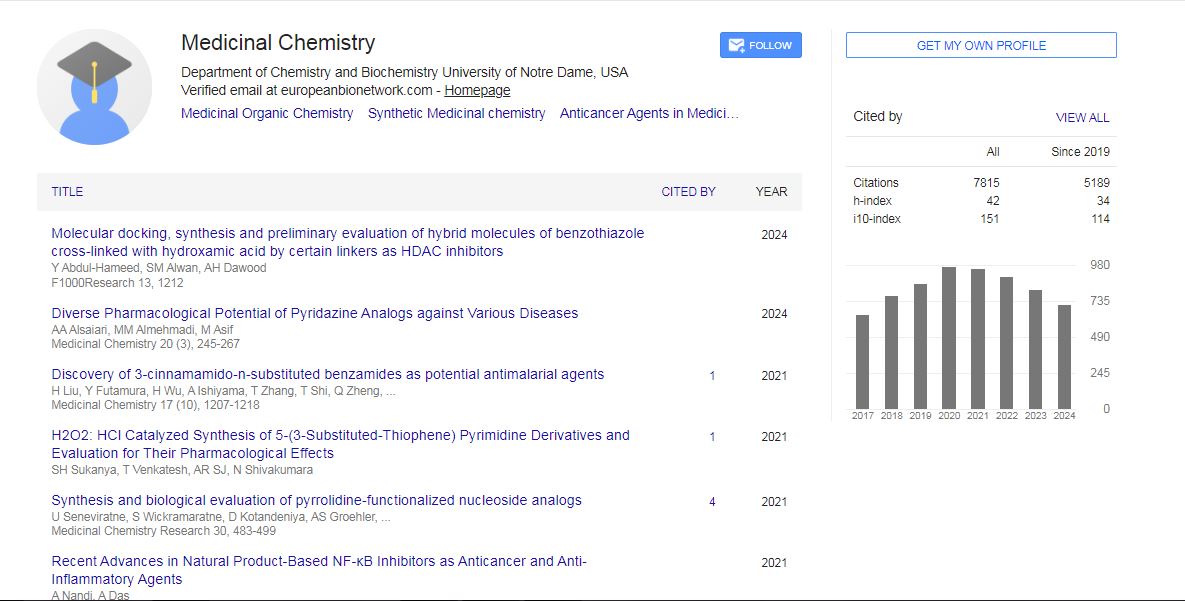
Medicinal Chemistry received 6627 citations as per Google Scholar report