Perspective - (2025) Volume 19, Issue 4
Received: 01-Aug-2025, Manuscript No. jmgm-26-188358;
Editor assigned: 04-Aug-2025, Pre QC No. P-188358;
Reviewed: 18-Aug-2025, QC No. Q-188358;
Revised: 22-Aug-2025, Manuscript No. R-188358;
Published:
29-Aug-2025
, DOI: 10.37421/1747-0862.2025.19.737
Citation: Ivanov, Viktor. ”Mitochondrial Genetics: Inherited Metabolic Disorders and Their Management.” J Mol Genet Med 19 (2025):737.
Copyright: © 2025 Ivanov V. This is an open-access article distributed under the terms of the Creative Commons Attribution License, which permits unrestricted use, distribution and reproduction in any medium, provided the original author and source are credited.
Mitochondrial genetics is a foundational area of study for comprehending inherited metabolic disorders, which arise from genetic alterations within mitochondrial DNA (mtDNA) or nuclear genes responsible for mitochondrial proteins, profoundly affecting cellular energy production. This summary aims to illuminate critical insights into the inheritance patterns, clinical presentations, and diagnostic methodologies pertinent to mitochondrial genetic disorders, underscoring their vital role in maintaining metabolic homeostasis [1].
The inheritance of mitochondrial genetic disorders is particularly intricate, with a primary focus on the maternal transmission of mitochondrial DNA (mtDNA). This transmission clarifies how varying mutation loads and heteroplasmy levels contribute to the diverse expressivity and reduced penetrance observed in these conditions, thereby deepening our understanding of their genetic underpinnings [2].
An in-depth understanding of the clinical spectrum associated with mitochondrial genetic disorders is paramount for accurate diagnosis and effective management. This review elaborates on the broad array of phenotypes, encompassing neurodegenerative diseases, myopathies, and systemic involvement, thereby highlighting the complexities in clinical recognition and the imperative for a structured diagnostic framework [3].
Significant advancements in molecular diagnostics have dramatically transformed the landscape of identifying mitochondrial genetic disorders. This paper scrutinizes the utility of next-generation sequencing (NGS) for both mtDNA and nuclear genes, underscoring its superiority in detecting complex rearrangements and identifying novel disease-causing variants [4].
A particular focus is placed on inherited metabolic disorders stemming from defects in the mitochondrial respiratory chain. This study investigates the molecular mechanisms driving complex I deficiency, a frequent cause of mitochondrial disease, and its consequential effects on cellular respiration and ATP synthesis [5].
The intricate connection between mitochondrial genetics and neurological disorders is increasingly acknowledged. This research investigates the contribution of mtDNA mutations to conditions such as MELAS (Mitochondrial Encephalomyopathy, Lactic Acidosis, and Stroke-like episodes), elucidating the specific neurodegenerative pathways that are implicated [6].
This publication critically examines the therapeutic strategies currently under investigation for mitochondrial genetic disorders. It provides a comprehensive review of emerging approaches, including gene therapy, small molecule interventions, and dietary modifications like the ketogenic diet, offering valuable perspectives on potential treatment avenues [7].
Furthermore, this article addresses the crucial ethical and psychosocial dimensions inherent in the diagnosis and management of inherited mitochondrial genetic disorders. It delves into the challenges associated with genetic counseling, family planning decisions, and the long-term ramifications for both affected individuals and their families [8].
The involvement of mitochondrial dysfunction in the pathogenesis of metabolic syndrome is a subject of intense scientific inquiry. This paper explores how genetic variations that compromise mitochondrial function can predispose individuals to metabolic disturbances, such as insulin resistance and the development of type 2 diabetes [9].
This review highlights innovative diagnostic techniques for mitochondrial genetic disorders that extend beyond traditional sequencing methods. It discusses the potential contributions of metabolomics and advanced imaging in pinpointing cellular metabolic defects, thereby complementing genetic analyses and offering a more holistic diagnostic approach [10].
Mitochondrial genetics plays an indispensable role in elucidating inherited metabolic disorders, which originate from mutations within mitochondrial DNA (mtDNA) or nuclear genes encoding mitochondrial proteins, thereby impairing cellular energy production. This comprehensive summary provides key insights into the characteristic inheritance patterns, the diverse clinical manifestations, and the sophisticated diagnostic approaches for mitochondrial genetic disorders, emphasizing their profound significance in the context of overall metabolic health [1].
This article meticulously examines the complex inheritance patterns associated with mitochondrial genetic disorders, with a particular emphasis on the well-established maternal inheritance of mtDNA. It offers a clear elucidation of how variations in mutation loads and heteroplasmy levels contribute to the wide spectrum of expressivity and the phenomenon of reduced penetrance, thereby providing a deeper understanding of the fundamental genetic basis of these conditions [2].
Comprehending the broad clinical spectrum of mitochondrial genetic disorders is of paramount importance for accurate diagnosis and effective patient management. This review offers a detailed account of the extensive range of phenotypes observed, from severe neurodegenerative diseases and debilitating myopathies to complex multisystemic involvement, thereby underscoring the inherent challenges in clinical recognition and the critical need for a systematic and thorough diagnostic approach [3].
Substantial advancements in the field of molecular diagnostics have profoundly transformed the identification processes for mitochondrial genetic disorders. This paper thoroughly discusses the diagnostic utility of next-generation sequencing (NGS) for evaluating both mtDNA and nuclear genes, explicitly highlighting its advantages in the detection of complex genomic rearrangements and the identification of novel disease-causing variants [4].
This specific study concentrates on inherited metabolic disorders that are directly attributable to defects within the mitochondrial respiratory chain. It thoroughly explores the intricate molecular mechanisms that underlie complex I deficiency, which is recognized as a common etiology for mitochondrial diseases, and meticulously details its impact on cellular respiration and the critical process of ATP synthesis [5].
The significant role that mitochondrial genetics plays in the etiology of neurological disorders is an area of increasing recognition within the scientific community. This research specifically investigates how mutations within mtDNA contribute to the development of conditions such as MELAS (Mitochondrial Encephalomyopathy, Lactic Acidosis, and Stroke-like episodes), thereby shedding light on the specific neurodegenerative pathways that are adversely affected [6].
This publication provides an in-depth discussion of the various therapeutic strategies that are currently being explored and developed for the treatment of mitochondrial genetic disorders. It presents a comprehensive review of promising approaches, including advanced gene therapy techniques, the application of small molecule interventions, and supportive measures such as ketogenic diets, thereby offering valuable insights into potential future avenues for effective treatment [7].
This article addresses the crucial ethical and psychosocial considerations that are intrinsically linked to the diagnosis and ongoing management of inherited mitochondrial genetic disorders. It thoughtfully examines the complex challenges associated with genetic counseling, informed family planning decisions, and the enduring long-term impact that these disorders have on both patients and their families [8].
The contribution of mitochondrial dysfunction to the development of metabolic syndrome is an area of highly active and ongoing research. This paper meticulously explores how specific genetic variations that negatively affect mitochondrial function can significantly predispose individuals to developing conditions such as insulin resistance and the onset of type 2 diabetes [9].
This review article concentrates on the latest emerging diagnostic techniques that are being developed for mitochondrial genetic disorders, extending beyond the capabilities of conventional sequencing methods. It discusses the considerable potential of metabolomics and advanced imaging modalities in accurately identifying subtle cellular metabolic defects, thereby offering a complementary approach to traditional genetic analysis [10].
Mitochondrial genetics is central to understanding inherited metabolic disorders caused by mutations in mitochondrial or nuclear genes, impacting cellular energy production. These disorders exhibit complex inheritance, primarily maternal, with variable expressivity due to heteroplasmy. The clinical spectrum is broad, ranging from neurological to systemic conditions, necessitating advanced diagnostics like next-generation sequencing. Specific defects, such as complex I deficiency, disrupt cellular respiration. Therapeutic strategies including gene therapy and small molecule interventions are under development, alongside ongoing research into the role of mitochondrial dysfunction in metabolic syndrome and neurological conditions. Ethical and psychosocial aspects are also crucial considerations in patient care. Emerging diagnostic tools like metabolomics and advanced imaging complement genetic analysis.
None
None
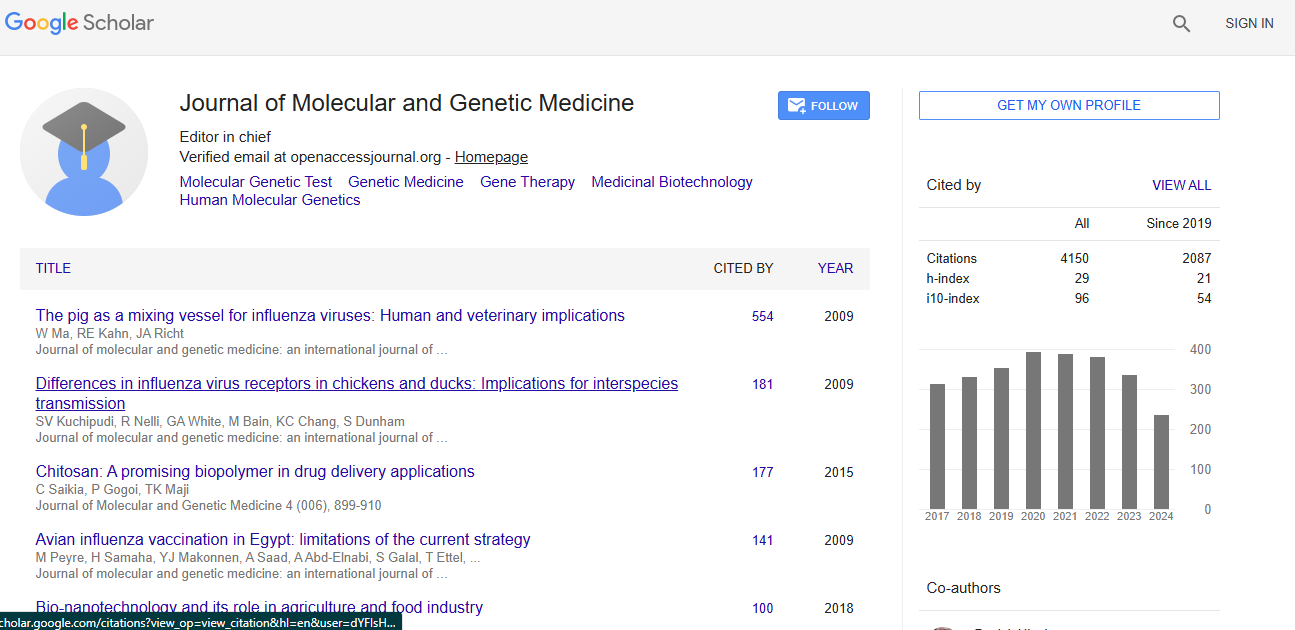
Molecular and Genetic Medicine received 3919 citations as per Google Scholar report