Opinion - (2025) Volume 10, Issue 3
Received: 01-Jun-2025, Manuscript No. jidm-26-188066;
Editor assigned: 03-Jun-2025, Pre QC No. P-188066;
Reviewed: 17-Jun-2025, QC No. Q-188066;
Revised: 23-Jun-2025, Manuscript No. R-188066;
Published:
30-Jun-2025
, DOI: 10.37421/2576-1420.2025.10.404
Citation: Dlamini, Nandi. ”Molecular Diagnostics: Revolutionizing
Infectious Disease Detection.” J Infect Dis Med 10 (2025):404.
Copyright: © 2025 Dlamini N. This is an open-access article distributed under the terms of the Creative Commons Attribution License, which permits unrestricted use,
distribution and reproduction in any medium, provided the original author and source are credited.
Molecular diagnostics have emerged as a cornerstone in the rapid and accurate identification of infectious diseases, offering unparalleled speed, sensitivity, and specificity in detection. These advanced techniques, including polymerase chain reaction (PCR), nucleic acid sequencing, and microarrays, are instrumental in pinpointing pathogens quickly, thereby facilitating timely treatment and improving patient outcomes. The ability to rapidly identify infectious agents is paramount for effective outbreak control and for guiding appropriate antimicrobial stewardship, particularly in the context of escalating antimicrobial resistance. The continuous integration of these sophisticated molecular technologies into daily clinical practice is fundamentally transforming the landscape of infection control and management strategies. [1]
Next-generation sequencing (NGS) represents a significant leap forward in the identification and detailed characterization of infectious agents. Its capacity for swift whole-genome sequencing provides deep insights into pathogen evolution, the mechanisms underlying drug resistance, and the dynamics of disease transmission, proving especially valuable during complex outbreaks. This high-throughput methodology allows for the simultaneous detection of a multitude of pathogens and the discovery of previously unknown microbial agents, substantially enhancing our comprehension of the human microbiome and its intricate relationship with disease. [2] The prominence of isothermal amplification techniques, such as loop-mediated isothermal amplification (LAMP), is steadily increasing in the field of infectious disease diagnostics, especially in settings with limited resources. These innovative methods circumvent the necessity for sophisticated thermal cycling equipment, rendering them highly adaptable for point-of-care testing applications. Their rapid turnaround times coupled with high sensitivity contribute significantly to the early diagnosis and containment of infectious diseases, presenting a robust and valuable alternative to conventional PCR-based approaches. [3] Point-of-care (POC) molecular diagnostics are indispensable for enabling decentralized infectious disease testing, bringing diagnostic capabilities directly to the patient's bedside or community settings. These advanced platforms facilitate the generation of rapid results, empowering swift clinical decision-making and the implementation of timely public health interventions. The ongoing development of user-friendly, portable POC devices is critically important for the effective management of infectious disease outbreaks and for broadening global access to essential diagnostic services. [4] Antimicrobial resistance (AMR) stands as a profound and escalating global health threat, and molecular diagnostics are proving to be an essential weapon in the fight against it. The swift identification of specific resistance genes and the underlying mechanisms of resistance enables clinicians to administer targeted therapies, thereby preserving the efficacy of existing antibiotics and informing the development of novel antimicrobial agents. Furthermore, molecular assays play a crucial role in tracking the emergence and dissemination of resistant strains, providing vital intelligence for public health strategies. [5] Multiplex molecular assays offer the significant advantage of simultaneously detecting multiple pathogens from a single patient sample, thereby substantially boosting diagnostic efficiency and reducing overall costs. This versatile approach is particularly beneficial for syndromic testing, where the rapid identification of a broad spectrum of potential causative agents is crucial, such as in cases of respiratory or gastrointestinal infections. These advanced assays streamline laboratory workflows and accelerate the diagnostic process. [6] The application of molecular diagnostics in the investigation of disease outbreaks is absolutely critical for facilitating rapid response and effective containment efforts. Techniques such as real-time PCR and whole-genome sequencing empower public health officials with the ability to precisely identify the causative agent, meticulously trace transmission pathways, and diligently monitor the evolutionary trajectory of pathogens. This invaluable information is essential for the implementation of robust control measures and the prevention of further disease spread. [7] Molecular diagnostic tools are increasingly being integrated with digital health platforms, leading to significant enhancements in data management, remote patient monitoring, and comprehensive public health surveillance systems. The synergy between rapid diagnostics and digital connectivity fosters a more accelerated dissemination of critical information, improved logistical coordination, and more effective real-time epidemiological analysis, all of which are indispensable for managing emerging infectious threats. [8] The ongoing development of novel molecular probes and innovative amplification chemistries continues to be a driving force behind improvements in diagnostic sensitivity and specificity. Emerging technologies, such as CRISPR-based diagnostics, hold considerable promise for the creation of highly accurate and remarkably adaptable detection systems. These advancements are pivotal for identifying pathogens present at extremely low concentrations and for accurately distinguishing between closely related strains, thereby refining diagnostic precision. [9] Despite their immense utility, the implementation of molecular diagnostics encounters several significant challenges, including high costs, complex regulatory pathways, and the essential requirement for highly skilled personnel. Nevertheless, continuous technological advancements and the progressive reduction in costs are steadily improving the accessibility of these vital methods. Effectively addressing these multifaceted challenges is imperative to fully realize the profound impact of molecular diagnostics on global infectious disease control and prevention initiatives. [10]Molecular diagnostics have fundamentally reshaped the landscape of infectious disease detection, providing unparalleled speed, sensitivity, and specificity. Techniques such as PCR, nucleic acid sequencing, and microarrays enable the rapid identification of pathogens, leading to timely treatment and improved patient outcomes. This rapid identification is crucial for controlling outbreaks and guiding antimicrobial stewardship, especially in the face of rising antimicrobial resistance. The integration of these technologies into routine clinical practice is fundamentally reshaping how we approach infection control and management. [1]
Next-generation sequencing (NGS) is transforming the identification and characterization of infectious agents. Its ability to sequence entire genomes rapidly provides insights into pathogen evolution, drug resistance mechanisms, and transmission dynamics, particularly useful in complex outbreaks. This high-throughput approach allows for the simultaneous detection of multiple pathogens and the discovery of novel microbial agents, significantly advancing our understanding of the human microbiome and its role in disease. [2] The role of isothermal amplification techniques, such as LAMP, is growing in infectious disease diagnostics, especially in resource-limited settings. These methods do not require complex thermal cycling equipment, making them adaptable for point-of-care testing. Their rapid turnaround times and high sensitivity contribute to early diagnosis and containment of infectious diseases, offering a valuable alternative to traditional PCR-based methods. [3] Point-of-care (POC) molecular diagnostics are essential for decentralized infectious disease testing. These platforms facilitate rapid results directly at the patient's bedside or in community settings, enabling swift clinical decisions and public health interventions. The development of user-friendly, portable POC devices is crucial for managing infectious disease outbreaks effectively and improving access to diagnostics globally. [4] Antimicrobial resistance (AMR) poses a significant global health threat, and molecular diagnostics play a vital role in combating it. Rapidly identifying resistance genes and mechanisms allows for targeted therapy, thereby preserving the efficacy of existing antibiotics and guiding the development of new ones. Molecular assays can also track the emergence and spread of resistant strains, informing public health strategies. [5] Multiplex molecular assays enable the simultaneous detection of multiple pathogens from a single sample, significantly improving diagnostic efficiency and reducing costs. This approach is particularly beneficial for syndromic testing, where a range of potential causative agents need to be identified quickly, such as in respiratory or gastrointestinal infections. Such assays streamline laboratory workflows and accelerate diagnosis. [6] The application of molecular diagnostics in outbreak investigations is critical for rapid response and containment. Real-time PCR and whole-genome sequencing allow for precise identification of the causative agent, tracing transmission pathways, and monitoring the evolution of pathogens. This information is invaluable for public health authorities to implement effective control measures and prevent further spread. [7] Molecular diagnostic tools are increasingly integrated with digital health platforms, enabling enhanced data management, remote monitoring, and public health surveillance. The combination of rapid diagnostics and digital connectivity facilitates faster dissemination of information, improved logistical coordination, and more effective real-time epidemiological analysis, which is crucial for managing emerging infectious threats. [8] The development of novel molecular probes and amplification chemistries continues to drive improvements in diagnostic sensitivity and specificity. Innovations such as CRISPR-based diagnostics offer potential for highly accurate and adaptable detection systems. These advancements are crucial for identifying pathogens at very low concentrations and distinguishing between closely related strains, thereby refining diagnostic precision. [9] The implementation of molecular diagnostics faces challenges including cost, regulatory hurdles, and the need for skilled personnel. However, ongoing technological advancements and decreasing costs are making these methods more accessible. Addressing these challenges is key to maximizing the impact of molecular diagnostics in global infectious disease control and prevention efforts. [10]Molecular diagnostics have revolutionized infectious disease detection, offering rapid, sensitive, and specific identification of pathogens. Techniques like PCR, nucleic acid sequencing, and microarrays are crucial for timely treatment and outbreak control. Next-generation sequencing provides deep insights into pathogen evolution and resistance. Isothermal amplification methods, such as LAMP, are valuable for resource-limited settings and point-of-care testing. Point-of-care diagnostics enable swift clinical decisions in decentralized settings. Molecular diagnostics are vital in combating antimicrobial resistance by identifying resistance mechanisms and tracking resistant strains. Multiplex assays improve efficiency by detecting multiple pathogens simultaneously, beneficial for syndromic testing. In outbreak investigations, molecular tools enable rapid response and containment through precise identification and transmission tracing. Integration with digital health platforms enhances data management and surveillance. Innovations in probes and amplification chemistries are refining diagnostic precision. Challenges like cost and regulatory hurdles remain, but technological advancements are increasing accessibility.
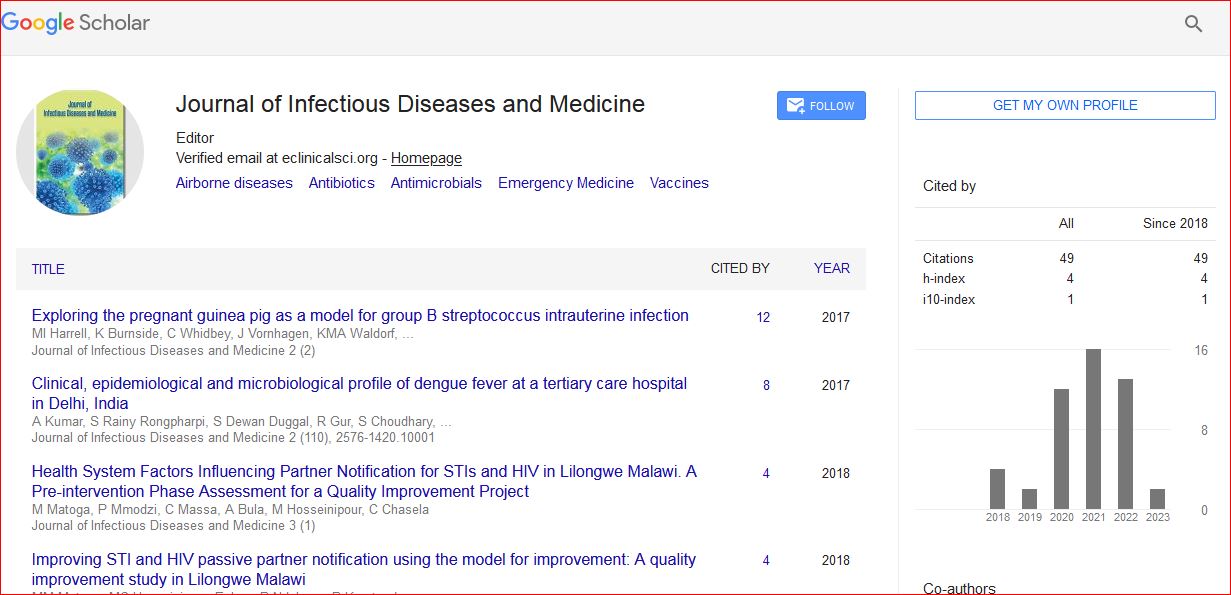
Journal of Infectious Diseases and Medicine received 1059 citations as per Google Scholar report