Commentary - (2025) Volume 17, Issue 2
Received: 01-Apr-2025, Manuscript No. jbabm-26-182323;
Editor assigned: 03-Apr-2025, Pre QC No. P-182323;
Reviewed: 17-Apr-2025, QC No. Q-182323;
Revised: 22-Apr-2025, Manuscript No. R-182323;
Published:
29-Apr-2025
, DOI: 10.37421/1948-593X.2025.17.481
Citation: Kapoor, Rahul. "Mass Spectrometry: Revolutionizing Biomedical Research and Diagnostics." J Bioanal Biomed 17 (2025):481.
Copyright: © 2025 Kapoor R. This is an open-access article distributed under the terms of the Creative Commons Attribution License, which permits unrestricted use, distribution and reproduction in any medium, provided the original author and source are credited.
Mass spectrometry (MS) has profoundly transformed modern biomedical analysis, offering unparalleled sensitivity, specificity, and speed across a wide spectrum of applications, including disease diagnostics, drug discovery, proteomics, and metabolomics [1].
Key advancements in ionization techniques, such as electrospray ionization (ESI) and matrix-assisted laser desorption/ionization (MALDI), alongside sophisticated mass analyzers like time-of-flight (TOF) and Orbitrap, have empowered researchers to identify and quantify a vast array of biomolecules, ranging from proteins and peptides to metabolites and lipids, even at trace levels [1].
This remarkable capability is indispensable for unraveling the complexities of biological systems, identifying crucial biomarkers for early disease detection, and facilitating the development of highly targeted therapeutic strategies [1].
Proteomics, the large-scale study of proteins, heavily relies on mass spectrometry for protein identification, quantification, and the detailed characterization of post-translational modifications (PTMs) [2].
Advanced MS techniques, particularly tandem MS (MS/MS), are essential for sequencing peptides and identifying proteins within intricate biological samples, providing vital insights into cellular functions, signaling pathways, and disease mechanisms [2].
Metabolomics, which involves the comprehensive study of small molecules or metabolites within biological systems, has experienced significant propulsion due to the widespread adoption of mass spectrometry [3].
LC-MS and GC-MS platforms are routinely utilized to profile and quantify hundreds to thousands of metabolites, offering a dynamic snapshot of cellular function and physiological state, which in turn aids in identifying metabolic biomarkers for various diseases [3].
In the realm of drug discovery and development, mass spectrometry plays a pivotal role in identifying potential drug candidates, characterizing their pharmacokinetic and pharmacodynamic properties, and monitoring drug metabolism with high sensitivity and specificity [4].
The application of mass spectrometry in clinical diagnostics is rapidly expanding, with MS-based assays offering substantial advantages over traditional methods, including increased throughput, enhanced sensitivity, and multiplexing capabilities for applications like newborn screening and cancer biomarker discovery [5].
The integration of ion mobility spectrometry-mass spectrometry (IMS-MS) introduces an additional dimension of separation based on ion size, shape, and charge, providing enhanced resolution and enabling the separation of isobaric species, proving valuable for biomarker discovery and analysis in complex biological mixtures [6].
Mass spectrometry (MS) has emerged as a transformative technology in modern biomedical research, revolutionizing analysis through its exceptional sensitivity, specificity, and speed [1].
Its pervasive applications span critical areas such as disease diagnostics, drug discovery, proteomics, and metabolomics, underscoring its versatility and importance in biological and medical science [1].
Significant technological advancements in ionization techniques like ESI and MALDI, coupled with sophisticated mass analyzers such as TOF and Orbitrap, have been instrumental in enabling the precise identification and quantification of a wide range of biomolecules, including proteins, peptides, metabolites, and lipids, even at trace concentrations [1].
This advanced analytical capability is crucial for comprehending complex biological systems, discovering biomarkers for early disease detection, and developing targeted therapeutic interventions [1].
In the field of proteomics, mass spectrometry is a cornerstone for protein identification, quantification, and the intricate characterization of post-translational modifications (PTMs) [2].
Particularly, tandem MS (MS/MS) allows for detailed peptide sequencing and protein identification within complex biological matrices, which is vital for understanding cellular functions, signaling pathways, and underlying disease mechanisms [2].
Metabolomics, the study of small molecules (metabolites) in biological systems, has been profoundly advanced by mass spectrometry, with LC-MS and GC-MS platforms being standard tools for profiling and quantifying numerous metabolites to capture cellular function and physiological states [3].
The ability of MS to detect subtle metabolic shifts is key to understanding disease progression and response to treatment, facilitating the identification of metabolic biomarkers for conditions like cancer and diabetes [3].
Mass spectrometry is integral to drug discovery and development, aiding in the identification of drug candidates, characterizing pharmacokinetic and pharmacodynamic properties, and monitoring drug metabolism due to its high sensitivity and specificity in detecting drugs and their metabolites in biological samples [4].
Its role extends to ensuring the safety and efficacy of pharmaceutical products through quantitative bioanalysis of drugs in biological fluids and understanding drug-target interactions [4].
The expanding application of mass spectrometry in clinical diagnostics is driven by its advantages over traditional methods, including higher throughput, improved sensitivity, and multiplexing capabilities, making it suitable for newborn screening, infectious disease testing, and cancer biomarker discovery [5].
The development of standardized MS assays and advanced bioinformatics tools is paving the way for broader adoption in routine clinical practice, enhancing the accuracy and timeliness of diagnoses [5].
Ion mobility spectrometry-mass spectrometry (IMS-MS) represents an emerging technique that adds a third separation dimension based on ion size, shape, and charge, offering enhanced resolution and the separation of isobaric species [6].
This orthogonal separation capability is proving invaluable in biomedical analysis for distinguishing isomers, analyzing complex mixtures, and improving biomarker discovery, particularly in fields like lipidomics and drug analysis [6].
High-resolution mass spectrometry (HRMS) instruments, such as Orbitrap and TOF analyzers, have significantly improved the accuracy and precision of mass measurements, allowing for unambiguous identification of unknown compounds and detailed characterization of complex molecular structures [7].
In biomedical research, HRMS is crucial for identifying novel metabolites, elucidating drug metabolites, and characterizing complex protein modifications, thereby deepening our understanding of biological processes [7].
The integration of mass spectrometry with bioinformatics tools is paramount for interpreting the vast datasets generated, employing sophisticated algorithms for spectral searching, protein/peptide identification, pathway analysis, and statistical modeling to extract meaningful biological insights [8].
This computational power is essential for biomarker discovery, understanding disease mechanisms, and guiding therapeutic strategies [8].
Lipidomics, the study of lipids, has greatly benefited from mass spectrometry, with LC-MS and MALDI-MS being powerful tools for identifying and quantifying numerous lipid species, advancing our understanding of lipid metabolism, signaling, and their roles in diseases such as cardiovascular disease and neurodegenerative disorders [9].
The ability to profile the lipidome opens new avenues for biomarker discovery and therapeutic intervention [9].
Advancements in direct infusion mass spectrometry, alongside improvements in instrumentation, have enabled rapid analysis of biological samples with minimal sample preparation, which is particularly beneficial for high-throughput screening and point-of-care diagnostics [10].
Emerging technologies like paper spray ionization and ambient ionization methods are further streamlining sample handling and accelerating analytical workflows, making MS more accessible for routine biomedical applications [10].
Mass spectrometry (MS) is a pivotal technology in biomedical research and clinical practice, revolutionizing fields like proteomics, metabolomics, and lipidomics through its high sensitivity and specificity. Advancements in ionization techniques and mass analyzers have enabled detailed analysis of biomolecules, crucial for disease diagnostics, drug discovery, and understanding complex biological systems. Coupled with chromatography (LC-MS, GC-MS) and bioinformatics, MS provides deep insights into cellular functions and disease mechanisms. Emerging techniques like IMS-MS and ambient ionization are further enhancing analytical capabilities and accessibility. Its application in clinical diagnostics is rapidly growing, promising earlier and more accurate diagnoses. Overall, MS is an indispensable tool for scientific discovery and healthcare.
None
None
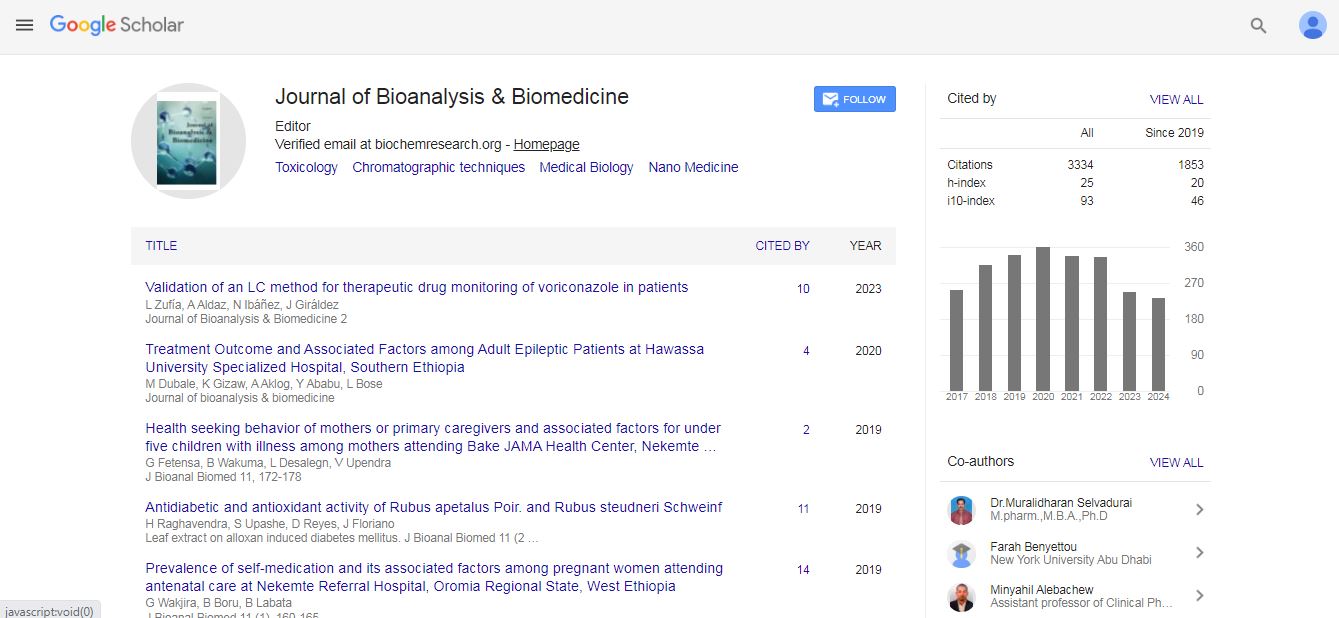
Journal of Bioanalysis & Biomedicine received 3099 citations as per Google Scholar report