Opinion - (2025) Volume 16, Issue 5
Received: 01-Sep-2025, Manuscript No. jpm-26-179453;
Editor assigned: 03-Sep-2025, Pre QC No. P-179453;
Reviewed: 17-Sep-2025, QC No. Q-179453;
Revised: 22-Sep-2025, Manuscript No. R-179453;
Published:
29-Sep-2025
, DOI: 10.37421/2090-0902.2025.16.554
Citation: Echeverría, Tomás. ”Mathematics Unifying Statistical Mechanics: A Deep Dive.” J Phys Math 16 (2025):554.
Copyright: © 2025 Echeverría T. This is an open-access article distributed under the terms of the Creative Commons Attribution License, which permits unrestricted use,distribution and reproduction in
any medium, provided the original author and source are credited.
The field of statistical mechanics stands as a cornerstone of modern physics, offering profound insights into the collective behavior of microscopic constituents that give rise to macroscopic thermodynamic phenomena. At its heart lies a sophisticated mathematical framework, essential for bridging the quantum or classical mechanical descriptions of individual particles with the emergent laws governing large systems. This mathematical rigor is indispensable for defining and analyzing concepts such as ensembles, entropy, and phase transitions with precision, illuminating the theoretical underpinnings that connect the micro and macro worlds [1].
In the realm of equilibrium statistical mechanics, mathematical derivations are paramount for establishing the connection between microscopic partition functions and macroscopic thermodynamic potentials. This includes the rigorous justification of the equivalences among the microcanonical, canonical, and grand canonical ensembles for systems comprising a vast number of particles. However, the mathematical complexities in accurately defining and computing these quantities for intricate systems remain a significant area of research, paving the way for future theoretical advancements [2].
Phase transitions and critical phenomena represent another domain where advanced mathematical tools are indispensable. Theories such as Renormalization Group and field theory provide the necessary formalisms to analyze the singular behaviors of thermodynamic quantities in the vicinity of critical points. These subtle mathematical structures are crucial for understanding how order emerges and symmetry is broken in macroscopic systems [3].
The mathematical foundations of quantum statistical mechanics are equally intricate, involving concepts like density matrices, Gibbs states, and the spectral theory of Hamiltonians. This area delves into the quantum mechanical descriptions of thermal properties and explores the role of entanglement, demanding a deep understanding of advanced mathematical principles to unravel the behavior of quantum systems at equilibrium [4].
Beyond equilibrium, the study of non-equilibrium statistical mechanics presents unique mathematical challenges. Techniques such as kinetic theory and master equations are employed to describe the time evolution of macroscopic systems. The rigorous calculation of transport coefficients and relaxation times from fundamental principles remains a complex task, requiring sophisticated mathematical approaches [5].
Furthermore, statistical mechanics finds a profound connection with information theory, particularly through the adaptation of concepts like Shannon entropy. This mathematical linkage allows for the quantification of uncertainty and information content within physical systems, offering new perspectives on the arrow of time and the fundamental limits of computation within physical processes [6].
Systems characterized by long-range interactions exhibit distinct thermodynamic and dynamic properties that necessitate specialized mathematical analysis. These systems can display phenomena like the breakdown of standard ensemble equivalences, requiring advanced methods from statistical physics and probability theory to fully comprehend their behavior and derive their unique characteristics [7].
The emergence of irreversibility in statistical mechanics is a fundamental question that has been explored through various mathematical lenses. From Boltzmann's H-theorem and its limitations to modern perspectives involving coarse-graining and open systems, providing a solid mathematical foundation for understanding time-irreversible macroscopic processes is an ongoing endeavor [8].
Topological methods are increasingly being applied to statistical mechanics, offering novel ways to characterize phases of matter, analyze critical phenomena, and understand exotic states such as topological insulators and superconductors. The inherent mathematical sophistication of these topological approaches reveals deeper structures governing physical systems [9].
Finally, the application of stochastic processes provides a powerful mathematical framework for statistical mechanics. Langevin and Fokker-Planck equations are crucial for modeling systems influenced by random fluctuations, enabling the rigorous derivation of stationary states and the analysis of relaxation dynamics, thereby offering a comprehensive understanding of system evolution over time [10].
This article delves into the core mathematical principles underpinning statistical mechanics, emphasizing how theoretical constructs are employed to interpret macroscopic properties arising from microscopic interactions. It highlights the essential role of mathematical frameworks in defining and analyzing key concepts such as ensembles, entropy, and phase transitions, thereby bridging the gap between the quantum or classical mechanics of individual particles and the emergent thermodynamic laws governing large-scale systems [1].
A rigorous exploration of equilibrium statistical mechanics is presented, focusing on the derivation of thermodynamic potentials from partition functions and the mathematical justification for the equivalence of microcanonical, canonical, and grand canonical ensembles in the limit of large systems. The inherent mathematical difficulties in defining and calculating these quantities for complex systems are also addressed, setting the stage for future theoretical developments in this area [2].
The mathematical formalisms crucial for understanding phase transitions and critical phenomena are investigated. This involves the application of advanced tools from Renormalization Group theory and field theory to meticulously analyze the singular behavior of thermodynamic quantities near critical points, showcasing how subtle mathematical structures govern the emergence of order and symmetry breaking in macroscopic systems [3].
A comprehensive review of the mathematical foundations pertinent to quantum statistical mechanics is provided. This includes detailed coverage of density matrices, Gibbs states, and the spectral theory of Hamiltonians within the context of quantum systems, extending the discussion to the mathematical treatment of entanglement and its significant role in determining thermal properties [4].
The mathematical aspects of non-equilibrium statistical mechanics are explored, with a particular focus on techniques used to describe the time evolution of macroscopic systems. This encompasses the application of kinetic theory and master equations, and addresses the significant challenges encountered in the rigorous definition and calculation of transport coefficients and relaxation times from fundamental physical principles [5].
The intricate interplay between statistical mechanics and information theory is examined, detailing how concepts such as Shannon entropy are adapted and applied to quantify uncertainty and information content in physical systems. This exploration sheds light on the implications for understanding the directionality of time and the theoretical limits of computation within physical processes [6].
This research focuses on the mathematical intricacies of statistical mechanics applied to systems with long-range interactions. It probes the unique thermodynamic and dynamic properties that emerge in such systems, including the breakdown of standard ensemble equivalences, employing advanced methodologies from statistical physics and probability theory to elucidate these phenomena [7].
A detailed mathematical analysis concerning the emergence of irreversibility in statistical mechanics is undertaken. The paper scrutinizes various approaches, from Boltzmann's H-theorem and its inherent limitations to contemporary perspectives involving coarse-graining and open systems, aiming to establish a robust mathematical foundation for comprehending the apparent time-irreversibility of macroscopic processes [8].
The application of topological methods within statistical mechanics is explored, investigating their utility in characterizing distinct phases of matter, analyzing critical phenomena, and understanding complex states like topological insulators and superconductors from a statistical viewpoint. The sophisticated mathematical nature of these topological approaches is underscored throughout the discussion [9].
A thorough mathematical treatment of stochastic processes as they relate to statistical mechanics is presented. This involves detailing the utilization of Langevin and Fokker-Planck equations for modeling the dynamics of systems driven by random fluctuations, with a concentrated effort on the rigorous derivation of stationary states and the analytical examination of relaxation dynamics [10].
This collection of articles explores the crucial role of mathematics in understanding statistical mechanics across various domains. It covers the fundamental principles connecting microscopic behavior to macroscopic properties, equilibrium and non-equilibrium systems, phase transitions, and quantum statistical mechanics. The research highlights the application of advanced mathematical tools such as partition functions, Renormalization Group theory, topological methods, and stochastic processes. Connections to information theory and the emergence of irreversibility are also examined, underscoring the theoretical rigor required to explain complex physical phenomena. The mathematical frameworks discussed are essential for deriving thermodynamic laws, analyzing system dynamics, and understanding unique behaviors in systems with long-range interactions.
None
None
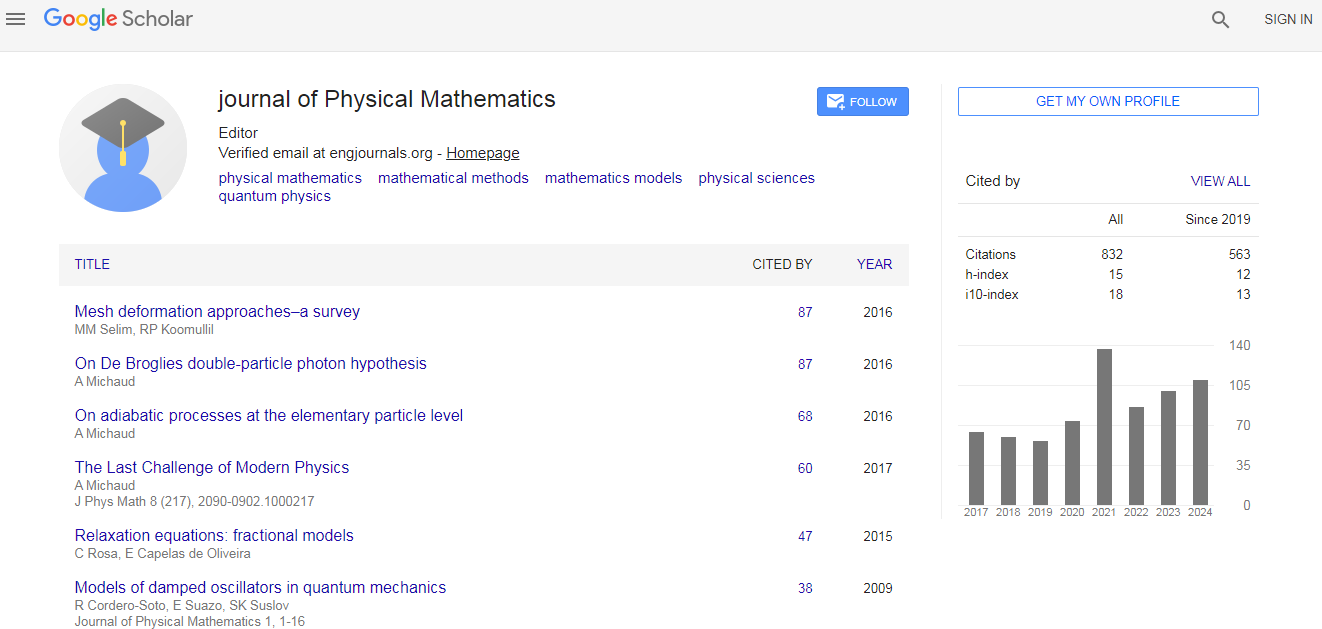
Physical Mathematics received 686 citations as per Google Scholar report