Opinion - (2025) Volume 16, Issue 6
Received: 01-Nov-2025, Manuscript No. jpm-26-179476;
Editor assigned: 03-Nov-2025, Pre QC No. P-179476;
Reviewed: 17-Nov-2025, QC No. Q-179476;
Revised: 24-Nov-2025, Manuscript No. R-179476;
Published:
29-Nov-2025
, DOI: 10.37421/2090-0902.2025.16.564
Citation: Sen, Amrita. ”Mathematics: The Backbone of Quantum Computing.” J Phys Math 16 (2025):564.
Copyright: © 2025 Sen A. This is an open-access article distributed under the terms of the Creative Commons Attribution License, which permits unrestricted use, distribution and reproduction in any medium, provided the original author and source are credited.
The burgeoning field of quantum computing necessitates a robust understanding of its foundational mathematical principles. Linear algebra plays a pivotal role, providing the framework for describing quantum states as vectors and quantum operations as unitary matrices. These mathematical constructs are indispensable for comprehending the manipulation and evolution of qubits, the fundamental units of quantum information. The intricate nature of quantum mechanics, with its inherent probabilistic outcomes, is elegantly captured by the probabilistic interpretations of quantum states, making probability theory a cornerstone in this domain. The exploration of these mathematical underpinnings is crucial for anyone seeking to engage with the design and analysis of quantum algorithms and the development of quantum hardware. This foundational knowledge equips researchers with the tools to navigate the complexities of this transformative technology. The mathematical landscape of quantum computing extends beyond basic linear algebra and probability. Advanced concepts from group theory are instrumental in identifying and exploiting symmetries within quantum algorithms, leading to potentially significant efficiency gains. By understanding the underlying group structures, researchers can design more elegant and powerful quantum computations. These symmetries can be leveraged to simplify complex operations and optimize algorithm performance, highlighting the deep connection between abstract mathematical concepts and practical computational advancements. Furthermore, the representation of complex quantum systems often requires sophisticated mathematical tools. Differential geometry and topology offer powerful methodologies for characterizing the behavior and evolution of these systems. Concepts such as curvature and topological invariants provide novel ways to describe intricate quantum states, offering new perspectives on challenges like error correction and quantum control. The application of these advanced geometric and topological concepts unlocks new avenues for understanding and manipulating quantum phenomena. In the realm of formalizing quantum computation, algebraic structures such as category theory and abstract algebra are proving to be immensely valuable. These frameworks offer a unified and rigorous approach to defining and analyzing different quantum computing models. By providing a common language, they facilitate the development of more efficient, verifiable, and conceptually sound quantum algorithms. This abstract algebraic perspective helps to unify disparate approaches to quantum computation under a single theoretical umbrella. The practical implementation of quantum algorithms and the exploration of quantum phenomena often rely heavily on numerical simulation techniques. Finite difference methods, spectral methods, and Monte Carlo simulations are essential tools for overcoming the computational challenges associated with simulating complex quantum systems on classical hardware. These numerical approaches bridge the gap between theoretical models and observable phenomena, enabling researchers to test hypotheses and gain insights into quantum behavior. Information theory provides a critical lens through which to view the capabilities and limitations of quantum computing. Concepts such as quantum entropy, entanglement measures, and quantum channel capacities are fundamental to understanding the efficiency of quantum communication and the robustness of quantum computations. Information-theoretic principles guide the development of advanced quantum error correction codes and efficient quantum communication protocols, ensuring reliable and effective quantum information processing. The development of fault-tolerant quantum computation hinges on effective quantum error correction. The mathematical formalisms underlying various error correction codes, including stabilizer codes, surface codes, and LDPC codes, are crucial for ensuring the reliability of quantum computations. Understanding these mathematical principles is paramount for building robust quantum computers that can overcome the inherent fragility of quantum states. Graph theory offers a powerful set of tools for understanding and manipulating quantum information. The representation of quantum circuits as graphs, the analysis of entanglement structures using graph-theoretic concepts, and the development of new quantum algorithms, particularly in fields like quantum chemistry and optimization, all benefit from the application of graph theory. This interdisciplinary approach highlights the broad applicability of mathematical concepts in quantum computing. Quantum machine learning represents a rapidly advancing frontier, and its mathematical underpinnings are equally critical. Linear algebra, optimization techniques, and probability distributions are essential for developing and analyzing quantum neural networks and other quantum learning models. The integration of machine learning principles with quantum computation promises to unlock new computational paradigms and accelerate scientific discovery. Finally, the emergent field of quantum chaos explores the mathematical connections between classical chaos theory and quantum systems. Understanding how concepts from classical chaos can inform the behavior of quantum systems opens up avenues for novel quantum algorithms and a deeper appreciation of the intricate dynamics governing quantum phenomena. This exploration highlights unexpected connections between seemingly disparate areas of physics and mathematics.
The core of quantum computing rests upon a foundation of mathematical frameworks that enable its unique computational capabilities. Linear algebra provides the language for defining quantum states as vectors in Hilbert spaces and quantum operations as unitary transformations. These mathematical constructs are essential for manipulating qubits and understanding the unitary evolution of quantum systems. The probabilistic nature of quantum mechanics is inherently tied to probability theory, which is crucial for interpreting measurement outcomes and quantifying uncertainties. These fundamental mathematical tools are indispensable for comprehending, designing, and analyzing the behavior of quantum algorithms and the physical implementation of quantum hardware. The ability to precisely represent and manipulate these quantum states is a direct result of these mathematical underpinnings. Beyond the basic principles, more advanced mathematical theories illuminate deeper aspects of quantum computation. Group theory, for instance, is vital for understanding symmetries present in quantum algorithms. Identifying and exploiting these symmetries can lead to significant improvements in computational efficiency and the development of more elegant algorithmic structures. The application of group theory allows for a more profound understanding of the underlying structure and potential optimizations within quantum algorithms, showcasing a direct link between abstract algebraic concepts and practical performance gains. Furthermore, the characterization of complex quantum systems often benefits from sophisticated mathematical tools drawn from differential geometry and topology. Concepts such as curvature and topological invariants offer novel ways to describe intricate quantum states and their dynamic evolution. This geometric and topological perspective provides new insights into critical areas such as quantum error correction and quantum control, potentially leading to more robust and controllable quantum systems. The use of these advanced mathematical fields opens up new frontiers in understanding quantum behavior. In the pursuit of formalizing quantum computation, algebraic structures including category theory and abstract algebra play a significant role. These frameworks provide a rigorous and unified approach to defining and comparing various quantum computing models. By establishing a common theoretical foundation, they aid in the development of more efficient, verifiable, and conceptually robust quantum algorithms. This abstract algebraic lens helps to bridge the gap between different computational paradigms and offers a pathway towards more standardized and reliable quantum computing. The practical realization and exploration of quantum computing heavily rely on sophisticated numerical methods and computational techniques. Essential tools such as finite difference methods, spectral methods, and Monte Carlo simulations are indispensable for tackling the challenges of simulating complex quantum systems on classical hardware. These numerical approaches are vital for bridging the gap between theoretical predictions and empirical observations, enabling the validation of quantum algorithms and the study of quantum phenomena. Information theory offers a crucial perspective on the efficiency and limitations of quantum information processing. Concepts like quantum entropy, entanglement measures, and quantum channel capacities are central to understanding the performance of quantum communication protocols and the development of advanced quantum error correction strategies. By applying information-theoretic principles, researchers can design more effective quantum systems that are resilient to noise and capable of reliable information transmission. The design and analysis of robust quantum error correction codes are deeply rooted in mathematical formalism. Various approaches, including stabilizer codes, surface codes, and LDPC codes, all rely on specific mathematical principles to achieve fault-tolerant quantum computation. A thorough understanding of these mathematical underpinnings is essential for building quantum computers that can reliably execute complex computations without succumbing to errors. Graph theory provides a valuable framework for representing and analyzing quantum computational structures. Concepts from graph theory are widely applied to model quantum circuits, understand the complex relationships within entangled quantum states, and develop novel quantum algorithms. This is particularly evident in applications within quantum chemistry and optimization, where graph-based representations offer significant analytical advantages. Quantum machine learning, a rapidly evolving area, is built upon a solid mathematical foundation. Linear algebra, optimization techniques, and the careful application of probability distributions are critical for the development and analysis of quantum neural networks and other quantum learning models. This interdisciplinary field promises to unlock new computational capabilities by merging the power of quantum mechanics with the principles of machine learning. Lastly, the study of quantum chaos explores the profound mathematical connections between classical chaos theory and quantum systems. Understanding how chaotic dynamics manifest in quantum regimes offers insights into the behavior of complex quantum systems and opens up possibilities for developing entirely new classes of quantum algorithms. This exploration highlights the interconnectedness of mathematical concepts across different domains of physics and computation.
This collection of articles explores the critical role of mathematics in quantum computing. It covers fundamental mathematical frameworks such as linear algebra, group theory, and probability theory that underpin quantum states, operations, and measurements. The papers also delve into advanced topics like differential geometry, topology, and algebraic structures for formalizing quantum computation, alongside numerical simulation techniques for analyzing quantum systems. Furthermore, the applications of information theory and graph theory are examined for their contributions to quantum error correction, communication, and algorithm design. The synthesis of these mathematical disciplines is essential for advancing the field of quantum computing, from understanding its theoretical underpinnings to developing practical algorithms and hardware.
None
None
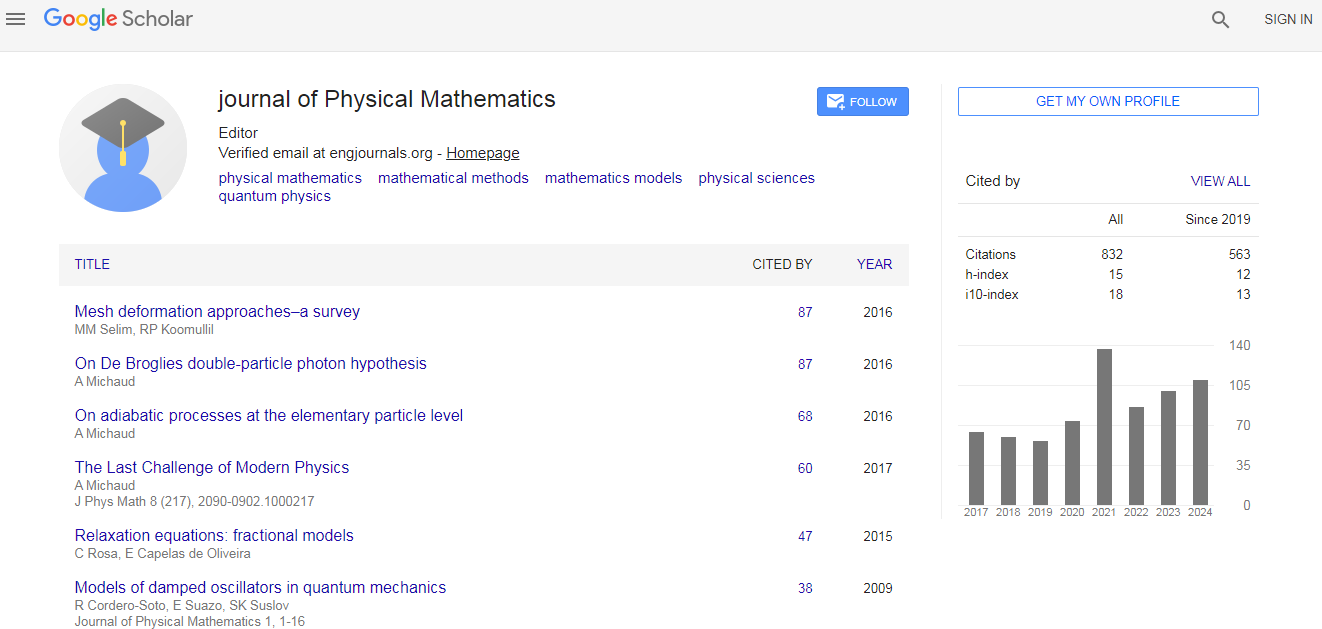
Physical Mathematics received 686 citations as per Google Scholar report