Short Communication - (2025) Volume 11, Issue 6
Received: 03-Nov-2025, Manuscript No. OHCR-25-167878;
Editor assigned: 05-Nov-2025, Pre QC No. P-167878;
Reviewed: 17-Nov-2025, QC No. Q-167878;
Revised: 22-Nov-2025, Manuscript No. R-167878;
Published:
29-Nov-2025
, DOI: 10.37421/2471-8726.2025.11.219
Citation: Patano, Kratrdello. “Matching Dental Prostheses with Individual Oral Constitutions.” Oral Health Case Rep 11 (2025): 219.
Copyright: © 2025 Patano K. This is an open-access article distributed under the terms of the Creative Commons Attribution License, which permits unrestricted use, distribution and reproduction in any medium, provided the original author and source are credited.
Dental prostheses play a crucial role in restoring function, speech, and aesthetics for patients with missing or damaged teeth. However, successful outcomes depend not just on technical accuracy but on how well the prosthesis matches the individualâ??s oral constitution. This includes anatomical considerations such as jaw shape, bite alignment, gingival architecture, and soft tissue tone, as well as patient-specific factors like facial proportions and muscle dynamics. Failure to accommodate these differences can result in discomfort, poor aesthetics, and compromised function. Customization is therefore essential, with design choices tailored to each patientâ??s physiological and aesthetic profile. Advances in digital dentistry, including 3D imaging and CAD/CAM technologies, now allow for more precise replication of oral features, enhancing both performance and appearance. Individualization ensures better integration, comfort, and long-term satisfaction [1].
Aesthetic and functional harmony in prosthetic dentistry begins with a thorough understanding of the patientâ??s oral constitution. This encompasses not only hard and soft tissue anatomy but also personal habits, phonetics, and psychological expectations. A prosthesis must blend seamlessly into the patientâ??s smile, respecting natural tooth morphology, gingival contours, and lip support. Gender, age, and ethnic characteristics further influence design considerations, making one-size-fits-all solutions inadequate. The clinicianâ??s ability to recognize and respond to these unique traits determines the success of prosthetic rehabilitation. The integration of digital diagnostics with manual expertise has elevated the standard of customization, allowing for accurate shade matching, natural emergence profiles, and occlusal balance. Matching dental prostheses to individual constitutions is not simply a technical process it is an art form rooted in empathy, observation, and meticulous planning [2].
Properly matching dental prostheses with an individualâ??s oral constitution requires a comprehensive assessment that goes beyond missing tooth replacement. It begins with evaluating facial symmetry, vertical dimension, occlusal plane, and lip mobility. These elements dictate how a prosthesis will appear and function within the dynamic environment of the mouth. Aesthetic success depends on replicating natural forms and transitions, including gingival emergence and incisal translucency. Functional success relies on proper occlusion, phonetics, and load distribution. For removable prostheses, factors such as ridge morphology, saliva flow, and tissue resiliency are essential for retention and comfort. In fixed prosthetics, the prosthesis must align with periodontal health, crown-to-root ratio, and abutment integrity. Digital tools such as intraoral scanners, smile design software, and facial scanners aid in capturing accurate data to guide customization. Prosthodontists must also consider patient expectations, lifestyle, and habits like bruxism or smoking, which can influence material choice and design. Clinical artistry is key subtle adjustments in contour, texture, and color can make a prosthesis indistinguishable from natural dentition. Ultimately, the objective is not just to replace what is missing but to restore what is individually appropriate, creating prostheses that function naturally, feel comfortable, and meet the patientâ??s personal and social expectations [3].
The aesthetic component of dental prosthetics must be tailored to complement the patientâ??s unique oral and facial characteristics. This includes selecting tooth shapes that align with facial form square, oval, or tapered and matching the color to adjacent teeth and skin tone. Gender plays a subtle but important role: females often benefit from softer, rounded tooth forms, while males may require squarer or more prominent designs to maintain facial harmony. Age is another factor; older patients may need prostheses that reflect natural wear patterns, while younger individuals may expect brighter, more symmetrical restorations. The gingival contours around the prosthesis must also mirror natural scalloping and color transitions, especially in the anterior zone where visibility is high. Technological advancements allow for digital wax-ups and 3D-printed mock-ups to test aesthetic compatibility before final fabrication. Equally important is communication between clinician, technician, and patient to align expectations and make real-time adjustments. Smile line, midline, and buccal corridor must be analyzed and incorporated into design. Overlooking these factors can lead to prostheses that appear artificial or fail to support facial musculature adequately. When executed properly, prostheses enhance not only dental aesthetics but also the entire facial appearance, contributing to a natural, confident smile that reflects the patientâ??s identity and character [4].
Functional compatibility is just as critical as aesthetic integration when designing dental prostheses that align with individual oral constitutions. Occlusion must be carefully assessed to prevent issues such as temporomandibular joint discomfort, uneven wear, or prosthesis fracture. The bite must harmonize with natural mandibular movement, accounting for overbite, overjet, and lateral excursions. Muscle activity, particularly in cases involving strong masseter or temporalis function, may influence material choice zirconia or metal-ceramic options may be preferable for durability. Speech articulation is another concern; the prosthesis must support proper phonetics, especially in cases involving anterior teeth. For implant-supported prostheses, bone density, implant angulation, and soft tissue management are essential for both function and longevity. Soft tissue compatibility involves choosing contours that promote hygiene access, avoiding food traps, and ensuring stable mucosal contact. For edentulous patients, palatal coverage, border extensions, and suction dynamics play a major role in prosthesis retention. Individual variations in oral anatomy demand a personalized approach in every case, often requiring try-ins and adjustments. The goal is seamless integration into the oral environment, where the prosthesis behaves like natural dentition. Matching prosthetics to the individual is not only a clinical necessity but also an ethical commitment to delivering care that is comfortable, effective, and uniquely tailored [5].
Google Scholar Cross Ref Indexed at
Google Scholar Cross Ref Indexed at
Google Scholar Cross Ref Indexed at
Google Scholar Cross Ref Indexed at
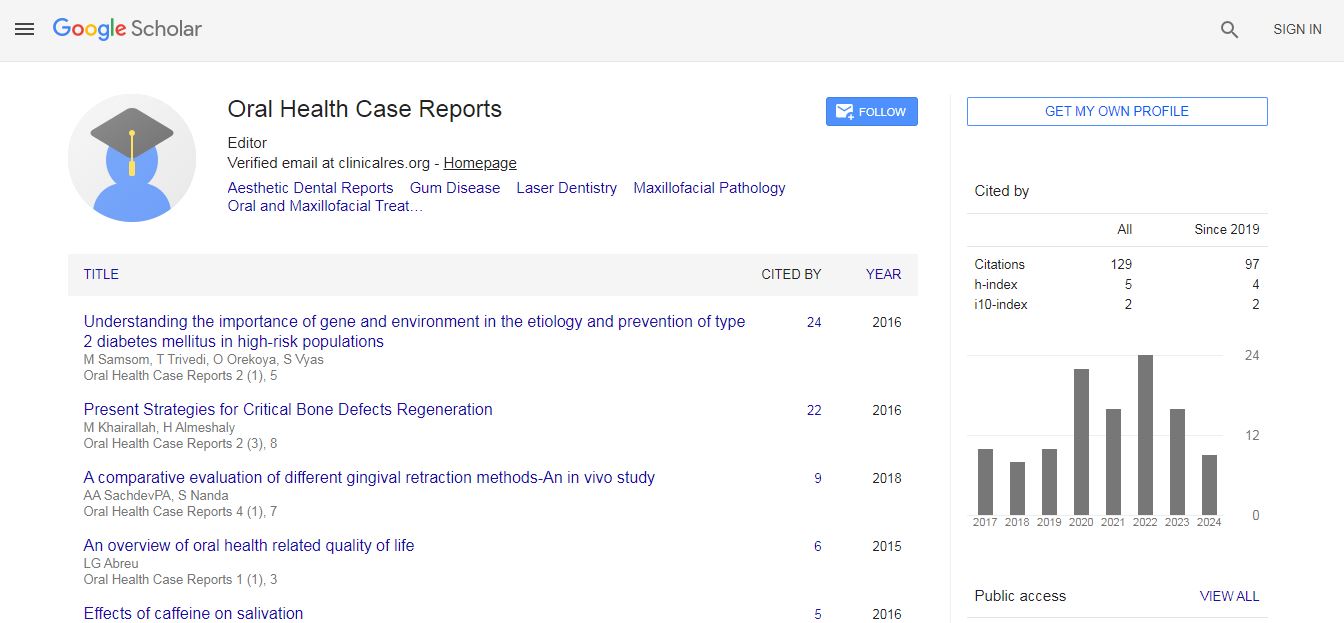
Oral Health Case Reports received 120 citations as per Google Scholar report