Short Communication - (2025) Volume 16, Issue 5
Received: 01-Oct-2025, Manuscript No. jfr-26-184127;
Editor assigned: 03-Oct-2025, Pre QC No. P-184127;
Reviewed: 17-Oct-2025, QC No. Q-184127;
Revised: 22-Oct-2025, Manuscript No. R-184127;
Published:
29-Oct-2025
, DOI: 10.37421/2157-7145.2025.16.688
Citation: Russo, Anthony. ”Mass Spectrometry: Key to Explosive
Forensics.” J Forensic Res 16 (2025):688.
Copyright: © 2025 Russo A. This is an open-access article distributed under the terms of the Creative Commons Attribution License, which permits unrestricted use, distribution
and reproduction in any medium, provided the original author and source are credited.
Mass spectrometry (MS) stands as a cornerstone technology in the forensic analysis of explosive devices, offering a sophisticated array of techniques essential for the identification and characterization of explosive residues, their precursors, and decomposition products. The sensitivity and specificity of techniques like Gas Chromatography-Mass Spectrometry (GC-MS) and Liquid Chromatography-Mass Spectrometry (LC-MS) enable the detection of even trace amounts of explosives, making them invaluable in forensic investigations [1].
Recent advancements have seen ion mobility spectrometry coupled with mass spectrometry (IMS-MS) significantly enhancing the speed and sensitivity of explosive detection. By separating ions based on size, shape, and charge before MS analysis, IMS-MS provides an orthogonal separation dimension that boosts confidence in identification, particularly for isomeric compounds [2].
High-resolution mass spectrometry (HRMS) is critical in forensic explosive analysis, providing accurate mass measurements that allow for the unambiguous determination of elemental composition. This capability is vital for identifying novel or improvised explosive materials and differentiating between structurally similar isomers [3].
Tandem mass spectrometry (MS/MS) offers enhanced selectivity and specificity through multiple stages of mass analysis. This layered approach provides detailed structural information, crucial for confirming presumptive identifications and dissecting complex mixtures encountered in post-blast scenarios [4].
Gas Chromatography-Mass Spectrometry (GC-MS) remains a primary tool for the routine analysis of volatile and semi-volatile explosive compounds and their residues. Its ability to separate complex mixtures and the definitive identification power of MS make it ideal for common explosives and their degradation products [5].
Liquid Chromatography-Mass Spectrometry (LC-MS) serves as a valuable complement to GC-MS, especially for analyzing thermally labile or less volatile explosive compounds. LC-MS excels with polar explosives and their degradation products that are not readily amenable to GC, contributing to comprehensive chemical fingerprints [6].
The analysis of improvised explosive devices (IEDs) presents unique challenges due to their inherent diversity. Mass spectrometry, particularly when coupled with GC or LC, is instrumental in identifying precursor chemicals, energetic compounds, and additives, aiding in inferring synthesis routes and tracing material origins [7].
Surface-Enhanced Raman Spectroscopy (SERS) in conjunction with mass spectrometry offers a synergistic approach for identifying explosive residues at trace levels. SERS enhances Raman signals, providing vibrational fingerprints, while MS offers complementary molecular weight and fragmentation data, boosting identification confidence [8].
The development of portable and field-deployable mass spectrometry systems is revolutionizing on-site analysis of explosive devices. Techniques like direct analysis in real-time mass spectrometry (DART-MS) enable rapid identification at the scene, guiding immediate response and evidence collection efforts [9].
Mass spectrometry is also integral to understanding the aging and degradation processes of explosives. By analyzing decomposition products over time, MS can reveal insights into the stability of energetic materials and assist in reconstructing event timelines, thereby supporting investigative narratives [10].
The forensic analysis of explosive devices relies heavily on mass spectrometry (MS) and its diverse techniques for identifying explosive residues, precursors, and decomposition products. Techniques such as Gas Chromatography-Mass Spectrometry (GC-MS) and Liquid Chromatography-Mass Spectrometry (LC-MS) are routinely employed due to their exceptional sensitivity and specificity in detecting minute quantities of explosives, which are critical for post-blast investigations [1].
In parallel, ion mobility spectrometry coupled with mass spectrometry (IMS-MS) has emerged as a significant advancement, substantially improving the speed and sensitivity of explosive detection. This hyphenated technique offers an orthogonal separation dimension by separating ions based on their physical characteristics before MS analysis, thereby increasing confidence in identification, especially for isomeric compounds [2].
High-resolution mass spectrometry (HRMS) plays a pivotal role by providing highly accurate mass measurements that enable the unambiguous determination of elemental compositions. This precise capability is indispensable for identifying novel or improvised explosive materials and for differentiating between various isomers and related compounds that may exhibit similar fragmentation patterns in lower-resolution instruments [3].
Tandem mass spectrometry (MS/MS) is a crucial technique that enhances selectivity and specificity in the analysis of explosive devices. Through multiple stages of mass analysis, MS/MS can isolate specific precursor ions and fragment them to generate characteristic daughter ions, yielding detailed structural information vital for confirming identifications and analyzing complex mixtures [4].
Gas Chromatography-Mass Spectrometry (GC-MS) continues to be a fundamental method for the routine analysis of volatile and semi-volatile explosive compounds and their residues. Its effectiveness in separating complex mixtures, combined with the definitive identification capabilities of MS, makes it ideal for analyzing common explosive materials and their decomposition products [5].
Liquid Chromatography-Mass Spectrometry (LC-MS) provides a valuable alternative and complementary approach to GC-MS, particularly for the analysis of explosive compounds that are thermally labile or less volatile. LC-MS is well-suited for polar explosives and their degradation products that may not be readily analyzed by GC, contributing to comprehensive chemical profiles of explosive materials [6].
The analysis of improvised explosive devices (IEDs) presents unique challenges owing to the wide variability of homemade explosives. Mass spectrometry, especially when integrated with GC or LC, is essential for identifying precursor chemicals, energetic compounds, and additives present in IEDs. This information is crucial for inferring potential synthesis routes and tracing the origin of materials, offering critical intelligence for counter-terrorism efforts [7].
Surface-Enhanced Raman Spectroscopy (SERS) when coupled with mass spectrometry, offers a powerful synergistic approach for the identification of explosive residues, particularly at trace levels. SERS enhances Raman signals to provide highly specific vibrational fingerprints, while MS offers complementary molecular weight and fragmentation data, thereby increasing the confidence in identification, even with minimal sample quantities [8].
The ongoing development of portable and field-deployable mass spectrometry systems is transforming the on-site analysis of explosive devices. These instruments facilitate rapid identification of explosive residues directly at the scene, mitigating the need for sample transport and reducing risks of contamination or degradation. This allows for faster screening and preliminary identification, guiding immediate response and evidence collection [9].
Mass spectrometry is also indispensable for understanding the aging and degradation processes of explosives. Analyzing the decomposition products over time provides insights into the stability of different energetic materials and can help estimate the time since detonation or placement. This analytical aspect aids in reconstructing event timelines and supporting investigative narratives by chemically characterizing the state of the explosives [10].
Mass spectrometry (MS) is a critical technology for the forensic analysis of explosive devices, enabling the identification of residues, precursors, and decomposition products. Techniques like GC-MS and LC-MS are standard for their sensitivity, while advanced methods like HRMS and MS/MS offer enhanced identification capabilities through precise mass measurements and fragmentation patterns. IMS-MS provides increased speed and sensitivity, particularly for isomers. Portable MS systems are revolutionizing on-site analysis, allowing for rapid identification at crime scenes. MS also plays a role in understanding explosive aging and degradation, aiding in timeline reconstruction.
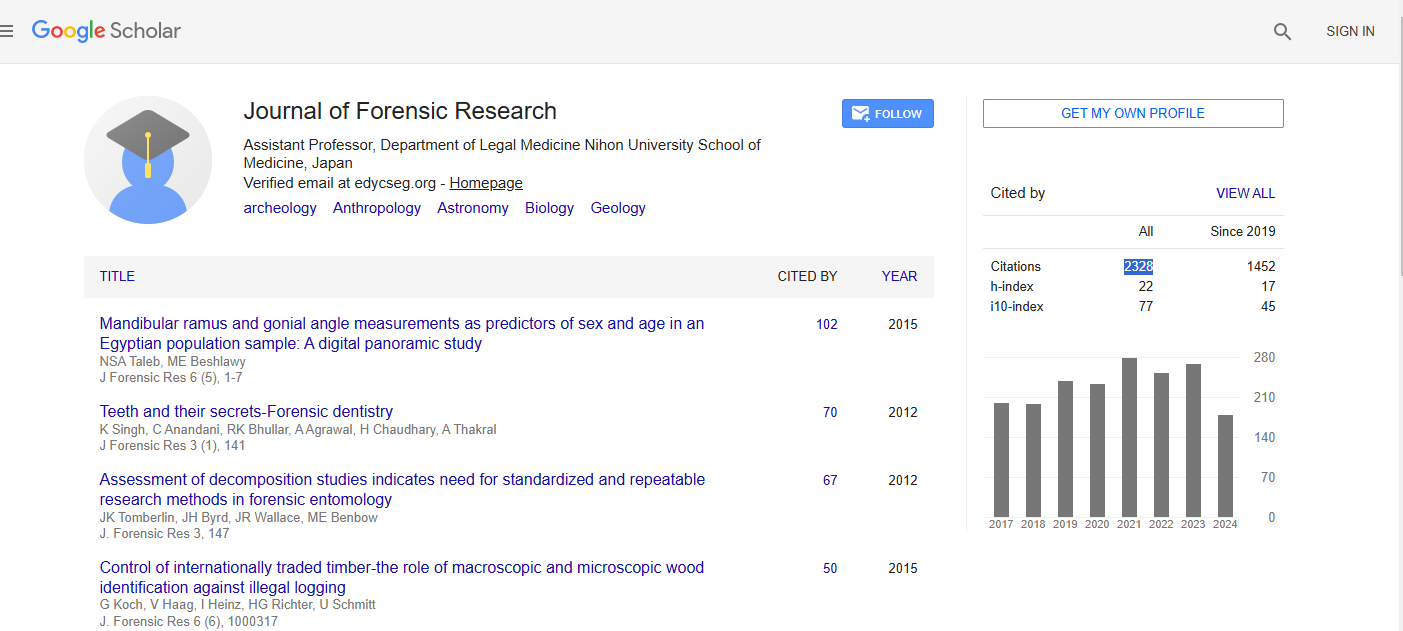
Journal of Forensic Research received 2328 citations as per Google Scholar report