Opinion - (2025) Volume 14, Issue 2
Received: 01-Mar-2025, Manuscript No. jtsm-26-179502;
Editor assigned: 03-Mar-2025, Pre QC No. P-179502;
Reviewed: 17-Mar-2025, QC No. Q-179502;
Revised: 24-Mar-2025, Manuscript No. R-179502;
Published:
31-Mar-2025
, DOI: 10.37421/2167-0919.2025.14.489
Citation: Malhotra, Rajiv. ”Managing The 5G And Beyond Telecommunications Frontier.” J Telecommun Syst Manage 14 (2025):489.
Copyright: © 2025 Malhotra R. This is an open-access article distributed under the terms of the Creative Commons Attribution License, which permits unrestricted use, distribution and reproduction in any medium, provided the original author and source are credited.
The telecommunications landscape is undergoing a profound transformation with the advent of 5G and the ongoing development towards beyond-5G (B5G) systems, introducing unprecedented complexities in network management. These advanced networks are characterized by their dynamic and virtualized nature, demanding sophisticated approaches to handle the intricate management of network functions. The exponential growth in data traffic and the proliferation of connected devices further exacerbate these challenges, necessitating robust solutions for efficient resource utilization and service delivery. Central to the 5G architecture is network slicing, a capability that allows for the creation of multiple virtual networks on a common physical infrastructure, each tailored to specific service requirements. However, managing these slices presents significant hurdles, including resource isolation, end-to-end orchestration, and dynamic re-configuration to ensure Quality of Service (QoS) and Quality of Experience (QoE) for diverse applications. In parallel, the integration of Artificial Intelligence (AI) and Machine Learning (ML) is becoming indispensable for navigating the inherent complexity of 5G and B5G networks. Developing AI/ML models that can process real-time data, adapt to the fluid network environment, and provide reliable and explainable decision-making is a critical area of research and development. The expansion of 5G services is closely intertwined with the growth of edge computing, which plays a pivotal role in enabling low-latency applications. Managing distributed resources across a multitude of edge nodes, along with data management and security concerns in this decentralized paradigm, poses novel and substantial challenges. Furthermore, the pervasive integration of the Internet of Things (IoT) into 5G ecosystems introduces its own set of management complexities. The sheer scale of connected devices, their diverse capabilities, and the inherent security vulnerabilities necessitate scalable and efficient strategies for device onboarding, data aggregation, and real-time monitoring. Ensuring robust security and privacy remains a paramount concern throughout the evolution of telecommunications systems. The expanded attack surface, driven by increased connectivity, virtualization, and new service models, demands advanced security management, including sophisticated threat detection and mitigation techniques. The shift towards virtualized and cloud-native network functions (VNFs and CNFs) in 5G architecture necessitates advanced orchestration and management systems. Challenges in lifecycle management, ensuring fault tolerance, optimizing performance, and facilitating interworking between various management layers are key areas of focus. Extending network slicing capabilities beyond a single administrative domain, known as inter-domain network slicing, introduces significant challenges related to interoperability and standardization. Achieving seamless end-to-end service delivery across multiple operators requires common management frameworks and collaborative agreements. As networks become denser and data rates increase, energy efficiency emerges as a critical management challenge. Optimizing network operations to reduce the energy footprint without compromising performance is essential for sustainable telecommunications. Finally, the adoption of Open RAN architectures in 5G introduces new complexities in radio access network management, particularly concerning interoperability, performance assurance, and security among disaggregated components from different vendors, requiring standardized interfaces and robust management platforms.
The transition to advanced telecommunications systems like 5G and beyond (B5G) introduces significant operational complexities that necessitate sophisticated management strategies. Key among these are the dynamic and virtualized nature of network functions, the exponential surge in data traffic and connected devices, and the imperative for enhanced security and privacy measures. Effective management in this environment hinges on advanced automation, intelligent resource allocation, and cutting-edge analytics for performance monitoring and fault prediction, marking a paradigm shift in how network services are orchestrated and assured across heterogeneous infrastructure [1].
Network slicing, a fundamental characteristic of 5G, presents intricate management challenges concerning resource isolation, comprehensive end-to-end orchestration, and dynamic re-configuration to satisfy diverse service demands. The task of ensuring consistent Quality of Service (QoS) and Quality of Experience (QoE) for each slice, while simultaneously optimizing resource utilization across the entire network, requires the implementation of advanced management frameworks that integrate intelligent resource allocation and sophisticated monitoring techniques [2].
The integration of Artificial Intelligence (AI) and Machine Learning (ML) is pivotal in addressing the inherent complexities of 5G and B5G networks. The primary challenges lie in the development of robust AI/ML models capable of handling real-time data streams, adapting to evolving network conditions, and guaranteeing the reliability and explainability of their operational decisions, which is crucial for automated fault detection, predictive maintenance, and dynamic resource optimization [3].
Edge computing, a critical enabler for low-latency 5G services, introduces a new set of management challenges related to the orchestration of distributed resources, efficient data management, and security across a vast number of edge nodes. Ensuring consistent service quality and optimal resource utilization within this highly decentralized framework remains a significant hurdle, necessitating intelligent management platforms adept at handling mobility and diverse resource types [4].
The proliferation of a wide array of Internet of Things (IoT) devices within 5G and future networks demands scalable and efficient management strategies. Overcoming challenges associated with massive connectivity, accommodating diverse device capabilities, and mitigating security vulnerabilities requires robust system management solutions for device onboarding, data aggregation, and real-time monitoring of millions of heterogeneous endpoints [5].
Ensuring unwavering security and privacy is a non-negotiable challenge in the deployment and operation of 5G and subsequent telecommunications systems. The significantly expanded attack surface, a consequence of increased connectivity, extensive virtualization, and novel service paradigms, necessitates advanced security management encompassing threat detection, mitigation, and continuous monitoring to safeguard user data confidentiality and integrity across complex, distributed networks [6].
The management of highly virtualized and cloud-native network functions (VNFs and CNFs) within 5G environments calls for sophisticated orchestration and management systems. Key challenges include the intricacies of lifecycle management, ensuring robust fault tolerance, optimizing performance metrics, and managing interworking between different management layers, all of which demand comprehensive automation and standardized interfaces for seamless operational integration [7].
Managing network slicing across multiple administrative domains, or inter-domain network slicing, introduces substantial interoperability and standardization challenges. Achieving fluid end-to-end service delivery necessitates the adoption of common management frameworks, standardized APIs, and cooperative agreements among network operators, further complicated by the need for dynamic resource sharing and policy enforcement across disparate networks [8].
Energy efficiency in 5G and future networks represents a growing concern and a significant management challenge. The increased density of base stations and higher data transmission rates can lead to a dramatic escalation in power consumption. Consequently, effective management strategies are essential to optimize network operations for reduced energy footprints without compromising overall performance [9].
The management of radio access networks (RAN) in 5G, particularly with the emergence of Open RAN architectures, presents new challenges related to interoperability, performance assurance, and security. Ensuring that disaggregated RAN components from various vendors can be managed effectively and securely requires the establishment of standardized interfaces and the development of robust management platforms capable of handling this heightened complexity and dynamism [10].
The evolution to 5G and beyond telecommunications systems presents significant management challenges including network virtualization, data traffic growth, and security. Network slicing, while crucial, requires robust orchestration and quality of service assurance. Artificial intelligence and machine learning are vital for managing complexity, enabling automation and predictive capabilities. Edge computing and massive IoT deployments introduce new hurdles in distributed resource management, data handling, and security. Ensuring robust security and privacy is paramount due to an expanded attack surface. The management of virtualized network functions (VNFs/CNFs) demands sophisticated orchestration and lifecycle management. Inter-domain network slicing faces interoperability and standardization issues. Energy efficiency is a growing concern, requiring optimized operations. Open RAN introduces complexities in interoperability and security for radio access networks.
None
None
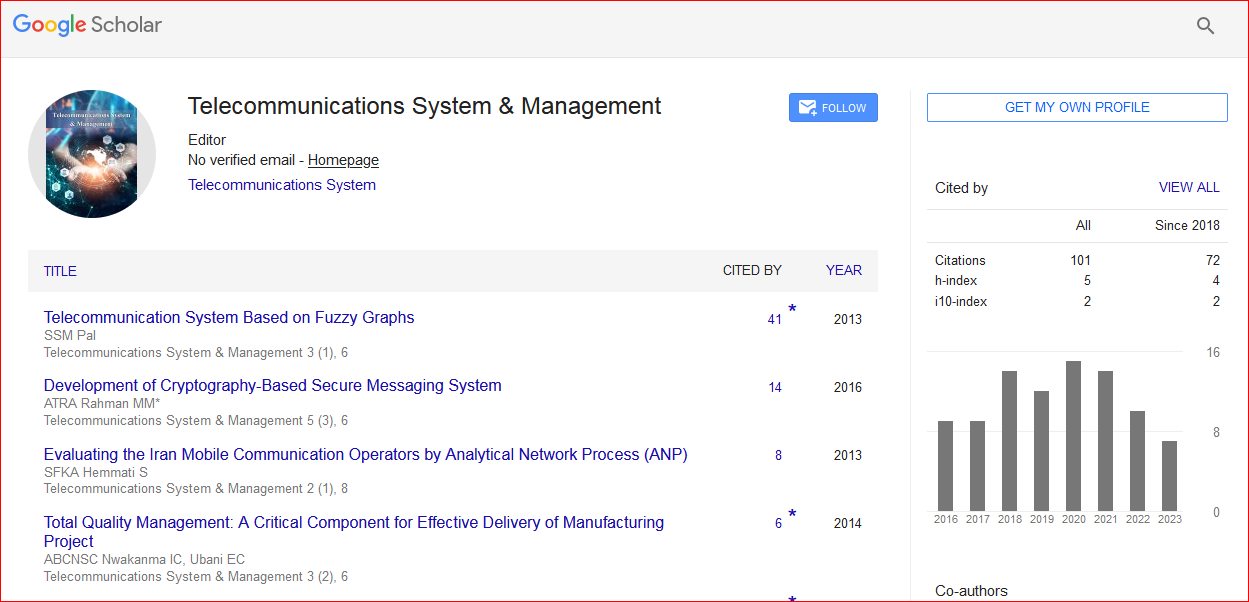
Telecommunications System & Management received 109 citations as per Google Scholar report